

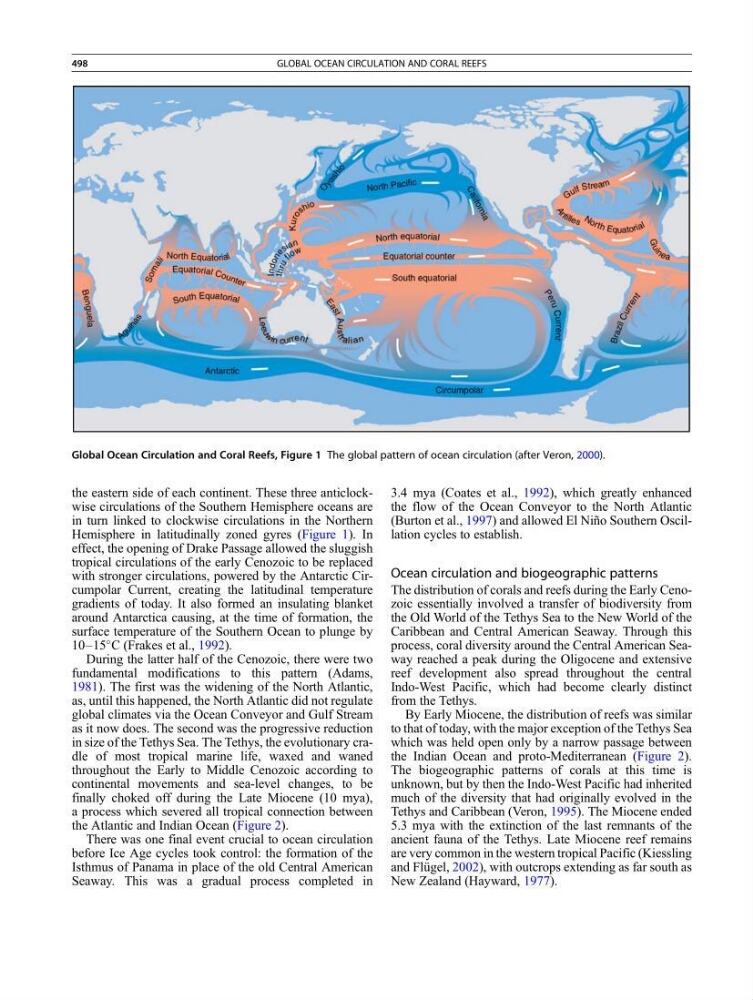
the eastern side of each continent. These three anticlockwise circulations of the Southern Hemisphere oceans are
in turn linked to clockwise circulations in the Northern
Hemisphere in latitudinally zoned gyres (Figure 1). In
effect, the opening of Drake Passage allowed the sluggish
tropical circulations of the early Cenozoic to be replaced
with stronger circulations, powered by the Antarctic Circumpolar Current, creating the latitudinal temperature
gradients of today. It also formed an insulating blanket
around Antarctica causing, at the time of formation, the
surface temperature of the Southern Ocean to plunge by
10–15
C (Frakes et al., 1992).
During the latter half of the Cenozoic, there were two
fundamental modifications to this pattern (Adams,
1981). The first was the widening of the North Atlantic,
as, until this happened, the North Atlantic did not regulate
global climates via the Ocean Conveyor and Gulf Stream
as it now does. The second was the progressive reduction
in size of the Tethys Sea. The Tethys, the evolutionary cradle of most tropical marine life, waxed and waned
throughout the Early to Middle Cenozoic according to
continental movements and sea-level changes, to be
finally choked off during the Late Miocene (10 mya),
a process which severed all tropical connection between
the Atlantic and Indian Ocean (Figure 2).
There was one final event crucial to ocean circulation
before Ice Age cycles took control: the formation of the
Isthmus of Panama in place of the old Central American
Seaway. This was a gradual process completed in
3.4 mya (Coates et al., 1992), which greatly enhanced
the flow of the Ocean Conveyor to the North Atlantic
(Burton et al., 1997) and allowed El Niño Southern Oscillation cycles to establish.
Ocean circulation and biogeographic patterns
The distribution of corals and reefs during the Early Cenozoic essentially involved a transfer of biodiversity from
the Old World of the Tethys Sea to the New World of the
Caribbean and Central American Seaway. Through this
process, coral diversity around the Central American Seaway reached a peak during the Oligocene and extensive
reef development also spread throughout the central
Indo-West Pacific, which had become clearly distinct
from the Tethys.
By Early Miocene, the distribution of reefs was similar
to that of today, with the major exception of the Tethys Sea
which was held open only by a narrow passage between
the Indian Ocean and proto-Mediterranean (Figure 2).
The biogeographic patterns of corals at this time is
unknown, but by then the Indo-West Pacific had inherited
much of the diversity that had originally evolved in the
Tethys and Caribbean (Veron, 1995). The Miocene ended
5.3 mya with the extinction of the last remnants of the
ancient fauna of the Tethys. Late Miocene reef remains
are very common in the western tropical Pacific (Kiessling
and Flügel, 2002), with outcrops extending as far south as
New Zealand (Hayward, 1977).
Global Ocean Circulation and Coral Reefs, Figure 1 The global pattern of ocean circulation (after Veron, 2000).
498
GLOBAL OCEAN CIRCULATION AND CORAL REEFS
in turn linked to clockwise circulations in the Northern
Hemisphere in latitudinally zoned gyres (Figure 1). In
effect, the opening of Drake Passage allowed the sluggish
tropical circulations of the early Cenozoic to be replaced
with stronger circulations, powered by the Antarctic Circumpolar Current, creating the latitudinal temperature
gradients of today. It also formed an insulating blanket
around Antarctica causing, at the time of formation, the
surface temperature of the Southern Ocean to plunge by
10–15
C (Frakes et al., 1992).
During the latter half of the Cenozoic, there were two
fundamental modifications to this pattern (Adams,
1981). The first was the widening of the North Atlantic,
as, until this happened, the North Atlantic did not regulate
global climates via the Ocean Conveyor and Gulf Stream
as it now does. The second was the progressive reduction
in size of the Tethys Sea. The Tethys, the evolutionary cradle of most tropical marine life, waxed and waned
throughout the Early to Middle Cenozoic according to
continental movements and sea-level changes, to be
finally choked off during the Late Miocene (10 mya),
a process which severed all tropical connection between
the Atlantic and Indian Ocean (Figure 2).
There was one final event crucial to ocean circulation
before Ice Age cycles took control: the formation of the
Isthmus of Panama in place of the old Central American
Seaway. This was a gradual process completed in
3.4 mya (Coates et al., 1992), which greatly enhanced
the flow of the Ocean Conveyor to the North Atlantic
(Burton et al., 1997) and allowed El Niño Southern Oscillation cycles to establish.
Ocean circulation and biogeographic patterns
The distribution of corals and reefs during the Early Cenozoic essentially involved a transfer of biodiversity from
the Old World of the Tethys Sea to the New World of the
Caribbean and Central American Seaway. Through this
process, coral diversity around the Central American Seaway reached a peak during the Oligocene and extensive
reef development also spread throughout the central
Indo-West Pacific, which had become clearly distinct
from the Tethys.
By Early Miocene, the distribution of reefs was similar
to that of today, with the major exception of the Tethys Sea
which was held open only by a narrow passage between
the Indian Ocean and proto-Mediterranean (Figure 2).
The biogeographic patterns of corals at this time is
unknown, but by then the Indo-West Pacific had inherited
much of the diversity that had originally evolved in the
Tethys and Caribbean (Veron, 1995). The Miocene ended
5.3 mya with the extinction of the last remnants of the
ancient fauna of the Tethys. Late Miocene reef remains
are very common in the western tropical Pacific (Kiessling
and Flügel, 2002), with outcrops extending as far south as
New Zealand (Hayward, 1977).
Global Ocean Circulation and Coral Reefs, Figure 1 The global pattern of ocean circulation (after Veron, 2000).
498
GLOBAL OCEAN CIRCULATION AND CORAL REEFS