

Some examples
Figure 4 illustrates predictions based on the complete theory, for sites equidistantly spaced across the Great Barrier
Reef (Queensland, Australia) from within the inner Broad
Sound, across the outer Reef and to Marion Reef in the
Coral Sea. They are based on nominal ice and earth
models that have been found to describe well the far-field
behavior of sea level during Holocene time and are representative of a wide range of plausible models. In this
model calculation, it has been assumed that all melting
ceased abruptly at 6,000 (C
14
) years BP and this results
in the sharp highstand at this time. If this cessation was
less abrupt then this peak becomes broader and its shape
is diagnostic of changes in late Holocene ocean volumes.
This example illustrates that with increasing distance from
the continental coastline:
the mid-Holocene highstand decreases in amplitude
from a few meters maximum at the ‘inland’ sites;
the oldest corals occurring at sea level become increasingly younger;
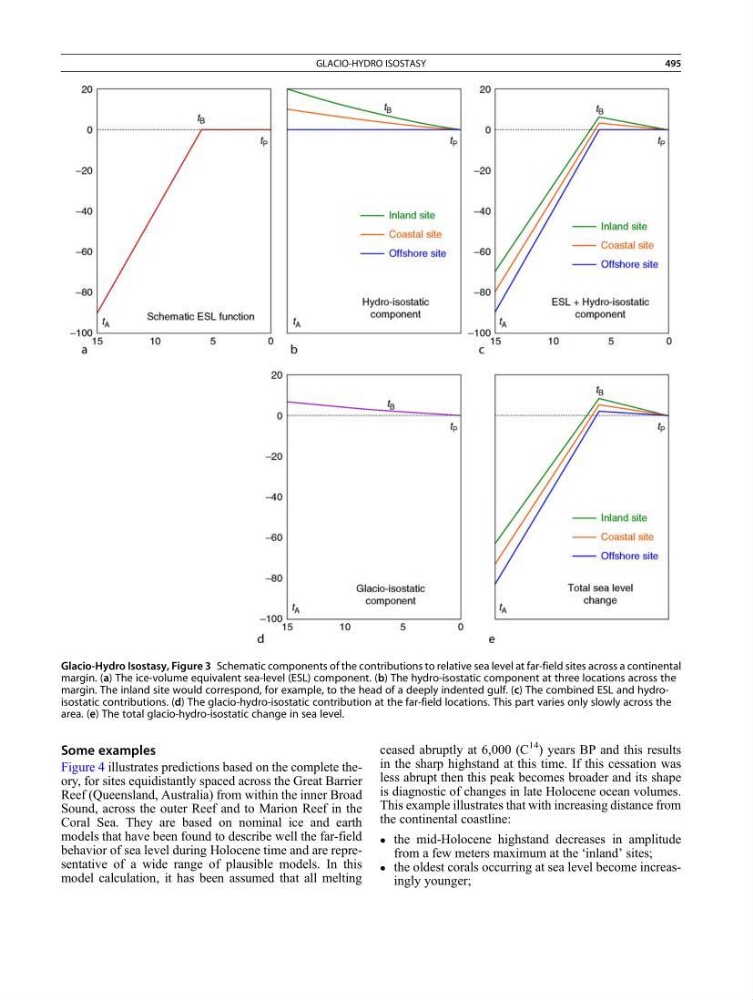
Glacio-Hydro Isostasy, Figure 3 Schematic components of the contributions to relative sea level at far-field sites across a continental
margin. (a) The ice-volume equivalent sea-level (ESL) component. (b) The hydro-isostatic component at three locations across the
margin. The inland site would correspond, for example, to the head of a deeply indented gulf. (c) The combined ESL and hydroisostatic contributions. (d) The glacio-hydro-isostatic contribution at the far-field locations. This part varies only slowly across the
area. (e) The total glacio-hydro-isostatic change in sea level.
GLACIO-HYDRO ISOSTASY
495
Figure 4 illustrates predictions based on the complete theory, for sites equidistantly spaced across the Great Barrier
Reef (Queensland, Australia) from within the inner Broad
Sound, across the outer Reef and to Marion Reef in the
Coral Sea. They are based on nominal ice and earth
models that have been found to describe well the far-field
behavior of sea level during Holocene time and are representative of a wide range of plausible models. In this
model calculation, it has been assumed that all melting
ceased abruptly at 6,000 (C
14
) years BP and this results
in the sharp highstand at this time. If this cessation was
less abrupt then this peak becomes broader and its shape
is diagnostic of changes in late Holocene ocean volumes.
This example illustrates that with increasing distance from
the continental coastline:
the mid-Holocene highstand decreases in amplitude
from a few meters maximum at the ‘inland’ sites;
the oldest corals occurring at sea level become increasingly younger;
Glacio-Hydro Isostasy, Figure 3 Schematic components of the contributions to relative sea level at far-field sites across a continental
margin. (a) The ice-volume equivalent sea-level (ESL) component. (b) The hydro-isostatic component at three locations across the
margin. The inland site would correspond, for example, to the head of a deeply indented gulf. (c) The combined ESL and hydroisostatic contributions. (d) The glacio-hydro-isostatic contribution at the far-field locations. This part varies only slowly across the
area. (e) The total glacio-hydro-isostatic change in sea level.
GLACIO-HYDRO ISOSTASY
495