

Consider the following simple model. At the end of
a long glacial period, t A , a volume of ice has been added
rapidly into the ocean at a constant rate until a time t B .
The ocean volume then remains constant until the present
t P (Figure 3a). During the deglaciation the meltwater loads
the ocean floor and induces flow in the mantle away from
the areas of loading to beneath the continents and to compensate for the concomitant rebound beneath the ice
sheets. The resulting subsidence of the seafloor will
include an elastic response followed by a viscous response
that continues after the load has stabilized and will still
occur today. The ocean has to fill the void created by the
subsiding seafloor and the sea surface, in a first approximation, follows the seafloor. In the middle of the ocean
basins, the maximum subsidence can be roughly approximated by the local isostatic effect. At the continental margin, because the water loading occurs to one side only, the
subsidence will be about 50% of that in mid-ocean, largely
because of the flexural strength of the lithosphere. At faroffshore island sites, there is no change because the island
subsides with the seafloor. Inland from the coast, within
a deeply indented gulf, for example, where the crust is
being progressively dragged down less by the ocean load,
this change will approach u r (Figure 3b).
The resulting spatial variability in the hydro-isostatic
response will then have the following characteristics
(Figure 3c):
A small amplitude highstand near the coast with
a maximum at the time meltwater addition ceased and
with a magnitude that depends on the distance from
the coast.
A rise of sea level prior to the maximum highstand that
occurs later with distance from the coast.
Relative sea level at the LGM that varies across the
shelf and that approaches the ice-volume equivalent
value at some distance from the coast.
This scenario is an incomplete description of the relative
sea-level change across the continental shelf since the
glacio-isostatic contribution has been ignored, as has the
change in gravitational potential during the deglaciation
and subsequent relaxation phase and any change in water
load caused by the migration of shorelines during the sealevel rise. Of these neglects the most important one is the
glacio-isostatic factor, including the gravitational part. At
the time of maximum glaciation a broad deformational
bulge develops around the ice sheet and this slowly subsides during and after the deglaciation phase. When this
bulge occurs in an ocean environment, additional space
is created that draws water into it and away from the farfield locations where the glacio-isostatic signal becomes
one of a falling sea level (Figure 3d). This contribution
varies relatively slowly across the far field and the predominant spatial variability across a reef system will come
from the hydro isostasy. The combined effect at the farfield sites is that a small amplitude highstand will also
occur for many ocean island sites (Figure 3e). It is sometimes stated that ocean islands act as dipsticks and provide
a direct measure of the changes in ocean volume. But this
is a first approximation and in reality this occurs only at
a few sites where the combination of all the factors contributing to the isostatic perturbation cancels out. These
simple illustrations also point to a second common
misconception, that it is the loading of the shelves that
constitutes the hydro-isostatic correction. But this is one
part of the water load only and the principal part comes
from the long-wavelength load of the entire ocean floor.
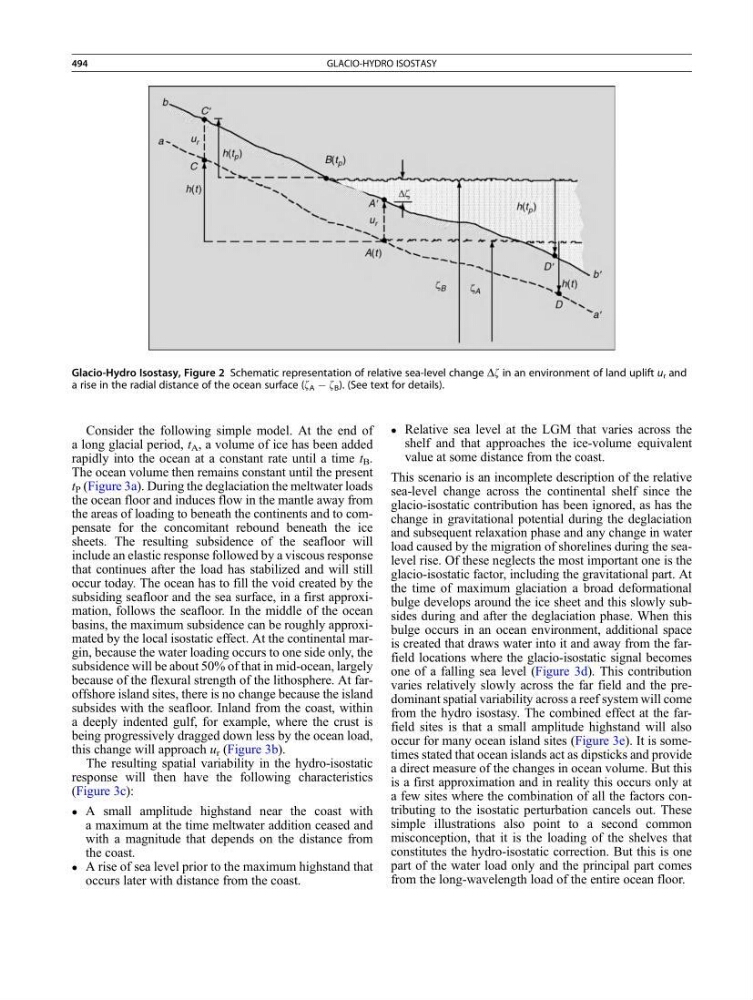
Glacio-Hydro Isostasy, Figure 2 Schematic representation of relative sea-level change Dz in an environment of land uplift u r and
a rise in the radial distance of the ocean surface (z A À z B ). (See text for details).
494
GLACIO-HYDRO ISOSTASY
a long glacial period, t A , a volume of ice has been added
rapidly into the ocean at a constant rate until a time t B .
The ocean volume then remains constant until the present
t P (Figure 3a). During the deglaciation the meltwater loads
the ocean floor and induces flow in the mantle away from
the areas of loading to beneath the continents and to compensate for the concomitant rebound beneath the ice
sheets. The resulting subsidence of the seafloor will
include an elastic response followed by a viscous response
that continues after the load has stabilized and will still
occur today. The ocean has to fill the void created by the
subsiding seafloor and the sea surface, in a first approximation, follows the seafloor. In the middle of the ocean
basins, the maximum subsidence can be roughly approximated by the local isostatic effect. At the continental margin, because the water loading occurs to one side only, the
subsidence will be about 50% of that in mid-ocean, largely
because of the flexural strength of the lithosphere. At faroffshore island sites, there is no change because the island
subsides with the seafloor. Inland from the coast, within
a deeply indented gulf, for example, where the crust is
being progressively dragged down less by the ocean load,
this change will approach u r (Figure 3b).
The resulting spatial variability in the hydro-isostatic
response will then have the following characteristics
(Figure 3c):
A small amplitude highstand near the coast with
a maximum at the time meltwater addition ceased and
with a magnitude that depends on the distance from
the coast.
A rise of sea level prior to the maximum highstand that
occurs later with distance from the coast.
Relative sea level at the LGM that varies across the
shelf and that approaches the ice-volume equivalent
value at some distance from the coast.
This scenario is an incomplete description of the relative
sea-level change across the continental shelf since the
glacio-isostatic contribution has been ignored, as has the
change in gravitational potential during the deglaciation
and subsequent relaxation phase and any change in water
load caused by the migration of shorelines during the sealevel rise. Of these neglects the most important one is the
glacio-isostatic factor, including the gravitational part. At
the time of maximum glaciation a broad deformational
bulge develops around the ice sheet and this slowly subsides during and after the deglaciation phase. When this
bulge occurs in an ocean environment, additional space
is created that draws water into it and away from the farfield locations where the glacio-isostatic signal becomes
one of a falling sea level (Figure 3d). This contribution
varies relatively slowly across the far field and the predominant spatial variability across a reef system will come
from the hydro isostasy. The combined effect at the farfield sites is that a small amplitude highstand will also
occur for many ocean island sites (Figure 3e). It is sometimes stated that ocean islands act as dipsticks and provide
a direct measure of the changes in ocean volume. But this
is a first approximation and in reality this occurs only at
a few sites where the combination of all the factors contributing to the isostatic perturbation cancels out. These
simple illustrations also point to a second common
misconception, that it is the loading of the shelves that
constitutes the hydro-isostatic correction. But this is one
part of the water load only and the principal part comes
from the long-wavelength load of the entire ocean floor.
Glacio-Hydro Isostasy, Figure 2 Schematic representation of relative sea-level change Dz in an environment of land uplift u r and
a rise in the radial distance of the ocean surface (z A À z B ). (See text for details).
494
GLACIO-HYDRO ISOSTASY