

may subsequently be filled with mud or synsedimentary
cement. Many mounds also display a rich attached metazoan biota of crinoids, tabulate corals, brachiopods, trilobites, sponges, ostracodes, and bryozoans.
The clotted, peloidal or laminated textures, and the
encrusting or frame-forming habit argue for an in situ microbial or organomineralic origin, augmented by a rapid
synsedimentary lithification. This origin is supported by
moderate rates of carbonate accumulation (0.2–0.8 m/
1,000 years), and the steepness (35–40
) of mound flanks.
Abundant Stromatactis cavities that parallel the accretionary
mound surfaces (Figure 8a) suggest a close relationship
between mound formation and internal sediment filled voids,
cementation, and carbonate production (Monty et al., 1995).
15
10
9
6
6
2
7
7
8
14
12
13
11
1 0 c m
2
3
4
5
a
b
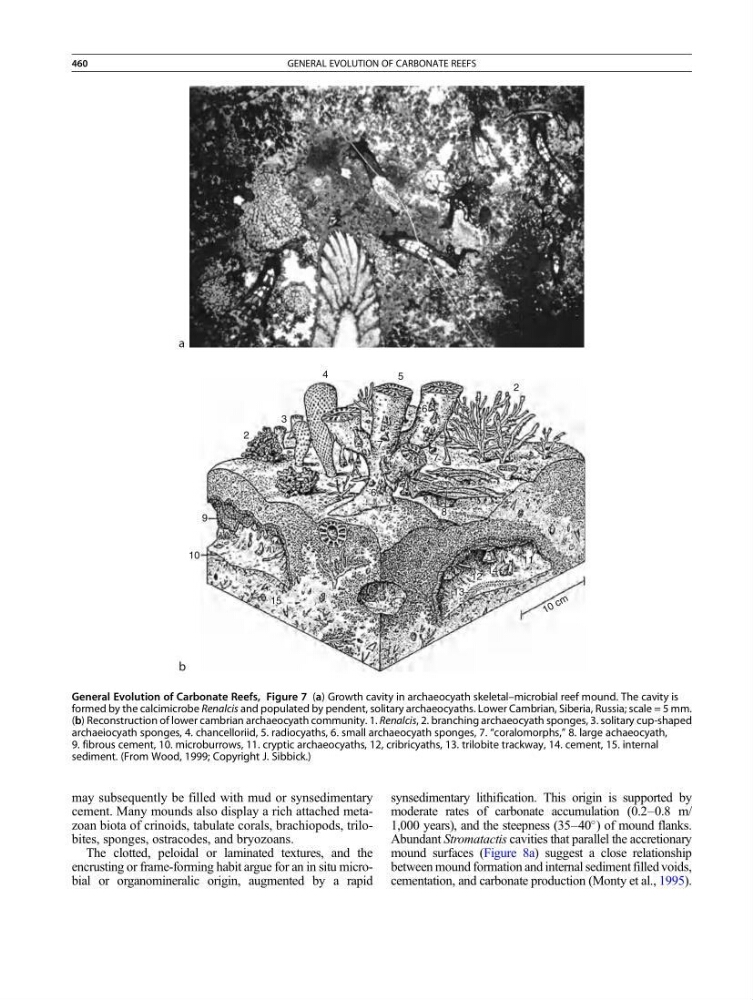
General Evolution of Carbonate Reefs, Figure 7 (a) Growth cavity in archaeocyath skeletal–microbial reef mound. The cavity is
formed by the calcimicrobe Renalcis and populated by pendent, solitary archaeocyaths. Lower Cambrian, Siberia, Russia; scale = 5 mm.
(b) Reconstruction of lower cambrian archaeocyath community. 1. Renalcis, 2. branching archaeocyath sponges, 3. solitary cup-shaped
archaeiocyath sponges, 4. chancelloriid, 5. radiocyaths, 6. small archaeocyath sponges, 7. “coralomorphs,” 8. large achaeocyath,
9. fibrous cement, 10. microburrows, 11. cryptic archaeocyaths, 12, cribricyaths, 13. trilobite trackway, 14. cement, 15. internal
sediment. (From Wood, 1999; Copyright J. Sibbick.)
460
GENERAL EVOLUTION OF CARBONATE REEFS
cement. Many mounds also display a rich attached metazoan biota of crinoids, tabulate corals, brachiopods, trilobites, sponges, ostracodes, and bryozoans.
The clotted, peloidal or laminated textures, and the
encrusting or frame-forming habit argue for an in situ microbial or organomineralic origin, augmented by a rapid
synsedimentary lithification. This origin is supported by
moderate rates of carbonate accumulation (0.2–0.8 m/
1,000 years), and the steepness (35–40
) of mound flanks.
Abundant Stromatactis cavities that parallel the accretionary
mound surfaces (Figure 8a) suggest a close relationship
between mound formation and internal sediment filled voids,
cementation, and carbonate production (Monty et al., 1995).
15
10
9
6
6
2
7
7
8
14
12
13
11
1 0 c m
2
3
4
5
a
b
General Evolution of Carbonate Reefs, Figure 7 (a) Growth cavity in archaeocyath skeletal–microbial reef mound. The cavity is
formed by the calcimicrobe Renalcis and populated by pendent, solitary archaeocyaths. Lower Cambrian, Siberia, Russia; scale = 5 mm.
(b) Reconstruction of lower cambrian archaeocyath community. 1. Renalcis, 2. branching archaeocyath sponges, 3. solitary cup-shaped
archaeiocyath sponges, 4. chancelloriid, 5. radiocyaths, 6. small archaeocyath sponges, 7. “coralomorphs,” 8. large achaeocyath,
9. fibrous cement, 10. microburrows, 11. cryptic archaeocyaths, 12, cribricyaths, 13. trilobite trackway, 14. cement, 15. internal
sediment. (From Wood, 1999; Copyright J. Sibbick.)
460
GENERAL EVOLUTION OF CARBONATE REEFS