

Mud mounds were often established in deep waters
below the photic zone as indicated by the absence of algae
and cyanobacterial activity. Locally, however, they show
shallowing-upward facies signatures, characteristic of
shallow depths and significant depositional energies. In
the Frasnian “récifs rouges” of the Belgian Ardennes, the
basal facies is composed of Stromatactis-rich red lime
mudstone to wackestone with abundant sponge spicules.
This may have formed in hypoxic waters below the photic
zone. Platy corals appear higher but are overlain by a more
diversified coral, stromatoporoid, and skeletal algae
wackestone to packstone with Stromatactis. Uppermost
facies consist of a stromatoporoid, coral, and bryozoan
framework with various microbial and calcimicrobial
encrusters, which formed in photic waters above fairweather base and sometimes in restricted or lagoonal
environments.
Early Mississippian reefs (Waulsortian facies) also
show a similar progression of facies. The growth of the
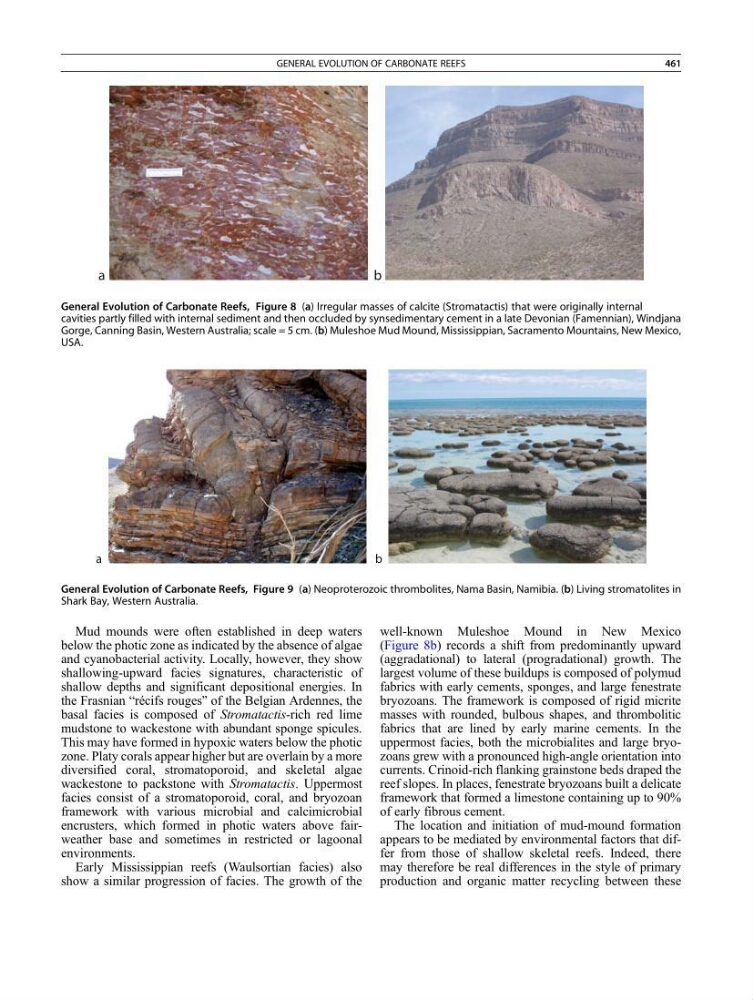
well-known Muleshoe Mound in New Mexico
(Figure 8b) records a shift from predominantly upward
(aggradational) to lateral (progradational) growth. The
largest volume of these buildups is composed of polymud
fabrics with early cements, sponges, and large fenestrate
bryozoans. The framework is composed of rigid micrite
masses with rounded, bulbous shapes, and thrombolitic
fabrics that are lined by early marine cements. In the
uppermost facies, both the microbialites and large bryozoans grew with a pronounced high-angle orientation into
currents. Crinoid-rich flanking grainstone beds draped the
reef slopes. In places, fenestrate bryozoans built a delicate
framework that formed a limestone containing up to 90%
of early fibrous cement.
The location and initiation of mud-mound formation
appears to be mediated by environmental factors that differ from those of shallow skeletal reefs. Indeed, there
may therefore be real differences in the style of primary
production and organic matter recycling between these
a
b
General Evolution of Carbonate Reefs, Figure 8 (a) Irregular masses of calcite (Stromatactis) that were originally internal
cavities partly filled with internal sediment and then occluded by synsedimentary cement in a late Devonian (Famennian), Windjana
Gorge, Canning Basin, Western Australia; scale = 5 cm. (b) Muleshoe Mud Mound, Mississippian, Sacramento Mountains, New Mexico,
USA.
a
b
General Evolution of Carbonate Reefs, Figure 9 (a) Neoproterozoic thrombolites, Nama Basin, Namibia. (b) Living stromatolites in
Shark Bay, Western Australia.
GENERAL EVOLUTION OF CARBONATE REEFS
461
below the photic zone as indicated by the absence of algae
and cyanobacterial activity. Locally, however, they show
shallowing-upward facies signatures, characteristic of
shallow depths and significant depositional energies. In
the Frasnian “récifs rouges” of the Belgian Ardennes, the
basal facies is composed of Stromatactis-rich red lime
mudstone to wackestone with abundant sponge spicules.
This may have formed in hypoxic waters below the photic
zone. Platy corals appear higher but are overlain by a more
diversified coral, stromatoporoid, and skeletal algae
wackestone to packstone with Stromatactis. Uppermost
facies consist of a stromatoporoid, coral, and bryozoan
framework with various microbial and calcimicrobial
encrusters, which formed in photic waters above fairweather base and sometimes in restricted or lagoonal
environments.
Early Mississippian reefs (Waulsortian facies) also
show a similar progression of facies. The growth of the
well-known Muleshoe Mound in New Mexico
(Figure 8b) records a shift from predominantly upward
(aggradational) to lateral (progradational) growth. The
largest volume of these buildups is composed of polymud
fabrics with early cements, sponges, and large fenestrate
bryozoans. The framework is composed of rigid micrite
masses with rounded, bulbous shapes, and thrombolitic
fabrics that are lined by early marine cements. In the
uppermost facies, both the microbialites and large bryozoans grew with a pronounced high-angle orientation into
currents. Crinoid-rich flanking grainstone beds draped the
reef slopes. In places, fenestrate bryozoans built a delicate
framework that formed a limestone containing up to 90%
of early fibrous cement.
The location and initiation of mud-mound formation
appears to be mediated by environmental factors that differ from those of shallow skeletal reefs. Indeed, there
may therefore be real differences in the style of primary
production and organic matter recycling between these
a
b
General Evolution of Carbonate Reefs, Figure 8 (a) Irregular masses of calcite (Stromatactis) that were originally internal
cavities partly filled with internal sediment and then occluded by synsedimentary cement in a late Devonian (Famennian), Windjana
Gorge, Canning Basin, Western Australia; scale = 5 cm. (b) Muleshoe Mud Mound, Mississippian, Sacramento Mountains, New Mexico,
USA.
a
b
General Evolution of Carbonate Reefs, Figure 9 (a) Neoproterozoic thrombolites, Nama Basin, Namibia. (b) Living stromatolites in
Shark Bay, Western Australia.
GENERAL EVOLUTION OF CARBONATE REEFS
461