

Upper Jurassic deep-water mixed reefs were
constructed by thrombolitic–stromatolitic columns or
mounds associated with Tubiphytes, the worm Terebella,
and hexactinellid and lithistid sponges. The platy
scleractinian coral Microsolena, which is thought to have
fed in part heterotrophically, is found in low-light settings,
such as shallow turbid or deep-water environments.
Microbial reefs
Modern stromatolites are relatively rare and appear to
grow in areas of abundant calcium carbonate saturation
and where faster-growing algae and seaweeds are
excluded due to some environmental stress such as active
tidal currents, low nutrients, or high salinity (Figure 9b).
Microbial reefs dominated much of earth history, from
the Archean until Middle Ordovician, but they are only
found in younger Phanerozoic facies, where most invertebrates have been excluded by environmental stresses.
They are built primarily by stromatolites and thrombolites
that have a wide variety of morphologies. Precambrian
reefs throughout the Archean, early, and middle Proterozoic are essentially a series of stacked stromatolites and,
to a lesser extent, thrombolites (Grotzinger and James,
2000). They have neither cavities nor inter-microbial
synsedimentary cements but exhibit a wide variety of delicate branching, lamellar, hemispherical, and conical morphologies that are thought to be due to a combination of
different microbial communities, hydrodynamics, and
sedimentation rates. These microbialites range in size
from centimeter to decimeter, with some large structures
up to 8 m high and 30 m long.
Shallow-water, high-energy Proterozoic buildups were
formed by isolated stromatolitic domes, linked domes,
columnar stromatolites, and their elongate equivalents.
Stromatolite fragments were ripped off during storms
and deposited as cross-bedded gravels locally surrounded
by individual shallow reefs. Reefs at platform margins
show a strong zonation of microbialite growth forms that
mimic facies zonations of metazoan reefs. Isolated deep
subtidal and slope reefs (probably below fairweather wave
base) were built primarily by conical stromatolites.
There seems to be an evolution of microbial structures
through the Precambrian. Archean and Palaeoproterozoic
reefs were mainly synsedimentary precipitates (possibly
microbially mediated) with microbial layers. Microbes
appear to become more prominent in Paleoproterozoic
and Mesoproterozoic structures. A profound change, however, took place in the Neoproterozoic with the increased
importance of thrombolites and the appearance of
calcimicrobes as reef builders (Figure 9a). This resulted
in the earliest formation of cavities complete with internal
sediment and synsedimentary cement, features that would
become a prominent attribute of all subsequent Phanerozoic reefs. This community had the ability to construct
reefs with up to 100 m of relief above the sea floor in
deeper water environments (Turner et al., 1997). Toward
the end of the Neoproterozoic, the first skeletal invertebrates (e.g., Cloudina, Namacalathus, and Namapoikia)
began to populate the surfaces of these reefs and were
entombed by the microbial precipitates.
Mud mounds
Mud mounds can form large, often over 100-m high and
400-m wide, isolated, steep-sided structures that consist
of more than 80% of a fine-grained carbonate (micrite)
(Figure 8b). This micrite has both in situ and detrital origin
but often shows accretionary structures constructed by
successive phases, known as polygenetic muds
(“polymuds”), which form on open surfaces and within
semi-enclosed cavities (Monty et al., 1995). Such
polymud fabrics produce complex, three-dimensional
accumulations that in turn form open frameworks that
a
b
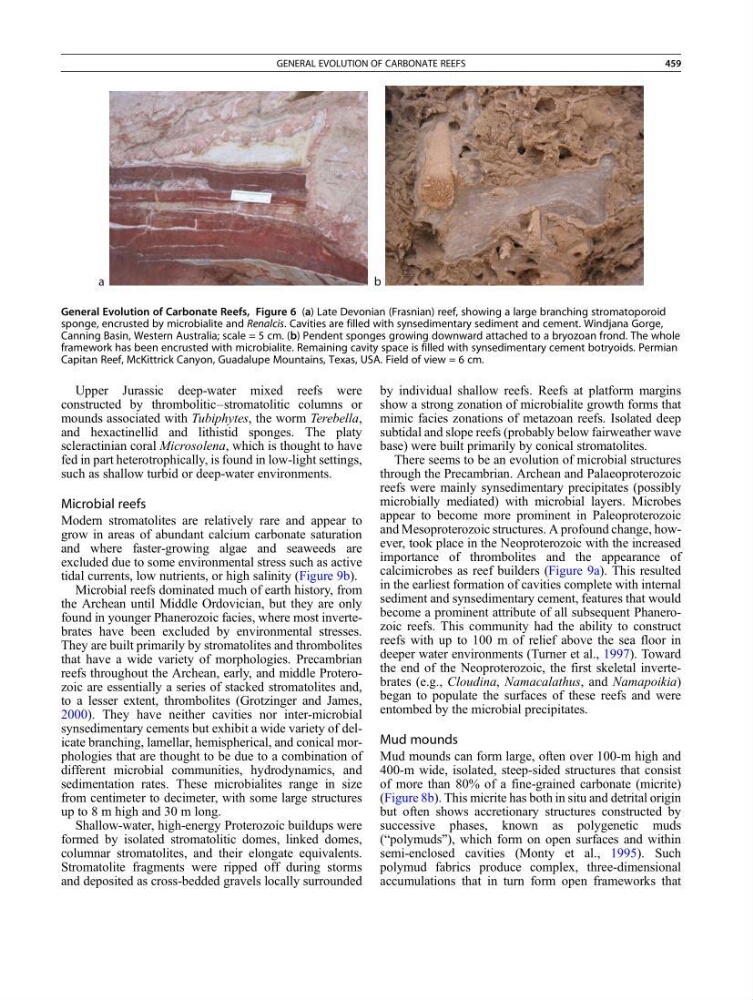
General Evolution of Carbonate Reefs, Figure 6 (a) Late Devonian (Frasnian) reef, showing a large branching stromatoporoid
sponge, encrusted by microbialite and Renalcis. Cavities are filled with synsedimentary sediment and cement. Windjana Gorge,
Canning Basin, Western Australia; scale = 5 cm. (b) Pendent sponges growing downward attached to a bryozoan frond. The whole
framework has been encrusted with microbialite. Remaining cavity space is filled with synsedimentary cement botryoids. Permian
Capitan Reef, McKittrick Canyon, Guadalupe Mountains, Texas, USA. Field of view = 6 cm.
GENERAL EVOLUTION OF CARBONATE REEFS
459
constructed by thrombolitic–stromatolitic columns or
mounds associated with Tubiphytes, the worm Terebella,
and hexactinellid and lithistid sponges. The platy
scleractinian coral Microsolena, which is thought to have
fed in part heterotrophically, is found in low-light settings,
such as shallow turbid or deep-water environments.
Microbial reefs
Modern stromatolites are relatively rare and appear to
grow in areas of abundant calcium carbonate saturation
and where faster-growing algae and seaweeds are
excluded due to some environmental stress such as active
tidal currents, low nutrients, or high salinity (Figure 9b).
Microbial reefs dominated much of earth history, from
the Archean until Middle Ordovician, but they are only
found in younger Phanerozoic facies, where most invertebrates have been excluded by environmental stresses.
They are built primarily by stromatolites and thrombolites
that have a wide variety of morphologies. Precambrian
reefs throughout the Archean, early, and middle Proterozoic are essentially a series of stacked stromatolites and,
to a lesser extent, thrombolites (Grotzinger and James,
2000). They have neither cavities nor inter-microbial
synsedimentary cements but exhibit a wide variety of delicate branching, lamellar, hemispherical, and conical morphologies that are thought to be due to a combination of
different microbial communities, hydrodynamics, and
sedimentation rates. These microbialites range in size
from centimeter to decimeter, with some large structures
up to 8 m high and 30 m long.
Shallow-water, high-energy Proterozoic buildups were
formed by isolated stromatolitic domes, linked domes,
columnar stromatolites, and their elongate equivalents.
Stromatolite fragments were ripped off during storms
and deposited as cross-bedded gravels locally surrounded
by individual shallow reefs. Reefs at platform margins
show a strong zonation of microbialite growth forms that
mimic facies zonations of metazoan reefs. Isolated deep
subtidal and slope reefs (probably below fairweather wave
base) were built primarily by conical stromatolites.
There seems to be an evolution of microbial structures
through the Precambrian. Archean and Palaeoproterozoic
reefs were mainly synsedimentary precipitates (possibly
microbially mediated) with microbial layers. Microbes
appear to become more prominent in Paleoproterozoic
and Mesoproterozoic structures. A profound change, however, took place in the Neoproterozoic with the increased
importance of thrombolites and the appearance of
calcimicrobes as reef builders (Figure 9a). This resulted
in the earliest formation of cavities complete with internal
sediment and synsedimentary cement, features that would
become a prominent attribute of all subsequent Phanerozoic reefs. This community had the ability to construct
reefs with up to 100 m of relief above the sea floor in
deeper water environments (Turner et al., 1997). Toward
the end of the Neoproterozoic, the first skeletal invertebrates (e.g., Cloudina, Namacalathus, and Namapoikia)
began to populate the surfaces of these reefs and were
entombed by the microbial precipitates.
Mud mounds
Mud mounds can form large, often over 100-m high and
400-m wide, isolated, steep-sided structures that consist
of more than 80% of a fine-grained carbonate (micrite)
(Figure 8b). This micrite has both in situ and detrital origin
but often shows accretionary structures constructed by
successive phases, known as polygenetic muds
(“polymuds”), which form on open surfaces and within
semi-enclosed cavities (Monty et al., 1995). Such
polymud fabrics produce complex, three-dimensional
accumulations that in turn form open frameworks that
a
b
General Evolution of Carbonate Reefs, Figure 6 (a) Late Devonian (Frasnian) reef, showing a large branching stromatoporoid
sponge, encrusted by microbialite and Renalcis. Cavities are filled with synsedimentary sediment and cement. Windjana Gorge,
Canning Basin, Western Australia; scale = 5 cm. (b) Pendent sponges growing downward attached to a bryozoan frond. The whole
framework has been encrusted with microbialite. Remaining cavity space is filled with synsedimentary cement botryoids. Permian
Capitan Reef, McKittrick Canyon, Guadalupe Mountains, Texas, USA. Field of view = 6 cm.
GENERAL EVOLUTION OF CARBONATE REEFS
459