

shallow-water reefs were dominated by hexactinellid and
lithistid spiculate sponges, coated by automicrite and
thrombolites, and encrusted by a variety of biota.
Deep-water skeletal–microbial reefs
Deep-water, heterotroph-mixed skeletal–microbial reef
communities are known from the Silurian to Devonian,
Jurassic, and Cretaceous. They were very different from
modern skeletal deep-water reefs. Muddy reefs with
Stromatactis (Figure 8), lithistid sponges, and
calcimicrobes were widespread during the Silurian, and
typically show a vertical zonation that culminates in
shallow-water stromatoporoid sponge-rich communities.
Similar communities, with the addition of microbialites,
stromatolites, and receptaculitids, formed deep-water
reefs in the mid-to-late Devonian.
14
1
12
11
11
12
9
4
3
4
12
2
6
8
1
8
5
5
6
4
10
2
7
13
1
15
1 m
a
b
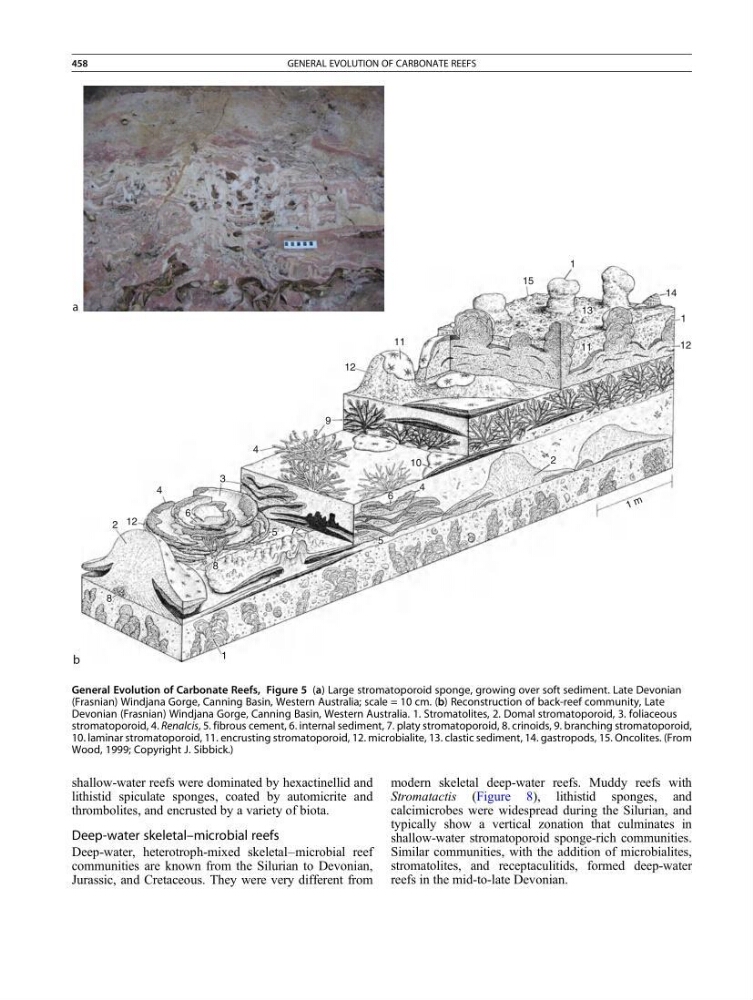
General Evolution of Carbonate Reefs, Figure 5 (a) Large stromatoporoid sponge, growing over soft sediment. Late Devonian
(Frasnian) Windjana Gorge, Canning Basin, Western Australia; scale = 10 cm. (b) Reconstruction of back-reef community, Late
Devonian (Frasnian) Windjana Gorge, Canning Basin, Western Australia. 1. Stromatolites, 2. Domal stromatoporoid, 3. foliaceous
stromatoporoid, 4. Renalcis, 5. fibrous cement, 6. internal sediment, 7. platy stromatoporoid, 8. crinoids, 9. branching stromatoporoid,
10. laminar stromatoporoid, 11. encrusting stromatoporoid, 12. microbialite, 13. clastic sediment, 14. gastropods, 15. Oncolites. (From
Wood, 1999; Copyright J. Sibbick.)
458
GENERAL EVOLUTION OF CARBONATE REEFS
lithistid spiculate sponges, coated by automicrite and
thrombolites, and encrusted by a variety of biota.
Deep-water skeletal–microbial reefs
Deep-water, heterotroph-mixed skeletal–microbial reef
communities are known from the Silurian to Devonian,
Jurassic, and Cretaceous. They were very different from
modern skeletal deep-water reefs. Muddy reefs with
Stromatactis (Figure 8), lithistid sponges, and
calcimicrobes were widespread during the Silurian, and
typically show a vertical zonation that culminates in
shallow-water stromatoporoid sponge-rich communities.
Similar communities, with the addition of microbialites,
stromatolites, and receptaculitids, formed deep-water
reefs in the mid-to-late Devonian.
14
1
12
11
11
12
9
4
3
4
12
2
6
8
1
8
5
5
6
4
10
2
7
13
1
15
1 m
a
b
General Evolution of Carbonate Reefs, Figure 5 (a) Large stromatoporoid sponge, growing over soft sediment. Late Devonian
(Frasnian) Windjana Gorge, Canning Basin, Western Australia; scale = 10 cm. (b) Reconstruction of back-reef community, Late
Devonian (Frasnian) Windjana Gorge, Canning Basin, Western Australia. 1. Stromatolites, 2. Domal stromatoporoid, 3. foliaceous
stromatoporoid, 4. Renalcis, 5. fibrous cement, 6. internal sediment, 7. platy stromatoporoid, 8. crinoids, 9. branching stromatoporoid,
10. laminar stromatoporoid, 11. encrusting stromatoporoid, 12. microbialite, 13. clastic sediment, 14. gastropods, 15. Oncolites. (From
Wood, 1999; Copyright J. Sibbick.)
458
GENERAL EVOLUTION OF CARBONATE REEFS