

cup-, bowl-, or upright leaf-like forms that may have been
encrusted by automicrite. Such reefs are usually low-relief
isolated structures, appear to have grown in shallow
waters, and are often associated with grainy sediments that
indicate growth under fairly energetic conditions with
extensive flanking beds. These mounds were typically
the source of significant skeletal debris that formed extensive flank beds. Halimeda mounds have been reported
from the late Miocene and may have been stabilized by
the rapid lithification of micrite and microbial crusts
(Martín et al., 1997).
Heterotroph dominated
Heterotroph reefs are common in the ancient record.
Lower Cambrian reefs occur as small isolated mounds,
consisting of archaeocyath sponges and calcimicrobes,
particularly Renalcis and Epiphyton (Figure 7a and b).
Lower Ordovician reefs were likewise dominated by
calcimicrobes, microbialite and, locally, corals.
Some back-reef shallow-water Frasnian (late Devonian) reefs exhibit large skeletal metazoans (particularly
stromatoporoid sponges and subsidiary corals), as well
as extensive fenestral microbialite and calcimicrobes, both
as free-standing mounds and as secondary encrustations
within cryptic habitats (Figures 5b and 6a).
Shallow-water Lower Carboniferous (Mississippian)
reefs are formed by endemic communities composed of
laminated microbial mounds with a rich encrusting open
surface and cryptic fauna dominated by algae, bryozoans,
corals, and sponges (Mundy, 1994; Webb, 1994; Ahr
et al., 2003).
The mid-to-late Permian is characterized by extensive
fringing reefs with a well-developed zonation. They consist in part of a primary framework of frondose bryozoans
and calcified sponges (many of whom were cavity
dwellers) that were bound by extensive crusts of laminated automicrite (Figure 6b). Tubiphytes is common,
together with various encrusting algae including
Archeolithoporella. Volumetrically, many of these reefs
were dominated by sediment and synsedimentary cement,
or automicrite. Such successions are inferred to have
formed within open cavity systems with freely circulating
seawater, in response to decreasing light and energy conditions as the reef was progressively buried. Upper Jurassic
Large skeletons
(corals; Stromatoporoids)
Skeletal
reefs
Skeletalmicrobial
reefs
Mud
mounds
Skeletal
reefs
Shallow
water
Neritic
Deep
water
Skeletalmicrobial
reefs
Reef fabric
a
c
e
b
d
f
Microbial
reefs
Stromatolite
Automicrite
calcimicrobes
synsedimentary cement
Internal cavity
geopetal sediment
synsedimentary cement
Spicules (sponges)
Thrombolite
Small skeletons
(non-photic corals)
Invertebrate skeletons
and calcareous algae
Platy skeletons
(bryozoans)
Small articulated skeletons
(crinoids, brachiopods, bivalves)
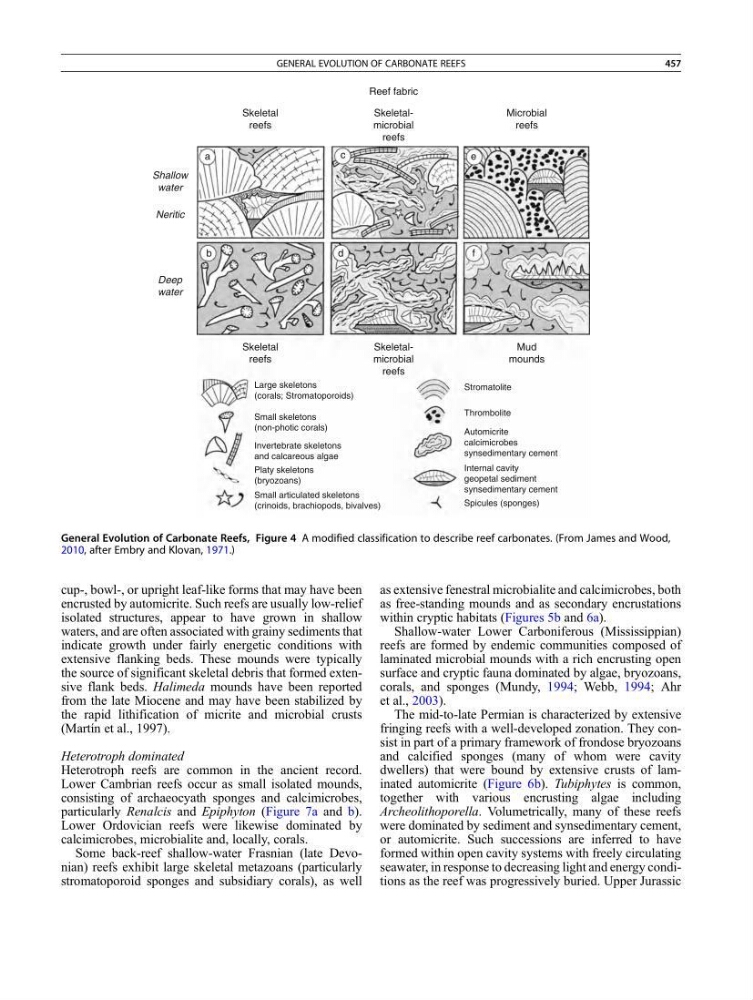
General Evolution of Carbonate Reefs, Figure 4 A modified classification to describe reef carbonates. (From James and Wood,
2010, after Embry and Klovan, 1971.)
GENERAL EVOLUTION OF CARBONATE REEFS
457
encrusted by automicrite. Such reefs are usually low-relief
isolated structures, appear to have grown in shallow
waters, and are often associated with grainy sediments that
indicate growth under fairly energetic conditions with
extensive flanking beds. These mounds were typically
the source of significant skeletal debris that formed extensive flank beds. Halimeda mounds have been reported
from the late Miocene and may have been stabilized by
the rapid lithification of micrite and microbial crusts
(Martín et al., 1997).
Heterotroph dominated
Heterotroph reefs are common in the ancient record.
Lower Cambrian reefs occur as small isolated mounds,
consisting of archaeocyath sponges and calcimicrobes,
particularly Renalcis and Epiphyton (Figure 7a and b).
Lower Ordovician reefs were likewise dominated by
calcimicrobes, microbialite and, locally, corals.
Some back-reef shallow-water Frasnian (late Devonian) reefs exhibit large skeletal metazoans (particularly
stromatoporoid sponges and subsidiary corals), as well
as extensive fenestral microbialite and calcimicrobes, both
as free-standing mounds and as secondary encrustations
within cryptic habitats (Figures 5b and 6a).
Shallow-water Lower Carboniferous (Mississippian)
reefs are formed by endemic communities composed of
laminated microbial mounds with a rich encrusting open
surface and cryptic fauna dominated by algae, bryozoans,
corals, and sponges (Mundy, 1994; Webb, 1994; Ahr
et al., 2003).
The mid-to-late Permian is characterized by extensive
fringing reefs with a well-developed zonation. They consist in part of a primary framework of frondose bryozoans
and calcified sponges (many of whom were cavity
dwellers) that were bound by extensive crusts of laminated automicrite (Figure 6b). Tubiphytes is common,
together with various encrusting algae including
Archeolithoporella. Volumetrically, many of these reefs
were dominated by sediment and synsedimentary cement,
or automicrite. Such successions are inferred to have
formed within open cavity systems with freely circulating
seawater, in response to decreasing light and energy conditions as the reef was progressively buried. Upper Jurassic
Large skeletons
(corals; Stromatoporoids)
Skeletal
reefs
Skeletalmicrobial
reefs
Mud
mounds
Skeletal
reefs
Shallow
water
Neritic
Deep
water
Skeletalmicrobial
reefs
Reef fabric
a
c
e
b
d
f
Microbial
reefs
Stromatolite
Automicrite
calcimicrobes
synsedimentary cement
Internal cavity
geopetal sediment
synsedimentary cement
Spicules (sponges)
Thrombolite
Small skeletons
(non-photic corals)
Invertebrate skeletons
and calcareous algae
Platy skeletons
(bryozoans)
Small articulated skeletons
(crinoids, brachiopods, bivalves)
General Evolution of Carbonate Reefs, Figure 4 A modified classification to describe reef carbonates. (From James and Wood,
2010, after Embry and Klovan, 1971.)
GENERAL EVOLUTION OF CARBONATE REEFS
457