

Autotroph-microbial or heterotrophic-microbial communities dominated ancient mixed reefs in shallow waters
of the photic zone. No direct modern analogs are known
for either of these systems.
Autotroph dominated
Ancient examples of mixed autotroph reefs include Pennsylvanian to early Permian phylloid algal mounds. These
algae are probably of mixed affinities and grew as laminar,
Corals +
Calcareous Algae
Rudists + Corals
Rudists
Corals + Rudists
Corals
Corals + Calcisponges
Calcisponges, Tubiphytes, bryozoans,
corals, tubular forminifera,
microbiolite
Phylloid algae
Stromatoporoids
microbiolite
Stromatoporoids
+ covrals
Strom-thrombolites
Calcimicrobes
Strom-thrombolites
Sponges
Archaeocyaths
Stromatolites
calcimicrobes
Thrombolites
Stromatolites
Stromatolites
Stromatolites
Mud mounds
Skeletal reefs
Skeletal-microbial reefs
(biogenic mounds)
Extinction events
A
P
C
O
S
D
M
P
P m
T R
JR
K
C
Bryozoans
sponges
Bryozoans, calcareous algae
Microbiolite
Calcimicrobes
Calcimicrobes
corals
sponges
Bryozoans
6
5
4
3
2
1
?
Archean
Protero.
Cambrian
Ord.
Silurian
Devon.
Miss.
Penn.
Permian
Triassic
Jurassic
Cret.
0
100
200
300
400
500
600
Geologic time in millions of years
1,000
2,000
3,000
Cenozoic
Periods Buildups Major biotic elements
*
Stromatoporoids
sponges
microbiolite
Calcareous
algae
7
8
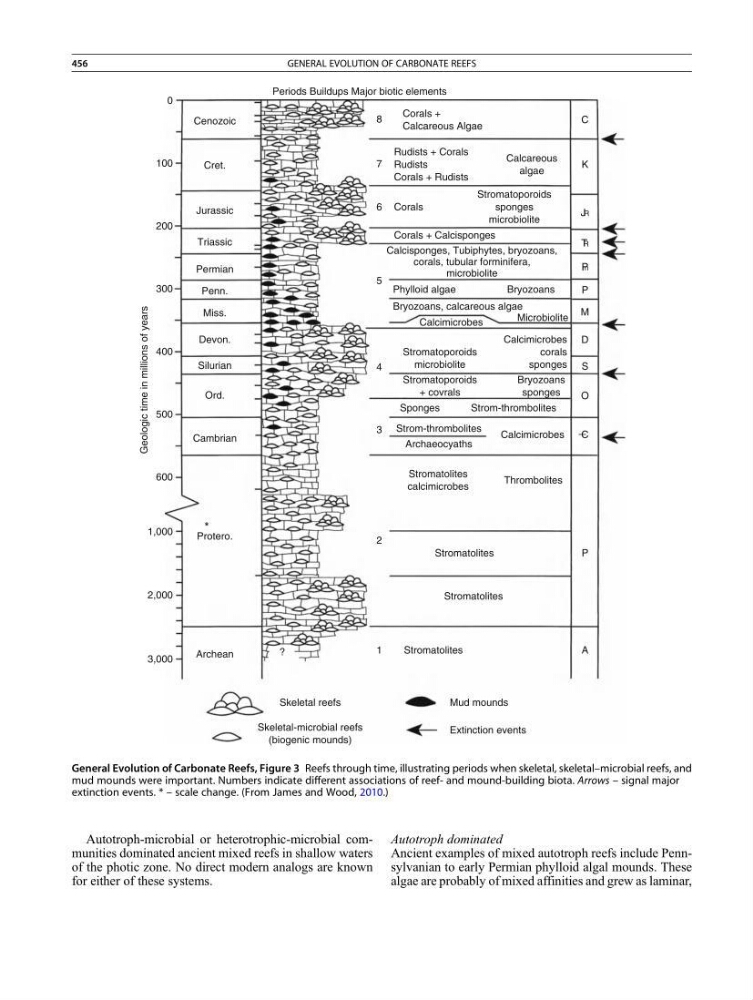
General Evolution of Carbonate Reefs, Figure 3 Reefs through time, illustrating periods when skeletal, skeletal–microbial reefs, and
mud mounds were important. Numbers indicate different associations of reef- and mound-building biota. Arrows – signal major
extinction events. * – scale change. (From James and Wood, 2010.)
456
GENERAL EVOLUTION OF CARBONATE REEFS
of the photic zone. No direct modern analogs are known
for either of these systems.
Autotroph dominated
Ancient examples of mixed autotroph reefs include Pennsylvanian to early Permian phylloid algal mounds. These
algae are probably of mixed affinities and grew as laminar,
Corals +
Calcareous Algae
Rudists + Corals
Rudists
Corals + Rudists
Corals
Corals + Calcisponges
Calcisponges, Tubiphytes, bryozoans,
corals, tubular forminifera,
microbiolite
Phylloid algae
Stromatoporoids
microbiolite
Stromatoporoids
+ covrals
Strom-thrombolites
Calcimicrobes
Strom-thrombolites
Sponges
Archaeocyaths
Stromatolites
calcimicrobes
Thrombolites
Stromatolites
Stromatolites
Stromatolites
Mud mounds
Skeletal reefs
Skeletal-microbial reefs
(biogenic mounds)
Extinction events
A
P
C
O
S
D
M
P
P m
T R
JR
K
C
Bryozoans
sponges
Bryozoans, calcareous algae
Microbiolite
Calcimicrobes
Calcimicrobes
corals
sponges
Bryozoans
6
5
4
3
2
1
?
Archean
Protero.
Cambrian
Ord.
Silurian
Devon.
Miss.
Penn.
Permian
Triassic
Jurassic
Cret.
0
100
200
300
400
500
600
Geologic time in millions of years
1,000
2,000
3,000
Cenozoic
Periods Buildups Major biotic elements
*
Stromatoporoids
sponges
microbiolite
Calcareous
algae
7
8
General Evolution of Carbonate Reefs, Figure 3 Reefs through time, illustrating periods when skeletal, skeletal–microbial reefs, and
mud mounds were important. Numbers indicate different associations of reef- and mound-building biota. Arrows – signal major
extinction events. * – scale change. (From James and Wood, 2010.)
456
GENERAL EVOLUTION OF CARBONATE REEFS