

differences between fringing reefs of the Indo-Pacific –
where present sea level was generally reached around
6,000 years ago has since slowly fallen to present (see
Mid Holocene) (Pirazzoli, 1991) – and the Caribbean,
where sea level has risen to present at a decelerating rate,
to reach its current position only recently (Lighty et al.,
1982) (see Western Atlantic/Caribbean, Coral Reefs).
Reef flat morphology is the most conspicuous consequence of the varying sea-level histories experienced by
fringing reefs in different locations. Throughout the
Indo-Pacific fringing reefs with back-reef reef flats (see
Reef Flat) that are dry at low tide are widespread, often
but not always reflecting the late Holocene sea-level
regression experienced in this region (see Postglacial
Transgression; Sea Level Change and Its Effect on Reef
Growth). In these locations the now emergent back reef
formed when sea levels were higher in the mid-Holocene
and the modern reef is confined at a lower level at the reef
front (e.g., Chappell et al., 1983). In the Caribbean, where
modern sea level has only recently been achieved (Lighty
et al., 1982), fringing reefs with shallowly submerged
back reefs are more common. Adey (1978) speculated that
the divergent back-reef morphologies were principally
a function of sea-level history; he suggested that shallow
lagoons developed on the Caribbean reefs where the more
vigorously growing reef crest reached sea level before the
back reef, confining a shallow lagoon over the back reef at
low tides.
Fringing reef structure and growth models
The growth histories of modern fringing reefs are
documented by the materials and depositional fabrics preserved in their internal structures. Detailed stratigraphic
and sedimentological investigations augmented by radiometric dating have enabled the growth histories of many
fringing reefs to be interpreted, revealing details on age
structure, past reef morphology, and the dominant processes
of reef construction. Kennedy and Woodroffe (2002)
reviewed the published literature on fringing reefs and
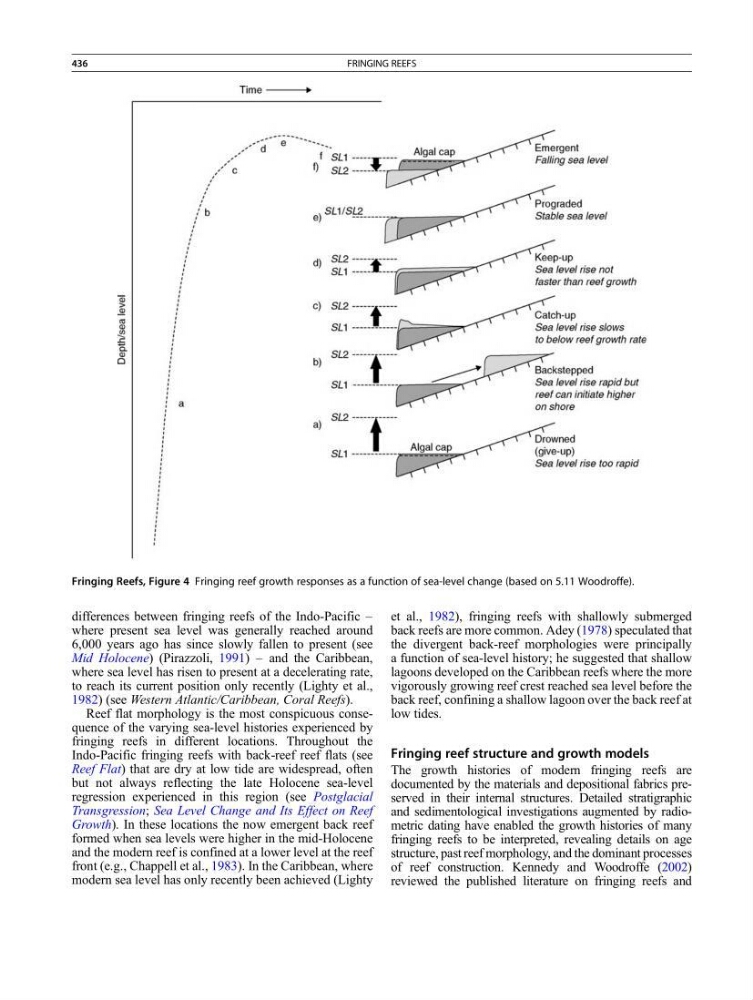
Fringing Reefs, Figure 4 Fringing reef growth responses as a function of sea-level change (based on 5.11 Woodroffe).
436
FRINGING REEFS
where present sea level was generally reached around
6,000 years ago has since slowly fallen to present (see
Mid Holocene) (Pirazzoli, 1991) – and the Caribbean,
where sea level has risen to present at a decelerating rate,
to reach its current position only recently (Lighty et al.,
1982) (see Western Atlantic/Caribbean, Coral Reefs).
Reef flat morphology is the most conspicuous consequence of the varying sea-level histories experienced by
fringing reefs in different locations. Throughout the
Indo-Pacific fringing reefs with back-reef reef flats (see
Reef Flat) that are dry at low tide are widespread, often
but not always reflecting the late Holocene sea-level
regression experienced in this region (see Postglacial
Transgression; Sea Level Change and Its Effect on Reef
Growth). In these locations the now emergent back reef
formed when sea levels were higher in the mid-Holocene
and the modern reef is confined at a lower level at the reef
front (e.g., Chappell et al., 1983). In the Caribbean, where
modern sea level has only recently been achieved (Lighty
et al., 1982), fringing reefs with shallowly submerged
back reefs are more common. Adey (1978) speculated that
the divergent back-reef morphologies were principally
a function of sea-level history; he suggested that shallow
lagoons developed on the Caribbean reefs where the more
vigorously growing reef crest reached sea level before the
back reef, confining a shallow lagoon over the back reef at
low tides.
Fringing reef structure and growth models
The growth histories of modern fringing reefs are
documented by the materials and depositional fabrics preserved in their internal structures. Detailed stratigraphic
and sedimentological investigations augmented by radiometric dating have enabled the growth histories of many
fringing reefs to be interpreted, revealing details on age
structure, past reef morphology, and the dominant processes
of reef construction. Kennedy and Woodroffe (2002)
reviewed the published literature on fringing reefs and
Fringing Reefs, Figure 4 Fringing reef growth responses as a function of sea-level change (based on 5.11 Woodroffe).
436
FRINGING REEFS