

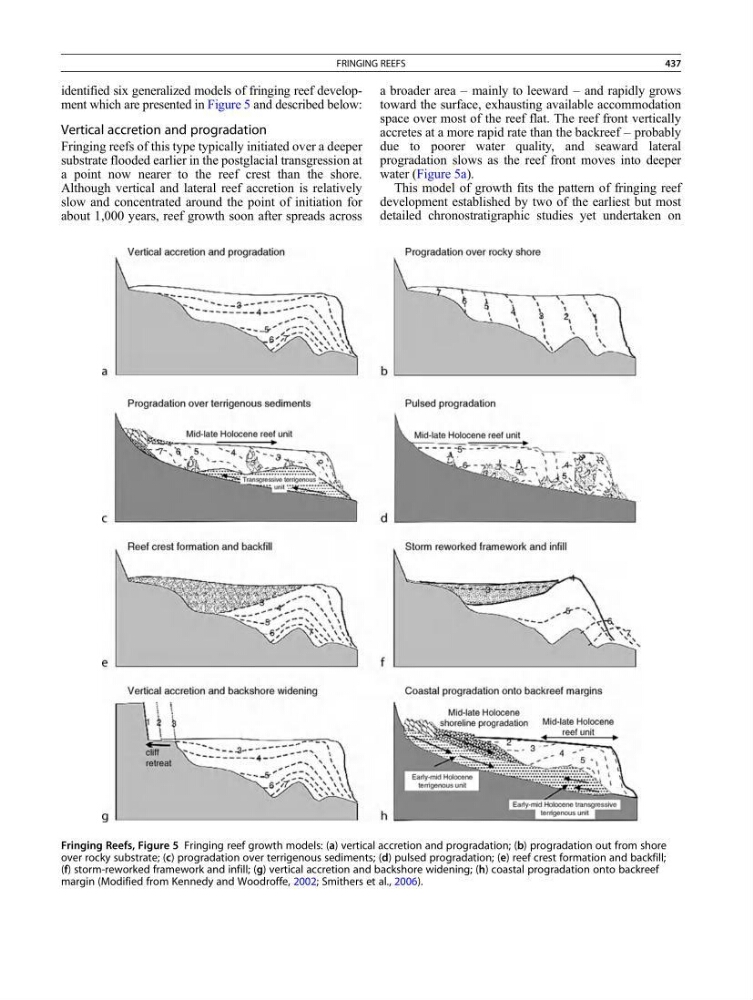
identified six generalized models of fringing reef development which are presented in Figure 5 and described below:
Vertical accretion and progradation
Fringing reefs of this type typically initiated over a deeper
substrate flooded earlier in the postglacial transgression at
a point now nearer to the reef crest than the shore.
Although vertical and lateral reef accretion is relatively
slow and concentrated around the point of initiation for
about 1,000 years, reef growth soon after spreads across
a broader area – mainly to leeward – and rapidly grows
toward the surface, exhausting available accommodation
space over most of the reef flat. The reef front vertically
accretes at a more rapid rate than the backreef – probably
due to poorer water quality, and seaward lateral
progradation slows as the reef front moves into deeper
water (Figure 5a).
This model of growth fits the pattern of fringing reef
development established by two of the earliest but most
detailed chronostratigraphic studies yet undertaken on
Fringing Reefs, Figure 5 Fringing reef growth models: (a) vertical accretion and progradation; (b) progradation out from shore
over rocky substrate; (c) progradation over terrigenous sediments; (d) pulsed progradation; (e) reef crest formation and backfill;
(f) storm-reworked framework and infill; (g) vertical accretion and backshore widening; (h) coastal progradation onto backreef
margin (Modified from Kennedy and Woodroffe, 2002; Smithers et al., 2006).
FRINGING REEFS
437
Vertical accretion and progradation
Fringing reefs of this type typically initiated over a deeper
substrate flooded earlier in the postglacial transgression at
a point now nearer to the reef crest than the shore.
Although vertical and lateral reef accretion is relatively
slow and concentrated around the point of initiation for
about 1,000 years, reef growth soon after spreads across
a broader area – mainly to leeward – and rapidly grows
toward the surface, exhausting available accommodation
space over most of the reef flat. The reef front vertically
accretes at a more rapid rate than the backreef – probably
due to poorer water quality, and seaward lateral
progradation slows as the reef front moves into deeper
water (Figure 5a).
This model of growth fits the pattern of fringing reef
development established by two of the earliest but most
detailed chronostratigraphic studies yet undertaken on
Fringing Reefs, Figure 5 Fringing reef growth models: (a) vertical accretion and progradation; (b) progradation out from shore
over rocky substrate; (c) progradation over terrigenous sediments; (d) pulsed progradation; (e) reef crest formation and backfill;
(f) storm-reworked framework and infill; (g) vertical accretion and backshore widening; (h) coastal progradation onto backreef
margin (Modified from Kennedy and Woodroffe, 2002; Smithers et al., 2006).
FRINGING REEFS
437