

plumes that can produce mass mortality events from
which recovery can be very slow, thus stunting reef
growth potential. Luxuriant reefs offshore of Mackay
photographed in the late 1880s that were killed by
a cyclone-generated flood plume in 1918 had recovered
little by 1982 (Hopley, 1982).
Sediment and nutrient delivery to coastal waters where
fringing reefs grow has been linked to the degradation
of many fringing reefs (e.g., Punta Islotes, Costa Rica
[Cortes et al., 1994]; Rodrigues [Naim et al., 2000];
Seychelles [Jennings et al., 2000]), with impacts arising
due to smothering and burial, elevated turbidity with loss
of photosynthetic capacity and energetic costs, and
increased competitiveness of fleshy macroalgae and shifts
from a coral to algal-dominated ecosystem (Umar et al.,
1998; Fabricius, 2005). For some fringing reefs sediment
related impacts may be natural; for example, periodic
shifts in the position of river mouths may affect fringing
reef growth and potential growth areas (Cortes et al.,
1994), and at a larger scale, two catchments draining
into the GBR exceed 130,000 km
2 in area, and the
total catchment area draining into the GBR is nearly
425,000 km
2
, and thus for significant stretches of the coast
large inputs of sediment and runoff are experienced periodically during natural floods (Neil et al., 2002).
However, there are clearly thresholds of sediment and
nutrient exposure above which corals are unlikely to survive to establish fringing reefs of significant size. Nevertheless, it is crucial to recognize that corals can adapt to
these pressures and that critical thresholds vary with location. On the GBR, high terrestrial runoff, into a relatively
low-energy and protected lagoon, routinely exposes corals
on inshore fringing reefs to ambient levels of turbidity and
sedimentation known to stress and possibly kill those on
other reefs (Pastorok and Bilyard, 1985; Hopley et al.,
2007), and stratigraphic evidence confirms that many
fringing reefs have always grown under naturally turbid
conditions (Smithers and Larcombe, 2003; Perry et al.,
2008). Many corals on these reefs grow vigorously, and
have adapted to these turbid conditions (Anthony, 2000,
2006). Paradoxically, however, the apparent vigor of reef
corals does not appear to directly translate to continued
reef accretion – most fringing and nearshore reefs have
not added much to their structures for several thousand
years (Smithers et al., 2006).
Fringing reef growth and sea level
Holocene sea-level changes have been an important control on the development of all modern reefs (see Sea Level
Change and Its Effect on Reef Growth), flooding substrates suitable for reef initiation and then providing the
accommodation space into which fringing reefs may grow
(see Accommodation Space; Postglacial Transgression).
The timing of initiation is broadly governed by substrate
depth, with deeper substrates flooded earliest and shallow
substrates more recently. The amount of accommodation
space available above any substrate depends on the rate
of sea-level rise, the lag between inundation and initiation,
and the rate of vertical reef accretion. These all vary from
place to place. The timing of initiation and rates of vertical
reef accretion are discussed in the following section on
reef structure and growth models.
Geographic differences in the nature of Holocene sealevel changes related both to ocean volume and regional
and local isostatic adjustments to the redistribution of
mass (see Glacio-Hydro Isostasy) have produced different
growth responses in fringing reefs, most of which reflect
the balance between rates of vertical reef accretion and
relative sea-level rise, the net result of which is available
accommodation space. The range of reef responses is
summarized in Figure 4 (modified from Woodroffe,
2002). Figure 4 presents sea-level change – reef growth
scenarios that can explain some of the morphological
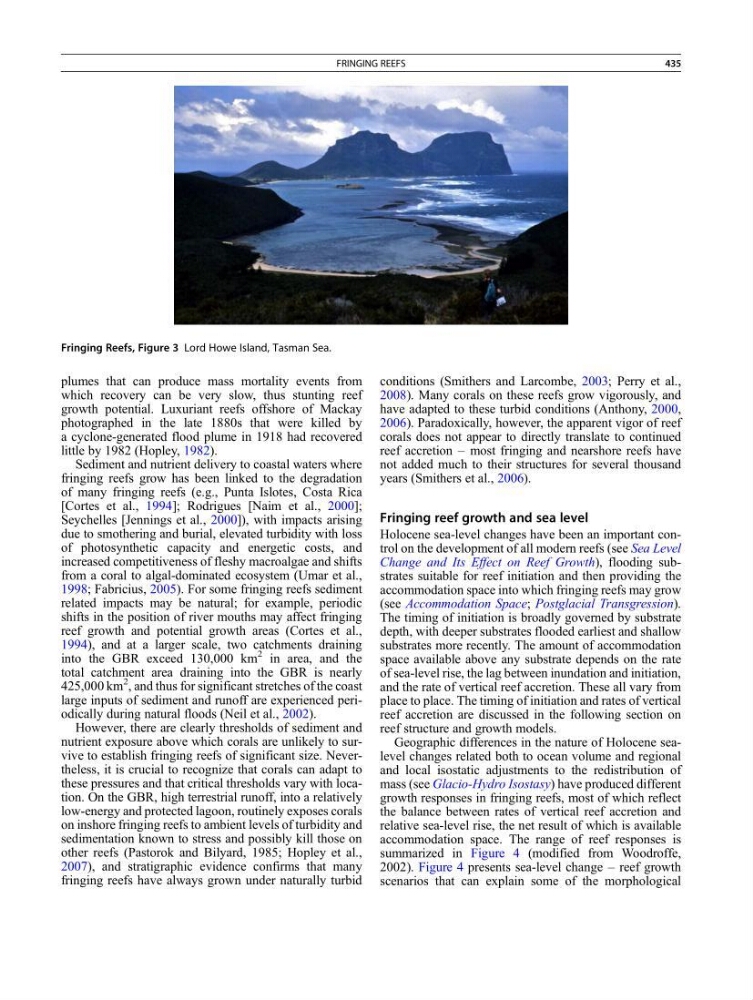
Fringing Reefs, Figure 3 Lord Howe Island, Tasman Sea.
FRINGING REEFS
435
which recovery can be very slow, thus stunting reef
growth potential. Luxuriant reefs offshore of Mackay
photographed in the late 1880s that were killed by
a cyclone-generated flood plume in 1918 had recovered
little by 1982 (Hopley, 1982).
Sediment and nutrient delivery to coastal waters where
fringing reefs grow has been linked to the degradation
of many fringing reefs (e.g., Punta Islotes, Costa Rica
[Cortes et al., 1994]; Rodrigues [Naim et al., 2000];
Seychelles [Jennings et al., 2000]), with impacts arising
due to smothering and burial, elevated turbidity with loss
of photosynthetic capacity and energetic costs, and
increased competitiveness of fleshy macroalgae and shifts
from a coral to algal-dominated ecosystem (Umar et al.,
1998; Fabricius, 2005). For some fringing reefs sediment
related impacts may be natural; for example, periodic
shifts in the position of river mouths may affect fringing
reef growth and potential growth areas (Cortes et al.,
1994), and at a larger scale, two catchments draining
into the GBR exceed 130,000 km
2 in area, and the
total catchment area draining into the GBR is nearly
425,000 km
2
, and thus for significant stretches of the coast
large inputs of sediment and runoff are experienced periodically during natural floods (Neil et al., 2002).
However, there are clearly thresholds of sediment and
nutrient exposure above which corals are unlikely to survive to establish fringing reefs of significant size. Nevertheless, it is crucial to recognize that corals can adapt to
these pressures and that critical thresholds vary with location. On the GBR, high terrestrial runoff, into a relatively
low-energy and protected lagoon, routinely exposes corals
on inshore fringing reefs to ambient levels of turbidity and
sedimentation known to stress and possibly kill those on
other reefs (Pastorok and Bilyard, 1985; Hopley et al.,
2007), and stratigraphic evidence confirms that many
fringing reefs have always grown under naturally turbid
conditions (Smithers and Larcombe, 2003; Perry et al.,
2008). Many corals on these reefs grow vigorously, and
have adapted to these turbid conditions (Anthony, 2000,
2006). Paradoxically, however, the apparent vigor of reef
corals does not appear to directly translate to continued
reef accretion – most fringing and nearshore reefs have
not added much to their structures for several thousand
years (Smithers et al., 2006).
Fringing reef growth and sea level
Holocene sea-level changes have been an important control on the development of all modern reefs (see Sea Level
Change and Its Effect on Reef Growth), flooding substrates suitable for reef initiation and then providing the
accommodation space into which fringing reefs may grow
(see Accommodation Space; Postglacial Transgression).
The timing of initiation is broadly governed by substrate
depth, with deeper substrates flooded earliest and shallow
substrates more recently. The amount of accommodation
space available above any substrate depends on the rate
of sea-level rise, the lag between inundation and initiation,
and the rate of vertical reef accretion. These all vary from
place to place. The timing of initiation and rates of vertical
reef accretion are discussed in the following section on
reef structure and growth models.
Geographic differences in the nature of Holocene sealevel changes related both to ocean volume and regional
and local isostatic adjustments to the redistribution of
mass (see Glacio-Hydro Isostasy) have produced different
growth responses in fringing reefs, most of which reflect
the balance between rates of vertical reef accretion and
relative sea-level rise, the net result of which is available
accommodation space. The range of reef responses is
summarized in Figure 4 (modified from Woodroffe,
2002). Figure 4 presents sea-level change – reef growth
scenarios that can explain some of the morphological
Fringing Reefs, Figure 3 Lord Howe Island, Tasman Sea.
FRINGING REEFS
435