

(down to 270 m, Littler et al., 1985). CCA occur as nodules in carbonate sands or as thin crusts on hard substrates
frequently intergrown with encrusting foraminifers,
forming complex, multigenerational open frameworks.
The genera Lithothamnion and Mesophyllum, belonging
to the subfamily Melobesioideae, dominate the algal
assemblages together with Sporolithon and the red alga
Peyssonnelia both in the Indo-Pacific and the western
Atlantic. Lithoporella is also common in this zone in
the Indian and Pacific oceans. In fossil reefs, this zone
is represented by rhodolith floatstones and rudstones,
and coralline algal and foraminiferal crust-dominated
bindstones, with the above-mentioned algae.
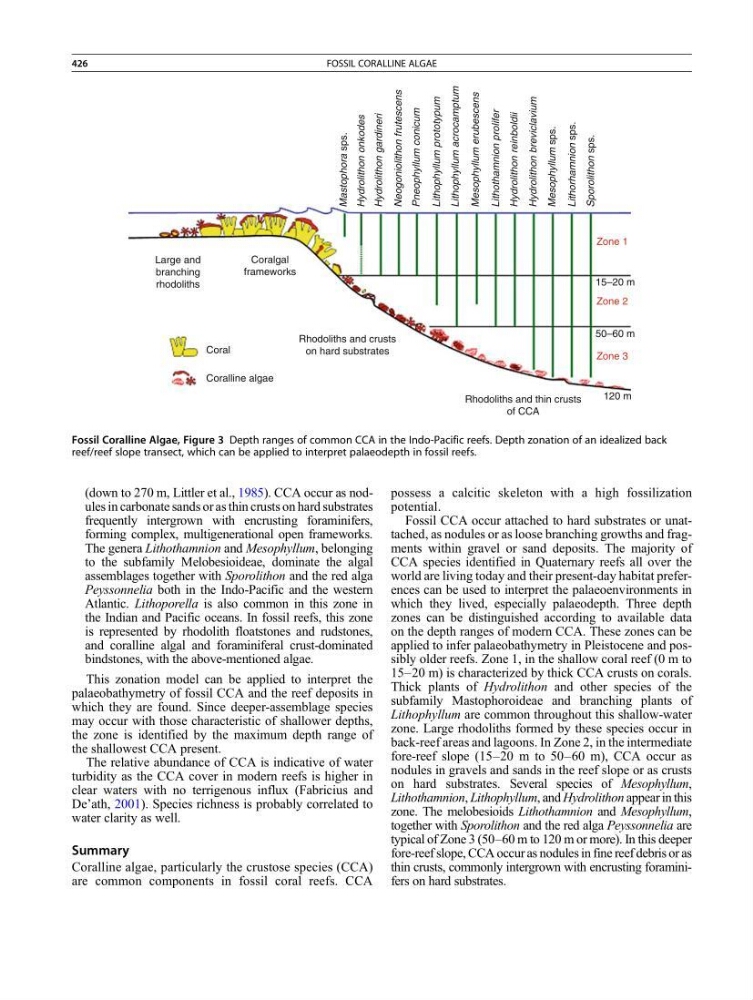
This zonation model can be applied to interpret the
palaeobathymetry of fossil CCA and the reef deposits in
which they are found. Since deeper-assemblage species
may occur with those characteristic of shallower depths,
the zone is identified by the maximum depth range of
the shallowest CCA present.
The relative abundance of CCA is indicative of water
turbidity as the CCA cover in modern reefs is higher in
clear waters with no terrigenous influx (Fabricius and
De'ath, 2001). Species richness is probably correlated to
water clarity as well.
Summary
Coralline algae, particularly the crustose species (CCA)
are common components in fossil coral reefs. CCA
possess a calcitic skeleton with a high fossilization
potential.
Fossil CCA occur attached to hard substrates or unattached, as nodules or as loose branching growths and fragments within gravel or sand deposits. The majority of
CCA species identified in Quaternary reefs all over the
world are living today and their present-day habitat preferences can be used to interpret the palaeoenvironments in
which they lived, especially palaeodepth. Three depth
zones can be distinguished according to available data
on the depth ranges of modern CCA. These zones can be
applied to infer palaeobathymetry in Pleistocene and possibly older reefs. Zone 1, in the shallow coral reef (0 m to
15–20 m) is characterized by thick CCA crusts on corals.
Thick plants of Hydrolithon and other species of the
subfamily Mastophoroideae and branching plants of
Lithophyllum are common throughout this shallow-water
zone. Large rhodoliths formed by these species occur in
back-reef areas and lagoons. In Zone 2, in the intermediate
fore-reef slope (15–20 m to 50–60 m), CCA occur as
nodules in gravels and sands in the reef slope or as crusts
on hard substrates. Several species of Mesophyllum,
Lithothamnion, Lithophyllum, and Hydrolithon appear in this
zone. The melobesioids Lithothamnion and Mesophyllum,
together with Sporolithon and the red alga Peyssonnelia are
typical of Zone 3 (50–60 m to 120 m or more). In this deeper
fore-reef slope, CCA occur as nodules in fine reef debris or as
thin crusts, commonly intergrown with encrusting foraminifers on hard substrates.
Mastophora sps.
Pneophyllum conicum
Sporolithon sps.
Rhodoliths and thin crusts
of CCA
Rhodoliths and crusts
on hard substrates
Coral
Coralline algae
Coralgal
frameworks
Large and
branching
rhodoliths
120 m
50–60 m
15–20 m
Zone 1
Zone 2
Zone 3
Lithorhamnion sps.
Mesophyllum sps.
Hydrolithon breviclavium
Hydrolithon reinboldii
Lithothamnion prolifer
Mesophyllum erubescens
Lithophyllum acrocamptum
Lithophyllum prototypum
Neogoniolithon frutescens
Hydrolithon gardineri
Hydrolithon onkodes
Fossil Coralline Algae, Figure 3 Depth ranges of common CCA in the Indo-Pacific reefs. Depth zonation of an idealized back
reef/reef slope transect, which can be applied to interpret palaeodepth in fossil reefs.
426
FOSSIL CORALLINE ALGAE
frequently intergrown with encrusting foraminifers,
forming complex, multigenerational open frameworks.
The genera Lithothamnion and Mesophyllum, belonging
to the subfamily Melobesioideae, dominate the algal
assemblages together with Sporolithon and the red alga
Peyssonnelia both in the Indo-Pacific and the western
Atlantic. Lithoporella is also common in this zone in
the Indian and Pacific oceans. In fossil reefs, this zone
is represented by rhodolith floatstones and rudstones,
and coralline algal and foraminiferal crust-dominated
bindstones, with the above-mentioned algae.
This zonation model can be applied to interpret the
palaeobathymetry of fossil CCA and the reef deposits in
which they are found. Since deeper-assemblage species
may occur with those characteristic of shallower depths,
the zone is identified by the maximum depth range of
the shallowest CCA present.
The relative abundance of CCA is indicative of water
turbidity as the CCA cover in modern reefs is higher in
clear waters with no terrigenous influx (Fabricius and
De'ath, 2001). Species richness is probably correlated to
water clarity as well.
Summary
Coralline algae, particularly the crustose species (CCA)
are common components in fossil coral reefs. CCA
possess a calcitic skeleton with a high fossilization
potential.
Fossil CCA occur attached to hard substrates or unattached, as nodules or as loose branching growths and fragments within gravel or sand deposits. The majority of
CCA species identified in Quaternary reefs all over the
world are living today and their present-day habitat preferences can be used to interpret the palaeoenvironments in
which they lived, especially palaeodepth. Three depth
zones can be distinguished according to available data
on the depth ranges of modern CCA. These zones can be
applied to infer palaeobathymetry in Pleistocene and possibly older reefs. Zone 1, in the shallow coral reef (0 m to
15–20 m) is characterized by thick CCA crusts on corals.
Thick plants of Hydrolithon and other species of the
subfamily Mastophoroideae and branching plants of
Lithophyllum are common throughout this shallow-water
zone. Large rhodoliths formed by these species occur in
back-reef areas and lagoons. In Zone 2, in the intermediate
fore-reef slope (15–20 m to 50–60 m), CCA occur as
nodules in gravels and sands in the reef slope or as crusts
on hard substrates. Several species of Mesophyllum,
Lithothamnion, Lithophyllum, and Hydrolithon appear in this
zone. The melobesioids Lithothamnion and Mesophyllum,
together with Sporolithon and the red alga Peyssonnelia are
typical of Zone 3 (50–60 m to 120 m or more). In this deeper
fore-reef slope, CCA occur as nodules in fine reef debris or as
thin crusts, commonly intergrown with encrusting foraminifers on hard substrates.
Mastophora sps.
Pneophyllum conicum
Sporolithon sps.
Rhodoliths and thin crusts
of CCA
Rhodoliths and crusts
on hard substrates
Coral
Coralline algae
Coralgal
frameworks
Large and
branching
rhodoliths
120 m
50–60 m
15–20 m
Zone 1
Zone 2
Zone 3
Lithorhamnion sps.
Mesophyllum sps.
Hydrolithon breviclavium
Hydrolithon reinboldii
Lithothamnion prolifer
Mesophyllum erubescens
Lithophyllum acrocamptum
Lithophyllum prototypum
Neogoniolithon frutescens
Hydrolithon gardineri
Hydrolithon onkodes
Fossil Coralline Algae, Figure 3 Depth ranges of common CCA in the Indo-Pacific reefs. Depth zonation of an idealized back
reef/reef slope transect, which can be applied to interpret palaeodepth in fossil reefs.
426
FOSSIL CORALLINE ALGAE