

the depth ranges of genera and species (Figure 3).
This zonation follows the one proposed by Webster et al.
(2009) for reef facies in Quaternary Pacific reefs. The
main components of these zones and their characteristic
growth forms, together with the resulting carbonate facies,
are summarized below.
Zone 1. Shallow coral reef (0 m to 15–20 m). This zone is
dominated by coralgal frameworks in which CCA
encrust massive and branching corals and intergrow
with encrusting corals and other sessile organisms. In
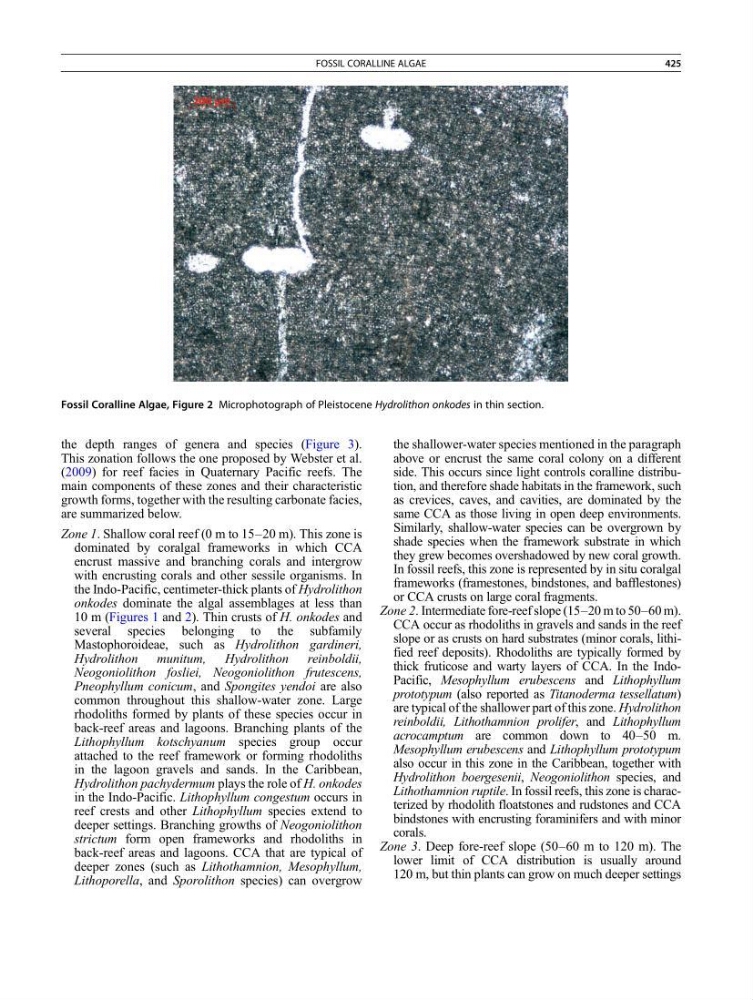
the Indo-Pacific, centimeter-thick plants of Hydrolithon
onkodes dominate the algal assemblages at less than
10 m (Figures 1 and 2). Thin crusts of H. onkodes and
several species belonging to the subfamily
Mastophoroideae, such as Hydrolithon gardineri,
Hydrolithon munitum, Hydrolithon reinboldii,
Neogoniolithon fosliei, Neogoniolithon frutescens,
Pneophyllum conicum, and Spongites yendoi are also
common throughout this shallow-water zone. Large
rhodoliths formed by plants of these species occur in
back-reef areas and lagoons. Branching plants of the
Lithophyllum kotschyanum species group occur
attached to the reef framework or forming rhodoliths
in the lagoon gravels and sands. In the Caribbean,
Hydrolithon pachydermum plays the role of H. onkodes
in the Indo-Pacific. Lithophyllum congestum occurs in
reef crests and other Lithophyllum species extend to
deeper settings. Branching growths of Neogoniolithon
strictum form open frameworks and rhodoliths in
back-reef areas and lagoons. CCA that are typical of
deeper zones (such as Lithothamnion, Mesophyllum,
Lithoporella, and Sporolithon species) can overgrow
the shallower-water species mentioned in the paragraph
above or encrust the same coral colony on a different
side. This occurs since light controls coralline distribution, and therefore shade habitats in the framework, such
as crevices, caves, and cavities, are dominated by the
same CCA as those living in open deep environments.
Similarly, shallow-water species can be overgrown by
shade species when the framework substrate in which
they grew becomes overshadowed by new coral growth.
In fossil reefs, this zone is represented by in situ coralgal
frameworks (framestones, bindstones, and bafflestones)
or CCA crusts on large coral fragments.
Zone 2. Intermediate fore-reef slope (15–20 m to 50–60 m).
CCA occur as rhodoliths in gravels and sands in the reef
slope or as crusts on hard substrates (minor corals, lithified reef deposits). Rhodoliths are typically formed by
thick fruticose and warty layers of CCA. In the IndoPacific, Mesophyllum erubescens and Lithophyllum
prototypum (also reported as Titanoderma tessellatum)
are typical of the shallower part of this zone. Hydrolithon
reinboldii, Lithothamnion prolifer, and Lithophyllum
acrocamptum are common down to 40–50 m.
Mesophyllum erubescens and Lithophyllum prototypum
also occur in this zone in the Caribbean, together with
Hydrolithon boergesenii, Neogoniolithon species, and
Lithothamnion ruptile. In fossil reefs, this zone is characterized by rhodolith floatstones and rudstones and CCA
bindstones with encrusting foraminifers and with minor
corals.
Zone 3. Deep fore-reef slope (50–60 m to 120 m). The
lower limit of CCA distribution is usually around
120 m, but thin plants can grow on much deeper settings
Fossil Coralline Algae, Figure 2 Microphotograph of Pleistocene Hydrolithon onkodes in thin section.
FOSSIL CORALLINE ALGAE
425
This zonation follows the one proposed by Webster et al.
(2009) for reef facies in Quaternary Pacific reefs. The
main components of these zones and their characteristic
growth forms, together with the resulting carbonate facies,
are summarized below.
Zone 1. Shallow coral reef (0 m to 15–20 m). This zone is
dominated by coralgal frameworks in which CCA
encrust massive and branching corals and intergrow
with encrusting corals and other sessile organisms. In
the Indo-Pacific, centimeter-thick plants of Hydrolithon
onkodes dominate the algal assemblages at less than
10 m (Figures 1 and 2). Thin crusts of H. onkodes and
several species belonging to the subfamily
Mastophoroideae, such as Hydrolithon gardineri,
Hydrolithon munitum, Hydrolithon reinboldii,
Neogoniolithon fosliei, Neogoniolithon frutescens,
Pneophyllum conicum, and Spongites yendoi are also
common throughout this shallow-water zone. Large
rhodoliths formed by plants of these species occur in
back-reef areas and lagoons. Branching plants of the
Lithophyllum kotschyanum species group occur
attached to the reef framework or forming rhodoliths
in the lagoon gravels and sands. In the Caribbean,
Hydrolithon pachydermum plays the role of H. onkodes
in the Indo-Pacific. Lithophyllum congestum occurs in
reef crests and other Lithophyllum species extend to
deeper settings. Branching growths of Neogoniolithon
strictum form open frameworks and rhodoliths in
back-reef areas and lagoons. CCA that are typical of
deeper zones (such as Lithothamnion, Mesophyllum,
Lithoporella, and Sporolithon species) can overgrow
the shallower-water species mentioned in the paragraph
above or encrust the same coral colony on a different
side. This occurs since light controls coralline distribution, and therefore shade habitats in the framework, such
as crevices, caves, and cavities, are dominated by the
same CCA as those living in open deep environments.
Similarly, shallow-water species can be overgrown by
shade species when the framework substrate in which
they grew becomes overshadowed by new coral growth.
In fossil reefs, this zone is represented by in situ coralgal
frameworks (framestones, bindstones, and bafflestones)
or CCA crusts on large coral fragments.
Zone 2. Intermediate fore-reef slope (15–20 m to 50–60 m).
CCA occur as rhodoliths in gravels and sands in the reef
slope or as crusts on hard substrates (minor corals, lithified reef deposits). Rhodoliths are typically formed by
thick fruticose and warty layers of CCA. In the IndoPacific, Mesophyllum erubescens and Lithophyllum
prototypum (also reported as Titanoderma tessellatum)
are typical of the shallower part of this zone. Hydrolithon
reinboldii, Lithothamnion prolifer, and Lithophyllum
acrocamptum are common down to 40–50 m.
Mesophyllum erubescens and Lithophyllum prototypum
also occur in this zone in the Caribbean, together with
Hydrolithon boergesenii, Neogoniolithon species, and
Lithothamnion ruptile. In fossil reefs, this zone is characterized by rhodolith floatstones and rudstones and CCA
bindstones with encrusting foraminifers and with minor
corals.
Zone 3. Deep fore-reef slope (50–60 m to 120 m). The
lower limit of CCA distribution is usually around
120 m, but thin plants can grow on much deeper settings
Fossil Coralline Algae, Figure 2 Microphotograph of Pleistocene Hydrolithon onkodes in thin section.
FOSSIL CORALLINE ALGAE
425