

levels, and their high preservation potential make fossil
CCA very useful palaeoenvironmental indicators (Adey,
1986). Light is the primary factor controlling the distribution of CCA species and, as light intensity and wavelength
reaching the seafloor strongly depends on depth, CCA
species have limited depth ranges. The ranges of
CCA genera are less defined, but some genera show distinctive depth zonation. CCA genera and several of their
species living in coral reefs have a pantropical distribution. Other species are held to be “paired,” occurring as
vicariant species, playing similar ecological roles, in the
Caribbean and in the Indo-Pacific. In cases where taxonomic revisions have been undertaken, they have shown
that species pairs are actually heterotypic synonyms.
CCA taxa have a slow rate of morphological evolution
and high longevity (Bosence, 1991). As result of this
trait, the immense majority of coralline taxa identified in
Quaternary reefs are living today and their present-day
environmental distribution can be used to interpret the
palaeoenvironments in which they lived. In particular,
depth ranges of living CCA can be applied to discern
the palaeobathymetry of the deposits in which fossil
CCA occur.
Assuming that CCA species, species groups, or genera
are correctly identified, certain other aspects might limit
the validity of this “transferred ecology” approach.
First, any postmortem displacement of fossil plants from
their original habitat has to be discarded. CCA encrusting
corals in reef frameworks offer the most positive proof of
in situ preservation. In contrast, taphonomic and sedimentological observations are needed to convincingly assume
the absence of transport of rhodoliths or algal fragments
occurring in gravels and sands. Second, the understanding
of the ecology of present-day corallines is uneven and limited for many areas. The depth distribution of CCA is relatively well known only from a certain number of regions
through field guides and monographic papers. The
reported depth ranges are patently affected by sampling
depth and probably by the area surveyed, and therefore
the data for a single taxon from different regions are not
always coincident. In addition to biases introduced by surveying procedures, factors influencing light penetration
(such as turbidity) can also affect the depth distribution
of CCA species. Even though the majority of genera and
many species in living reefs probably have broadly similar
ecological requirements across the oceans, their depth
ranges may vary between areas. Ideally, the palaeonvironmental interpretation of fossil corallines in
a Quaternary reef should be based on the ecological distribution demonstrated by the species living in the same area.
Third, some taxa may change their environmental requirements over time, although this factor is probably negligible for late Quaternary reefs.
Summarizing available data on the environmental distribution of modern CCA from the last few decades (Adey
et al., 1982; Adey, 1986; Verheij and Erftemeijer, 1993;
Iryu et al., 1995; Cabioch et al., 1999; Littler and Littler,
2000, 2003), three distinct zones can be defined by
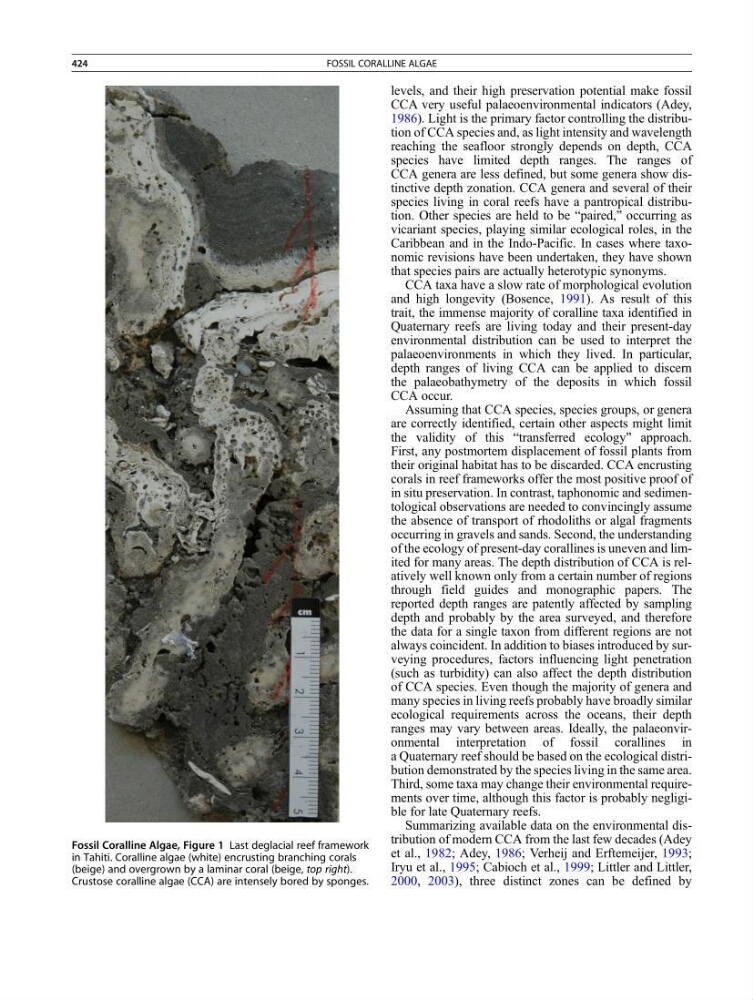
Fossil Coralline Algae, Figure 1 Last deglacial reef framework
in Tahiti. Coralline algae (white) encrusting branching corals
(beige) and overgrown by a laminar coral (beige, top right).
Crustose coralline algae (CCA) are intensely bored by sponges.
424
FOSSIL CORALLINE ALGAE
CCA very useful palaeoenvironmental indicators (Adey,
1986). Light is the primary factor controlling the distribution of CCA species and, as light intensity and wavelength
reaching the seafloor strongly depends on depth, CCA
species have limited depth ranges. The ranges of
CCA genera are less defined, but some genera show distinctive depth zonation. CCA genera and several of their
species living in coral reefs have a pantropical distribution. Other species are held to be “paired,” occurring as
vicariant species, playing similar ecological roles, in the
Caribbean and in the Indo-Pacific. In cases where taxonomic revisions have been undertaken, they have shown
that species pairs are actually heterotypic synonyms.
CCA taxa have a slow rate of morphological evolution
and high longevity (Bosence, 1991). As result of this
trait, the immense majority of coralline taxa identified in
Quaternary reefs are living today and their present-day
environmental distribution can be used to interpret the
palaeoenvironments in which they lived. In particular,
depth ranges of living CCA can be applied to discern
the palaeobathymetry of the deposits in which fossil
CCA occur.
Assuming that CCA species, species groups, or genera
are correctly identified, certain other aspects might limit
the validity of this “transferred ecology” approach.
First, any postmortem displacement of fossil plants from
their original habitat has to be discarded. CCA encrusting
corals in reef frameworks offer the most positive proof of
in situ preservation. In contrast, taphonomic and sedimentological observations are needed to convincingly assume
the absence of transport of rhodoliths or algal fragments
occurring in gravels and sands. Second, the understanding
of the ecology of present-day corallines is uneven and limited for many areas. The depth distribution of CCA is relatively well known only from a certain number of regions
through field guides and monographic papers. The
reported depth ranges are patently affected by sampling
depth and probably by the area surveyed, and therefore
the data for a single taxon from different regions are not
always coincident. In addition to biases introduced by surveying procedures, factors influencing light penetration
(such as turbidity) can also affect the depth distribution
of CCA species. Even though the majority of genera and
many species in living reefs probably have broadly similar
ecological requirements across the oceans, their depth
ranges may vary between areas. Ideally, the palaeonvironmental interpretation of fossil corallines in
a Quaternary reef should be based on the ecological distribution demonstrated by the species living in the same area.
Third, some taxa may change their environmental requirements over time, although this factor is probably negligible for late Quaternary reefs.
Summarizing available data on the environmental distribution of modern CCA from the last few decades (Adey
et al., 1982; Adey, 1986; Verheij and Erftemeijer, 1993;
Iryu et al., 1995; Cabioch et al., 1999; Littler and Littler,
2000, 2003), three distinct zones can be defined by
Fossil Coralline Algae, Figure 1 Last deglacial reef framework
in Tahiti. Coralline algae (white) encrusting branching corals
(beige) and overgrown by a laminar coral (beige, top right).
Crustose coralline algae (CCA) are intensely bored by sponges.
424
FOSSIL CORALLINE ALGAE