

warm, shallow, oligotrophic marine environments, where
food supply limits abundance and diversity of heterotrophic species (and therefore overall abundance and diversity), dominance by several algal symbiont-bearing
species often indicates high water quality. Higher overall
foraminiferal diversity and abundance indicates higher
nutrient flux, typically from terrestrial sources.
Conclusions
Reef-dwelling foraminiferal assemblages can be used as indicators of whether water quality supports prolific calcification
by symbiont-bearing organisms. However, the total influence of local, regional, and global environmental changes
associated with human activities impacts symbiont-bearing
taxa somewhat differently than reef-building corals. Thus,
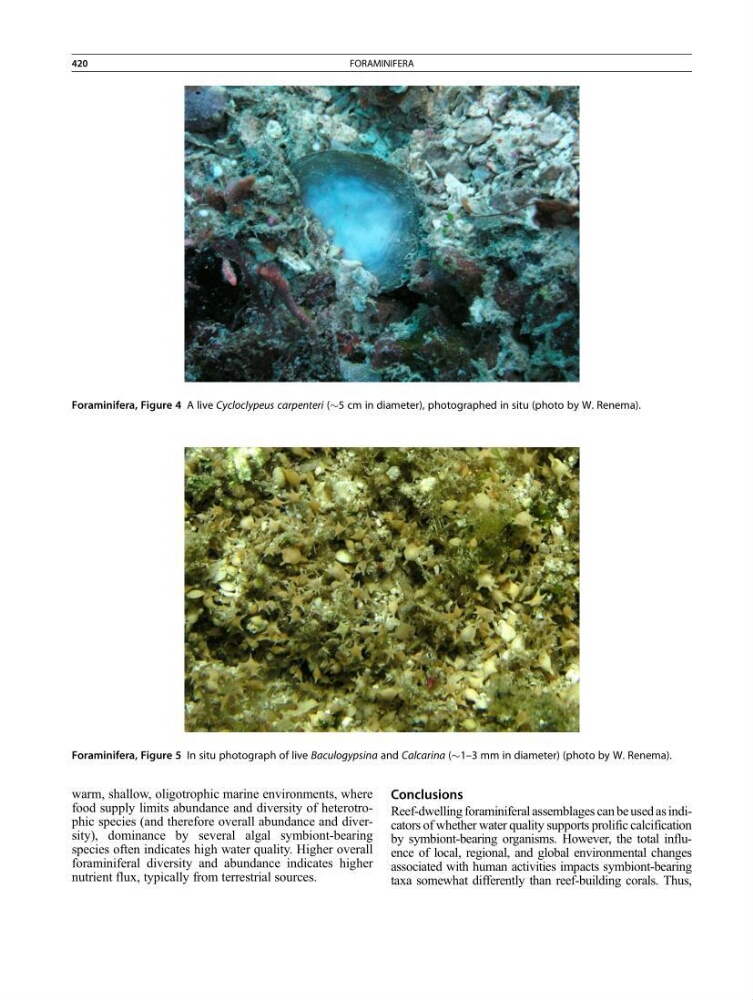
Foraminifera, Figure 4 A live Cycloclypeus carpenteri ($5 cm in diameter), photographed in situ (photo by W. Renema).
Foraminifera, Figure 5 In situ photograph of live Baculogypsina and Calcarina ($1–3 mm in diameter) (photo by W. Renema).
420
FORAMINIFERA
food supply limits abundance and diversity of heterotrophic species (and therefore overall abundance and diversity), dominance by several algal symbiont-bearing
species often indicates high water quality. Higher overall
foraminiferal diversity and abundance indicates higher
nutrient flux, typically from terrestrial sources.
Conclusions
Reef-dwelling foraminiferal assemblages can be used as indicators of whether water quality supports prolific calcification
by symbiont-bearing organisms. However, the total influence of local, regional, and global environmental changes
associated with human activities impacts symbiont-bearing
taxa somewhat differently than reef-building corals. Thus,
Foraminifera, Figure 4 A live Cycloclypeus carpenteri ($5 cm in diameter), photographed in situ (photo by W. Renema).
Foraminifera, Figure 5 In situ photograph of live Baculogypsina and Calcarina ($1–3 mm in diameter) (photo by W. Renema).
420
FORAMINIFERA