

environments in which adolescent and adult mortality are
low and access to sunlight is predictable (Hallock, 1985).
However, extreme specialization results in high potential
for extinction when environmental conditions change
(Hallock, 1987). Larger foraminiferal lineages, like other
major calcifying organisms, have diversified and suffered
extensive extinctions numerous times in Earth history
(Beavington-Penney and Racey, 2004).
A remarkable range of algae have been documented living symbiotically in members of modern families of
Miliolida (Lee, 2006). The superfamily Soritacea includes
one clade that hosts a rich diversity of dinoflagellate symbionts (Figure 1) similar to zooxanthellae found in reefbuilding corals (Pochon et al., 2007). A second clade hosts
chlorophyte (green algae) endosymbionts, while a third
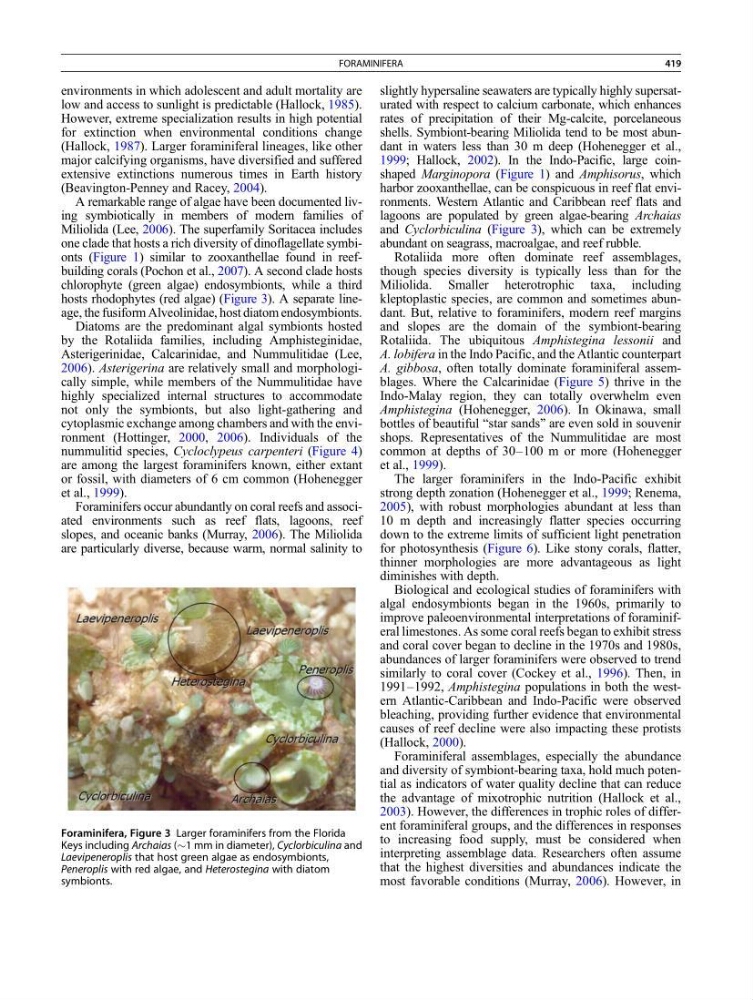
hosts rhodophytes (red algae) (Figure 3). A separate lineage, the fusiform Alveolinidae, host diatom endosymbionts.
Diatoms are the predominant algal symbionts hosted
by the Rotaliida families, including Amphisteginidae,
Asterigerinidae, Calcarinidae, and Nummulitidae (Lee,
2006). Asterigerina are relatively small and morphologically simple, while members of the Nummulitidae have
highly specialized internal structures to accommodate
not only the symbionts, but also light-gathering and
cytoplasmic exchange among chambers and with the environment (Hottinger, 2000, 2006). Individuals of the
nummulitid species, Cycloclypeus carpenteri (Figure 4)
are among the largest foraminifers known, either extant
or fossil, with diameters of 6 cm common (Hohenegger
et al., 1999).
Foraminifers occur abundantly on coral reefs and associated environments such as reef flats, lagoons, reef
slopes, and oceanic banks (Murray, 2006). The Miliolida
are particularly diverse, because warm, normal salinity to
slightly hypersaline seawaters are typically highly supersaturated with respect to calcium carbonate, which enhances
rates of precipitation of their Mg-calcite, porcelaneous
shells. Symbiont-bearing Miliolida tend to be most abundant in waters less than 30 m deep (Hohenegger et al.,
1999; Hallock, 2002). In the Indo-Pacific, large coinshaped Marginopora (Figure 1) and Amphisorus, which
harbor zooxanthellae, can be conspicuous in reef flat environments. Western Atlantic and Caribbean reef flats and
lagoons are populated by green algae-bearing Archaias
and Cyclorbiculina (Figure 3), which can be extremely
abundant on seagrass, macroalgae, and reef rubble.
Rotaliida more often dominate reef assemblages,
though species diversity is typically less than for the
Miliolida. Smaller heterotrophic taxa, including
kleptoplastic species, are common and sometimes abundant. But, relative to foraminifers, modern reef margins
and slopes are the domain of the symbiont-bearing
Rotaliida. The ubiquitous Amphistegina lessonii and
A. lobifera in the Indo Pacific, and the Atlantic counterpart
A. gibbosa, often totally dominate foraminiferal assemblages. Where the Calcarinidae (Figure 5) thrive in the
Indo-Malay region, they can totally overwhelm even
Amphistegina (Hohenegger, 2006). In Okinawa, small
bottles of beautiful “star sands” are even sold in souvenir
shops. Representatives of the Nummulitidae are most
common at depths of 30–100 m or more (Hohenegger
et al., 1999).
The larger foraminifers in the Indo-Pacific exhibit
strong depth zonation (Hohenegger et al., 1999; Renema,
2005), with robust morphologies abundant at less than
10 m depth and increasingly flatter species occurring
down to the extreme limits of sufficient light penetration
for photosynthesis (Figure 6). Like stony corals, flatter,
thinner morphologies are more advantageous as light
diminishes with depth.
Biological and ecological studies of foraminifers with
algal endosymbionts began in the 1960s, primarily to
improve paleoenvironmental interpretations of foraminiferal limestones. As some coral reefs began to exhibit stress
and coral cover began to decline in the 1970s and 1980s,
abundances of larger foraminifers were observed to trend
similarly to coral cover (Cockey et al., 1996). Then, in
1991–1992, Amphistegina populations in both the western Atlantic-Caribbean and Indo-Pacific were observed
bleaching, providing further evidence that environmental
causes of reef decline were also impacting these protists
(Hallock, 2000).
Foraminiferal assemblages, especially the abundance
and diversity of symbiont-bearing taxa, hold much potential as indicators of water quality decline that can reduce
the advantage of mixotrophic nutrition (Hallock et al.,
2003). However, the differences in trophic roles of different foraminiferal groups, and the differences in responses
to increasing food supply, must be considered when
interpreting assemblage data. Researchers often assume
that the highest diversities and abundances indicate the
most favorable conditions (Murray, 2006). However, in
Foraminifera, Figure 3 Larger foraminifers from the Florida
Keys including Archaias ($1 mm in diameter), Cyclorbiculina and
Laevipeneroplis that host green algae as endosymbionts,
Peneroplis with red algae, and Heterostegina with diatom
symbionts.
FORAMINIFERA
419
low and access to sunlight is predictable (Hallock, 1985).
However, extreme specialization results in high potential
for extinction when environmental conditions change
(Hallock, 1987). Larger foraminiferal lineages, like other
major calcifying organisms, have diversified and suffered
extensive extinctions numerous times in Earth history
(Beavington-Penney and Racey, 2004).
A remarkable range of algae have been documented living symbiotically in members of modern families of
Miliolida (Lee, 2006). The superfamily Soritacea includes
one clade that hosts a rich diversity of dinoflagellate symbionts (Figure 1) similar to zooxanthellae found in reefbuilding corals (Pochon et al., 2007). A second clade hosts
chlorophyte (green algae) endosymbionts, while a third
hosts rhodophytes (red algae) (Figure 3). A separate lineage, the fusiform Alveolinidae, host diatom endosymbionts.
Diatoms are the predominant algal symbionts hosted
by the Rotaliida families, including Amphisteginidae,
Asterigerinidae, Calcarinidae, and Nummulitidae (Lee,
2006). Asterigerina are relatively small and morphologically simple, while members of the Nummulitidae have
highly specialized internal structures to accommodate
not only the symbionts, but also light-gathering and
cytoplasmic exchange among chambers and with the environment (Hottinger, 2000, 2006). Individuals of the
nummulitid species, Cycloclypeus carpenteri (Figure 4)
are among the largest foraminifers known, either extant
or fossil, with diameters of 6 cm common (Hohenegger
et al., 1999).
Foraminifers occur abundantly on coral reefs and associated environments such as reef flats, lagoons, reef
slopes, and oceanic banks (Murray, 2006). The Miliolida
are particularly diverse, because warm, normal salinity to
slightly hypersaline seawaters are typically highly supersaturated with respect to calcium carbonate, which enhances
rates of precipitation of their Mg-calcite, porcelaneous
shells. Symbiont-bearing Miliolida tend to be most abundant in waters less than 30 m deep (Hohenegger et al.,
1999; Hallock, 2002). In the Indo-Pacific, large coinshaped Marginopora (Figure 1) and Amphisorus, which
harbor zooxanthellae, can be conspicuous in reef flat environments. Western Atlantic and Caribbean reef flats and
lagoons are populated by green algae-bearing Archaias
and Cyclorbiculina (Figure 3), which can be extremely
abundant on seagrass, macroalgae, and reef rubble.
Rotaliida more often dominate reef assemblages,
though species diversity is typically less than for the
Miliolida. Smaller heterotrophic taxa, including
kleptoplastic species, are common and sometimes abundant. But, relative to foraminifers, modern reef margins
and slopes are the domain of the symbiont-bearing
Rotaliida. The ubiquitous Amphistegina lessonii and
A. lobifera in the Indo Pacific, and the Atlantic counterpart
A. gibbosa, often totally dominate foraminiferal assemblages. Where the Calcarinidae (Figure 5) thrive in the
Indo-Malay region, they can totally overwhelm even
Amphistegina (Hohenegger, 2006). In Okinawa, small
bottles of beautiful “star sands” are even sold in souvenir
shops. Representatives of the Nummulitidae are most
common at depths of 30–100 m or more (Hohenegger
et al., 1999).
The larger foraminifers in the Indo-Pacific exhibit
strong depth zonation (Hohenegger et al., 1999; Renema,
2005), with robust morphologies abundant at less than
10 m depth and increasingly flatter species occurring
down to the extreme limits of sufficient light penetration
for photosynthesis (Figure 6). Like stony corals, flatter,
thinner morphologies are more advantageous as light
diminishes with depth.
Biological and ecological studies of foraminifers with
algal endosymbionts began in the 1960s, primarily to
improve paleoenvironmental interpretations of foraminiferal limestones. As some coral reefs began to exhibit stress
and coral cover began to decline in the 1970s and 1980s,
abundances of larger foraminifers were observed to trend
similarly to coral cover (Cockey et al., 1996). Then, in
1991–1992, Amphistegina populations in both the western Atlantic-Caribbean and Indo-Pacific were observed
bleaching, providing further evidence that environmental
causes of reef decline were also impacting these protists
(Hallock, 2000).
Foraminiferal assemblages, especially the abundance
and diversity of symbiont-bearing taxa, hold much potential as indicators of water quality decline that can reduce
the advantage of mixotrophic nutrition (Hallock et al.,
2003). However, the differences in trophic roles of different foraminiferal groups, and the differences in responses
to increasing food supply, must be considered when
interpreting assemblage data. Researchers often assume
that the highest diversities and abundances indicate the
most favorable conditions (Murray, 2006). However, in
Foraminifera, Figure 3 Larger foraminifers from the Florida
Keys including Archaias ($1 mm in diameter), Cyclorbiculina and
Laevipeneroplis that host green algae as endosymbionts,
Peneroplis with red algae, and Heterostegina with diatom
symbionts.
FORAMINIFERA
419