

resources for metabolism and carbon-intensive processes
such as mucus secretion, shell-matrix production, and lipids
needed for reproduction. The few food particles the host can
capture can primarily be used for the host’s growth and
reproduction, with only limited amount of nitrogenous
wastes being released to the algal symbionts. Thus,
a mixotrophic holobiont has access to literally orders of
magnitude more fixed carbon than purely heterotrophic
organisms in the same environment (Hallock, 1981).
Thanks to the tremendous energetic advantage of
algal symbiosis, lineages of highly specialized foraminifers have evolved in mid to low-latitude reef, shelf, and
bank environments several times in geologic history
(Beavington-Penney and Racey, 2004). The shells of such
foraminifers have been important producers of carbonate
sediments over the past 50 million years, typically associated with coralline red algae, and often with calcareous
green algae and scleractinian corals or bryozoans (Pomar
and Hallock, 2008). The most famous foraminiferal accumulations are the Eocene Nummulitic Limestones of
Egypt, from which the pyramids were built. Similar limestones are present worldwide, where they include major
aquifers and hydrocarbon reservoirs.
The algal symbiont-bearing foraminifers are often
referred to as larger benthic foraminifers because many
species, both extinct and extant, attained exceptionally
large adult sizes, in a few cases exceeding 10 cm in maximum diameter (Hallock, 2002). Growth and calcification
of substantial-sized shells over periods of months to years
can only be sustained by relatively predictable
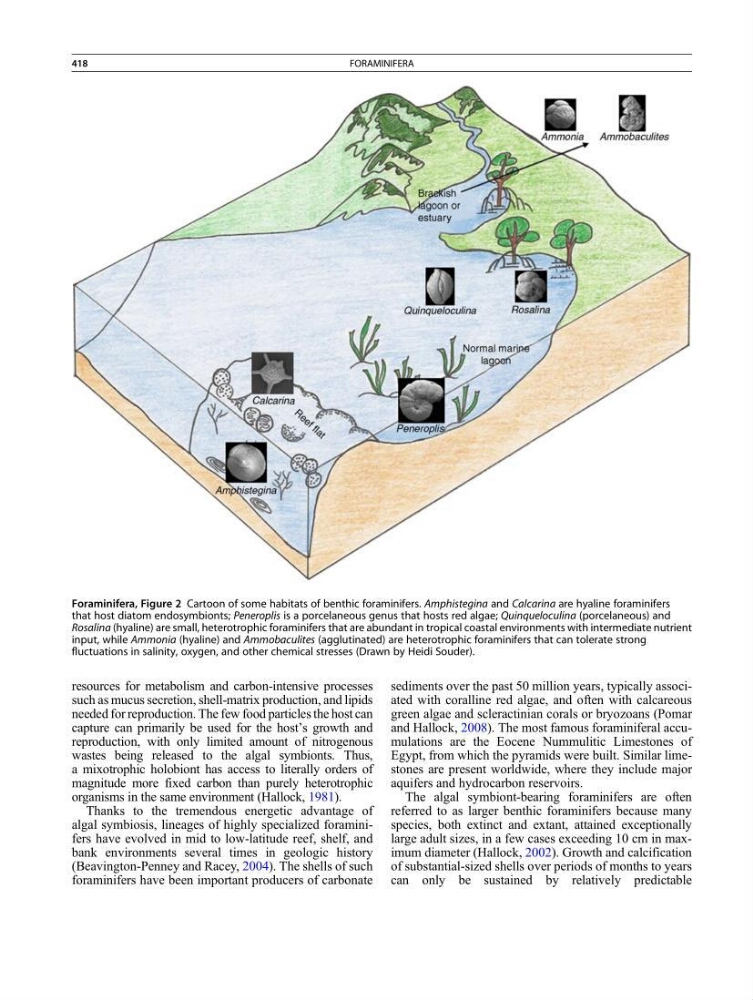
Foraminifera, Figure 2 Cartoon of some habitats of benthic foraminifers. Amphistegina and Calcarina are hyaline foraminifers
that host diatom endosymbionts; Peneroplis is a porcelaneous genus that hosts red algae; Quinqueloculina (porcelaneous) and
Rosalina (hyaline) are small, heterotrophic foraminifers that are abundant in tropical coastal environments with intermediate nutrient
input, while Ammonia (hyaline) and Ammobaculites (agglutinated) are heterotrophic foraminifers that can tolerate strong
fluctuations in salinity, oxygen, and other chemical stresses (Drawn by Heidi Souder).
418
FORAMINIFERA
such as mucus secretion, shell-matrix production, and lipids
needed for reproduction. The few food particles the host can
capture can primarily be used for the host’s growth and
reproduction, with only limited amount of nitrogenous
wastes being released to the algal symbionts. Thus,
a mixotrophic holobiont has access to literally orders of
magnitude more fixed carbon than purely heterotrophic
organisms in the same environment (Hallock, 1981).
Thanks to the tremendous energetic advantage of
algal symbiosis, lineages of highly specialized foraminifers have evolved in mid to low-latitude reef, shelf, and
bank environments several times in geologic history
(Beavington-Penney and Racey, 2004). The shells of such
foraminifers have been important producers of carbonate
sediments over the past 50 million years, typically associated with coralline red algae, and often with calcareous
green algae and scleractinian corals or bryozoans (Pomar
and Hallock, 2008). The most famous foraminiferal accumulations are the Eocene Nummulitic Limestones of
Egypt, from which the pyramids were built. Similar limestones are present worldwide, where they include major
aquifers and hydrocarbon reservoirs.
The algal symbiont-bearing foraminifers are often
referred to as larger benthic foraminifers because many
species, both extinct and extant, attained exceptionally
large adult sizes, in a few cases exceeding 10 cm in maximum diameter (Hallock, 2002). Growth and calcification
of substantial-sized shells over periods of months to years
can only be sustained by relatively predictable
Foraminifera, Figure 2 Cartoon of some habitats of benthic foraminifers. Amphistegina and Calcarina are hyaline foraminifers
that host diatom endosymbionts; Peneroplis is a porcelaneous genus that hosts red algae; Quinqueloculina (porcelaneous) and
Rosalina (hyaline) are small, heterotrophic foraminifers that are abundant in tropical coastal environments with intermediate nutrient
input, while Ammonia (hyaline) and Ammobaculites (agglutinated) are heterotrophic foraminifers that can tolerate strong
fluctuations in salinity, oxygen, and other chemical stresses (Drawn by Heidi Souder).
418
FORAMINIFERA