

Behind the shelf edge, the spur-and-groove system consists of coral zonations (Figure 3a), features that differ
from those of the pure A. palmata shelf-edge spurs.
Zonations result from reef efforts to keep pace with both
rising sea level and associated changing wave energy.
Deeper water head corals, especially the boulder-coral
species Montastraea annularis, typically first colonized
this type of reef. Their skeletons now form the deepest,
most seaward zone (Shinn, 1980). A shallower zone of
landward-oriented A. palmata followed. Orientation is
a response to constant unidirectional high-energy sea
swells and waves. Unoriented corals cannot survive in surf
because of physical breakage. The third zone is
a landward reef flat with unoriented A. palmata that
grew to spring low tide. The most landward zone is
a quiet-water back reef that harbors skeletal colonies of
unoriented A. palmata, massive species (Montastraea
annularis, Diploria strigosa, and Colpophyllia natans),
and forests of branching A. cervicornis. Though not necessarily of coral zonations, similar classes (fore reef, reef
crest, reef flat, back reef ) are found at different depths
on most Holocene outer-shelf reefs and are also present
in the Holocene record on the largest and most seaward
of the lower Keys outlier reefs.
The dominant type (head or branching) and species of
coral skeletons in an area are proxies for ambient conditions when the corals were alive. In Florida Keys reefs,
massive head corals characterize the Pleistocene, implying quiescent, protected, or deeper water. The promontory
landmass was the key (protective) element. Montastraea
annularis is the dominant species. Branching corals typify
the early Holocene, implying active surf. Acropora
palmata dominated then but is rarely found alive today.
Key Holocene events and effects
Rising Holocene sea level generated two respective
opposing processes (deposition and erosion) of different
durations ($7 and $4 ka) at different locations (shelf
edge and near shore). Two geomorphic structures unique
to the Keys windward-margin record resulted: an
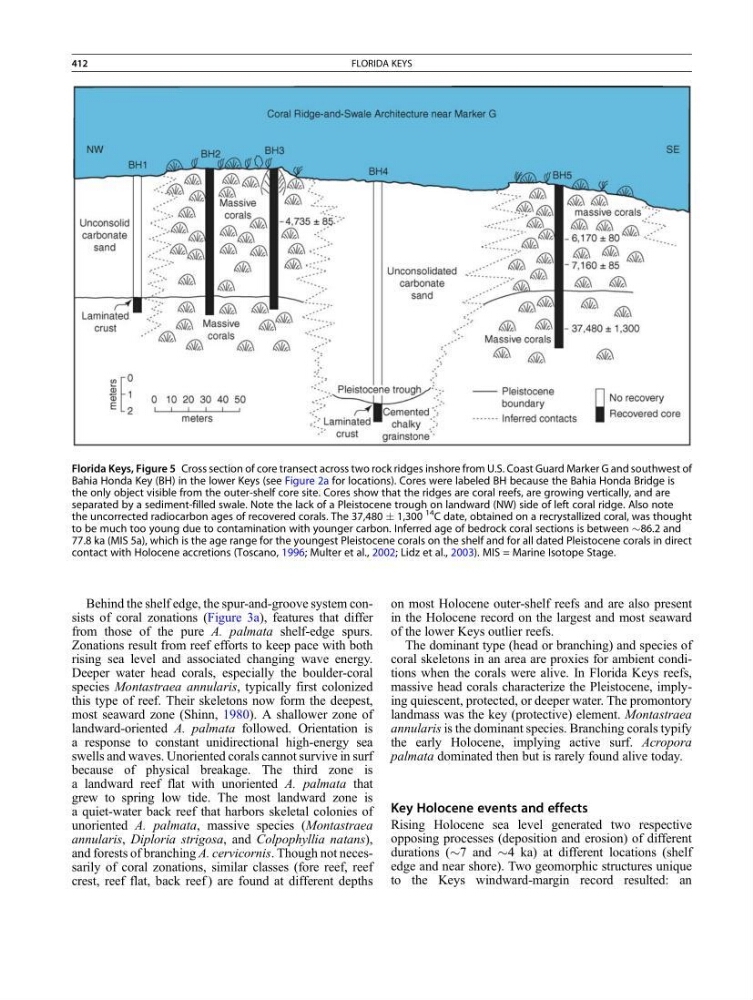
Florida Keys, Figure 5 Cross section of core transect across two rock ridges inshore from U.S. Coast Guard Marker G and southwest of
Bahia Honda Key (BH) in the lower Keys (see Figure 2a for locations). Cores were labeled BH because the Bahia Honda Bridge is
the only object visible from the outer-shelf core site. Cores show that the ridges are coral reefs, are growing vertically, and are
separated by a sediment-filled swale. Note the lack of a Pleistocene trough on landward (NW) side of left coral ridge. Also note
the uncorrected radiocarbon ages of recovered corals. The 37,480 Æ 1,300
14 C date, obtained on a recrystallized coral, was thought
to be much too young due to contamination with younger carbon. Inferred age of bedrock coral sections is between $86.2 and
77.8 ka (MIS 5a), which is the age range for the youngest Pleistocene corals on the shelf and for all dated Pleistocene corals in direct
contact with Holocene accretions (Toscano, 1996; Multer et al., 2002; Lidz et al., 2003). MIS = Marine Isotope Stage.
412
FLORIDA KEYS
from those of the pure A. palmata shelf-edge spurs.
Zonations result from reef efforts to keep pace with both
rising sea level and associated changing wave energy.
Deeper water head corals, especially the boulder-coral
species Montastraea annularis, typically first colonized
this type of reef. Their skeletons now form the deepest,
most seaward zone (Shinn, 1980). A shallower zone of
landward-oriented A. palmata followed. Orientation is
a response to constant unidirectional high-energy sea
swells and waves. Unoriented corals cannot survive in surf
because of physical breakage. The third zone is
a landward reef flat with unoriented A. palmata that
grew to spring low tide. The most landward zone is
a quiet-water back reef that harbors skeletal colonies of
unoriented A. palmata, massive species (Montastraea
annularis, Diploria strigosa, and Colpophyllia natans),
and forests of branching A. cervicornis. Though not necessarily of coral zonations, similar classes (fore reef, reef
crest, reef flat, back reef ) are found at different depths
on most Holocene outer-shelf reefs and are also present
in the Holocene record on the largest and most seaward
of the lower Keys outlier reefs.
The dominant type (head or branching) and species of
coral skeletons in an area are proxies for ambient conditions when the corals were alive. In Florida Keys reefs,
massive head corals characterize the Pleistocene, implying quiescent, protected, or deeper water. The promontory
landmass was the key (protective) element. Montastraea
annularis is the dominant species. Branching corals typify
the early Holocene, implying active surf. Acropora
palmata dominated then but is rarely found alive today.
Key Holocene events and effects
Rising Holocene sea level generated two respective
opposing processes (deposition and erosion) of different
durations ($7 and $4 ka) at different locations (shelf
edge and near shore). Two geomorphic structures unique
to the Keys windward-margin record resulted: an
Florida Keys, Figure 5 Cross section of core transect across two rock ridges inshore from U.S. Coast Guard Marker G and southwest of
Bahia Honda Key (BH) in the lower Keys (see Figure 2a for locations). Cores were labeled BH because the Bahia Honda Bridge is
the only object visible from the outer-shelf core site. Cores show that the ridges are coral reefs, are growing vertically, and are
separated by a sediment-filled swale. Note the lack of a Pleistocene trough on landward (NW) side of left coral ridge. Also note
the uncorrected radiocarbon ages of recovered corals. The 37,480 Æ 1,300
14 C date, obtained on a recrystallized coral, was thought
to be much too young due to contamination with younger carbon. Inferred age of bedrock coral sections is between $86.2 and
77.8 ka (MIS 5a), which is the age range for the youngest Pleistocene corals on the shelf and for all dated Pleistocene corals in direct
contact with Holocene accretions (Toscano, 1996; Multer et al., 2002; Lidz et al., 2003). MIS = Marine Isotope Stage.
412
FLORIDA KEYS