

normal seasonal changes in the environment; shuffling
between different clades of symbionts already in the coral,
in response to more extreme environmental fluctuations;
taking on new symbiont clades from the water column,
after bleaching caused by severe stress. In the latter case,
the switch to different symbionts may be a temporary
response to severe stress, with reversion to normal symbiont populations following a return to normal conditions.
There are tradeoffs between high growth and reproduction versus slow growth and stress resistance that affect
the bleaching response of corals, illustrating the adaptive
dimensions of bleaching. Corals characterized by rapid
growth and reproduction and thin coral tissues tend to
bleach and die at lower levels of stress (e.g., Acropora,
Pocillopora), while those characterized by slow growth
and thick coral tissues tend to bleach and survive at higher
levels of environmental stress (e.g., Porites) (Loya et al.,
2001). Greater tissue thickness and larger polyp size may
be adaptive through their shading of zooxanthellae, ameliorating stress from high light and temperatures.
Long-term change
Global climate change (Climate Change and Coral Reefs)
is proceeding in multiple environmental parameters critical to coral growth and survival. Water temperature and
acidification of ocean waters are two of the fundamental
ones (Hoegh-Guldberg et al., 2008), in addition to many
others such as changes in sea level, storm tracks, wave
regimes, precipitation, and terrestrial runoff that will affect
reef growth. The ability of corals and zooxanthellae to
adapt to the changes in these basic environmental parameters will fundamentally affect their ability to continue to
grow and build reef structures.
Increases in the frequency and severity of coral
bleaching events globally are an indicator of water temperatures exceeding the temperature envelopes to which
corals are historically adapted. The adaptive potential
of bleaching and other regulatory processes is currently
unknown (Hughes et al., 2003), however the adaptive
basis for coral bleaching explained above, and scenarios
for the degree of adaptation needed for corals to survive
future change (Donner, 2009), provide tools for understanding this process as it unfolds. The adaptive potential
of corals to seawater acidification is less known than that
for temperature, and as a basic chemical parameter controlling calcification it may be that there is very little ability for corals and other calcifying marine organisms to
adapt to more acidic conditions (Ocean Acidification,
Effects on Calcification). In this time of global change,
the adaptive capacity of corals will be a critical feature in
determining how reef ecosystems respond to change.
Bibliography
Brown, B. E., 1997. Adaptations of reef corals to physical environmental stress. Advances in Marine Biology, 31, 220–299.
Buddemeier, R., and Fautin, D.,1993. Coral bleaching as an adaptive mechanism. Bioscience, 43, 320–326.
Coles, S., and Brown, B. E., 2003. Coral bleaching – capacity for
acclimatization and adaptation. Advances in Marine Biology,
46, 183–224.
Darwin, C. R., 1856. On the origin of species by means of natural
selection, or the preservation of favoured races in the struggle
for life. London: Murray.
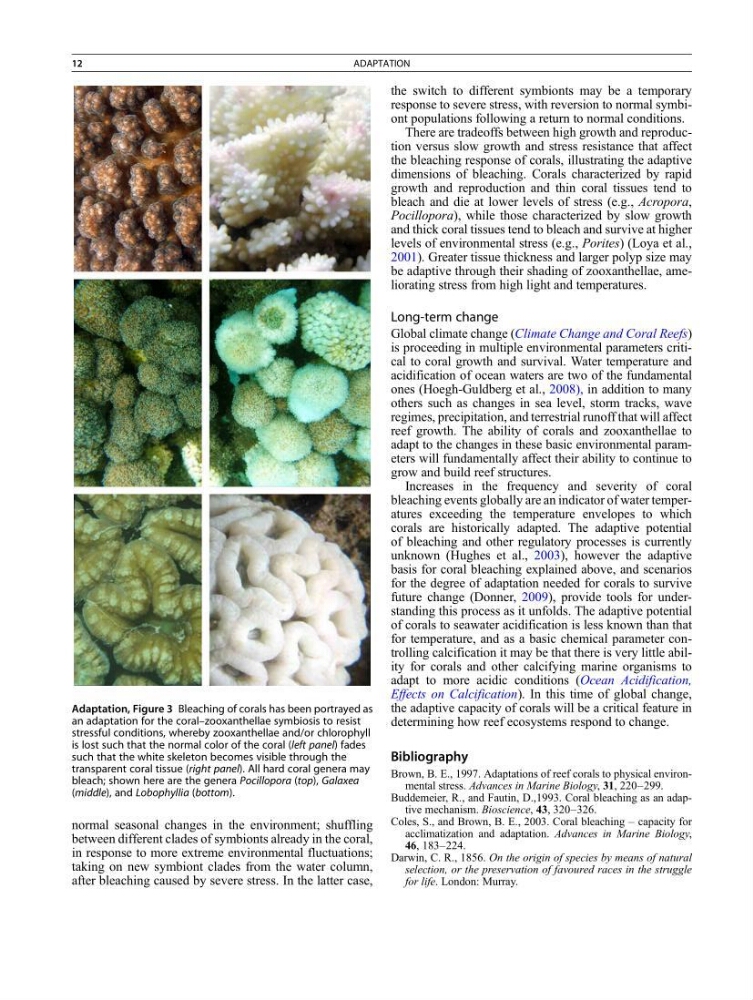
Adaptation, Figure 3 Bleaching of corals has been portrayed as
an adaptation for the coral–zooxanthellae symbiosis to resist
stressful conditions, whereby zooxanthellae and/or chlorophyll
is lost such that the normal color of the coral (left panel) fades
such that the white skeleton becomes visible through the
transparent coral tissue (right panel). All hard coral genera may
bleach; shown here are the genera Pocillopora (top), Galaxea
(middle), and Lobophyllia (bottom).
12
ADAPTATION
between different clades of symbionts already in the coral,
in response to more extreme environmental fluctuations;
taking on new symbiont clades from the water column,
after bleaching caused by severe stress. In the latter case,
the switch to different symbionts may be a temporary
response to severe stress, with reversion to normal symbiont populations following a return to normal conditions.
There are tradeoffs between high growth and reproduction versus slow growth and stress resistance that affect
the bleaching response of corals, illustrating the adaptive
dimensions of bleaching. Corals characterized by rapid
growth and reproduction and thin coral tissues tend to
bleach and die at lower levels of stress (e.g., Acropora,
Pocillopora), while those characterized by slow growth
and thick coral tissues tend to bleach and survive at higher
levels of environmental stress (e.g., Porites) (Loya et al.,
2001). Greater tissue thickness and larger polyp size may
be adaptive through their shading of zooxanthellae, ameliorating stress from high light and temperatures.
Long-term change
Global climate change (Climate Change and Coral Reefs)
is proceeding in multiple environmental parameters critical to coral growth and survival. Water temperature and
acidification of ocean waters are two of the fundamental
ones (Hoegh-Guldberg et al., 2008), in addition to many
others such as changes in sea level, storm tracks, wave
regimes, precipitation, and terrestrial runoff that will affect
reef growth. The ability of corals and zooxanthellae to
adapt to the changes in these basic environmental parameters will fundamentally affect their ability to continue to
grow and build reef structures.
Increases in the frequency and severity of coral
bleaching events globally are an indicator of water temperatures exceeding the temperature envelopes to which
corals are historically adapted. The adaptive potential
of bleaching and other regulatory processes is currently
unknown (Hughes et al., 2003), however the adaptive
basis for coral bleaching explained above, and scenarios
for the degree of adaptation needed for corals to survive
future change (Donner, 2009), provide tools for understanding this process as it unfolds. The adaptive potential
of corals to seawater acidification is less known than that
for temperature, and as a basic chemical parameter controlling calcification it may be that there is very little ability for corals and other calcifying marine organisms to
adapt to more acidic conditions (Ocean Acidification,
Effects on Calcification). In this time of global change,
the adaptive capacity of corals will be a critical feature in
determining how reef ecosystems respond to change.
Bibliography
Brown, B. E., 1997. Adaptations of reef corals to physical environmental stress. Advances in Marine Biology, 31, 220–299.
Buddemeier, R., and Fautin, D.,1993. Coral bleaching as an adaptive mechanism. Bioscience, 43, 320–326.
Coles, S., and Brown, B. E., 2003. Coral bleaching – capacity for
acclimatization and adaptation. Advances in Marine Biology,
46, 183–224.
Darwin, C. R., 1856. On the origin of species by means of natural
selection, or the preservation of favoured races in the struggle
for life. London: Murray.
Adaptation, Figure 3 Bleaching of corals has been portrayed as
an adaptation for the coral–zooxanthellae symbiosis to resist
stressful conditions, whereby zooxanthellae and/or chlorophyll
is lost such that the normal color of the coral (left panel) fades
such that the white skeleton becomes visible through the
transparent coral tissue (right panel). All hard coral genera may
bleach; shown here are the genera Pocillopora (top), Galaxea
(middle), and Lobophyllia (bottom).
12
ADAPTATION