

between the two, differs, reflecting adaptations to different
environments and ecological niches.
At the organismal level, a classic example of the adaptability of corals is in the diverse growth forms possible in some species. For example, growth form may
vary depending on hydrodynamics (affecting how robust
the skeleton must be) or light and sediment regimes (affecting shape, orientation, and self-shading (Corals: Environmental Controls on Growth). Pocillopora damicornis is
a fast-growing, opportunistic, branching coral species that
illustrates this well (Figure 2): individuals growing in calm
and light-limited conditions may have very fine branches
(no selection for robust growth but strong selection to
minimize self-shading) while individuals of the same species in rough, well-illuminated environments may have
very robust branches (resistant to breakage, no need to minimize shading effects). Individual colonies from the
extremes of these distributions may appear so different that
without intermediate growth forms being known, these
may appear to be separate species (Veron, 2000). Further
adaptations of growth form can relate to, for example, sediment shedding in high-sediment conditions.
The ability of coral holobionts to calcify extremely efficiently and thereby produce durable skeletons has enabled
successive generations to colonize the skeletons left
by previous generations and thereby raise up above the substrate resulting in reef construction over time (Coral Reef,
Definition). The specific growth forms and other adaptations of the dominant corals in these communities affect
the morphology and development of Reef Structure. Over
geological history different but functionally equivalent
symbioses have recurred: rugose corals in the Palaeozoic;
rudist bivalves in the Cretaceous; scleractinian corals in
the Cenozoic. The fossil reefs they have left behind show
characteristic adaptations to the periods in which they lived.
Current investigations, controversies, and gaps
in current knowledge
Coral bleaching
The life history of symbiotic corals and the as-yet incompletely understood phenomenon of coral bleaching
(Temperature Change: Bleaching) provide an interesting
case study of adaptation in action. As currently understood, the coral host provides a safe habitat and nutrients
to the endosymbiotic algae. They in turn contribute to
a range of the coral host’s physiological processes by
transferring energy from sunlight in the form of fixed carbon, and chemically facilitating a variety of intracellular
processes, such as calcification (Muscatine, 1990).
The symbiosis is obligate because coral species that are
symbiotic do not successfully compete in nature when
asymbiotic. However, the symbiosis can be disrupted
temporarily as happens under stress (e.g., heat, cold,
hyposalinity) when the symbionts part company and the
coral “bleaches,” or turns white (Figure 3). This occurs
by a reduction in the photosynthetic capacity of the
holobiont (by reduction in cholorophyll concentration in
individual symbionts, and/or by reduction in symbiont
densities), primarily to counter the damaging effects of
overproduction of free oxygen radicals by the symbionts.
As a stress response, bleaching must have some capacity for acclimatization and adaptation (Coles and Brown,
2003; Obura, 2009). The Adaptive Bleaching Hypothesis
first expressed this idea as a mechanism that allows coral
symbionts to adapt to changing environmental conditions
(Buddemeier and Fautin, 1993), a position countered by
other on the grounds of insufficient evidence (HoeghGuldberg, 2005). Further advances in the field may come
through seeing bleaching as an extreme state of a range of
symbiotic responses to changing environmental conditions (Obura, 2009). These include, from least to most
severe: fluctuating symbiont densities, such as occur under
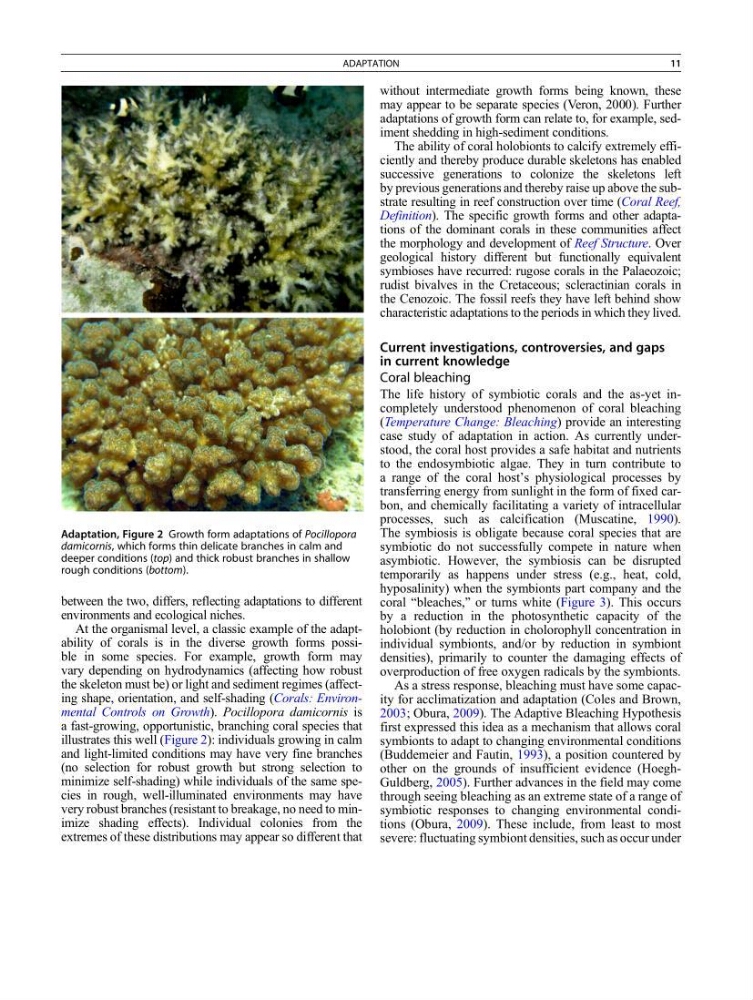
Adaptation, Figure 2 Growth form adaptations of Pocillopora
damicornis, which forms thin delicate branches in calm and
deeper conditions (top) and thick robust branches in shallow
rough conditions (bottom).
ADAPTATION
11
environments and ecological niches.
At the organismal level, a classic example of the adaptability of corals is in the diverse growth forms possible in some species. For example, growth form may
vary depending on hydrodynamics (affecting how robust
the skeleton must be) or light and sediment regimes (affecting shape, orientation, and self-shading (Corals: Environmental Controls on Growth). Pocillopora damicornis is
a fast-growing, opportunistic, branching coral species that
illustrates this well (Figure 2): individuals growing in calm
and light-limited conditions may have very fine branches
(no selection for robust growth but strong selection to
minimize self-shading) while individuals of the same species in rough, well-illuminated environments may have
very robust branches (resistant to breakage, no need to minimize shading effects). Individual colonies from the
extremes of these distributions may appear so different that
without intermediate growth forms being known, these
may appear to be separate species (Veron, 2000). Further
adaptations of growth form can relate to, for example, sediment shedding in high-sediment conditions.
The ability of coral holobionts to calcify extremely efficiently and thereby produce durable skeletons has enabled
successive generations to colonize the skeletons left
by previous generations and thereby raise up above the substrate resulting in reef construction over time (Coral Reef,
Definition). The specific growth forms and other adaptations of the dominant corals in these communities affect
the morphology and development of Reef Structure. Over
geological history different but functionally equivalent
symbioses have recurred: rugose corals in the Palaeozoic;
rudist bivalves in the Cretaceous; scleractinian corals in
the Cenozoic. The fossil reefs they have left behind show
characteristic adaptations to the periods in which they lived.
Current investigations, controversies, and gaps
in current knowledge
Coral bleaching
The life history of symbiotic corals and the as-yet incompletely understood phenomenon of coral bleaching
(Temperature Change: Bleaching) provide an interesting
case study of adaptation in action. As currently understood, the coral host provides a safe habitat and nutrients
to the endosymbiotic algae. They in turn contribute to
a range of the coral host’s physiological processes by
transferring energy from sunlight in the form of fixed carbon, and chemically facilitating a variety of intracellular
processes, such as calcification (Muscatine, 1990).
The symbiosis is obligate because coral species that are
symbiotic do not successfully compete in nature when
asymbiotic. However, the symbiosis can be disrupted
temporarily as happens under stress (e.g., heat, cold,
hyposalinity) when the symbionts part company and the
coral “bleaches,” or turns white (Figure 3). This occurs
by a reduction in the photosynthetic capacity of the
holobiont (by reduction in cholorophyll concentration in
individual symbionts, and/or by reduction in symbiont
densities), primarily to counter the damaging effects of
overproduction of free oxygen radicals by the symbionts.
As a stress response, bleaching must have some capacity for acclimatization and adaptation (Coles and Brown,
2003; Obura, 2009). The Adaptive Bleaching Hypothesis
first expressed this idea as a mechanism that allows coral
symbionts to adapt to changing environmental conditions
(Buddemeier and Fautin, 1993), a position countered by
other on the grounds of insufficient evidence (HoeghGuldberg, 2005). Further advances in the field may come
through seeing bleaching as an extreme state of a range of
symbiotic responses to changing environmental conditions (Obura, 2009). These include, from least to most
severe: fluctuating symbiont densities, such as occur under
Adaptation, Figure 2 Growth form adaptations of Pocillopora
damicornis, which forms thin delicate branches in calm and
deeper conditions (top) and thick robust branches in shallow
rough conditions (bottom).
ADAPTATION
11