

herbivores with hard fused teeth that can graze algal
crusts, fish with long tubular mouths for sucking polyp
tissue out of a coral skeleton, or top predators with needle-sharp pointed teeth for grabbing fast swimming
prey and holding it until it can be torn and swallowed.
Defense mechanisms may be even more numerous
including chemical defenses of unpalatable algae and
invertebrates that produce toxins, hard-shelled defenses
such as in snails and crustaceans, or mimicry by palatable species of unpalatable or poisonous species often
in completely different taxonomic groups;
3. Mutualisms: With limited space on a coral reef, numerous organisms adapt to live together cooperatively, in
stark contrast to predator–prey or competitive interactions, in which one wins over the other. Many species
live in or on one another, such as many types of crustaceans and anemones living on anemones and hard and
soft corals, or fish and shrimp that share skills to build,
maintain, and defend a burrow, or of microscopic
single-celled algae such as zooxanthellae living in the tissue of a host such as a coral, to the mutual benefit of both.
Coral–zooxanthellae symbiosis as an illustration of
adaptation
The symbiosis between corals (the host, a sessile
macroinvertebrate) and its zooxanthellae (the endosymbiont, an autotrophic single-celled algae) is the example par
excellence of a type of partnership that has recurred among
different partners in shallow tropical seas for hundreds of
millions of years. The host is attached (sessile) on a shallow
bottom, providing a sheltered nutrient-rich microhabitat in
the photic zone for the endosymbiont. The endosymbiont
fixes energy of sunlight into carbohydrates, which are
passed to the host for consumption, and may also enhance
the intracellular chemical environment for cellular processes of the host, such as calcification (Corals: Biology,
Skeletal Deposition, and Reef-Building). The adaptations
enabled by this symbiosis can be illustrated at physiological, organismal, and ecological–geological scales.
Because the symbiosis combines two organisms –
a photosynthetic algae and a consumer animal – two
forms of energy capture and nutrition are possible. Under
low-nutrient, high light conditions, photosynthesis is maximized, tight nutrient-cycling between the symbiotic partners enables growth in both, and autotrophy is the
dominant mode of energy capture for the holobiont.
By contrast, in highly turbid environments with limited
light, heterotrophy by the coral predominates. Under these
conditions feeding by the coral on plankton, detritus, and
dissolved organic matter (Corals: Environmental Controls
on Growth) may compensate for limited autotrophy and
enable corals to thrive. The reliance of different coral species
on autotrophy vs. heterotrophy, and their ability to shift
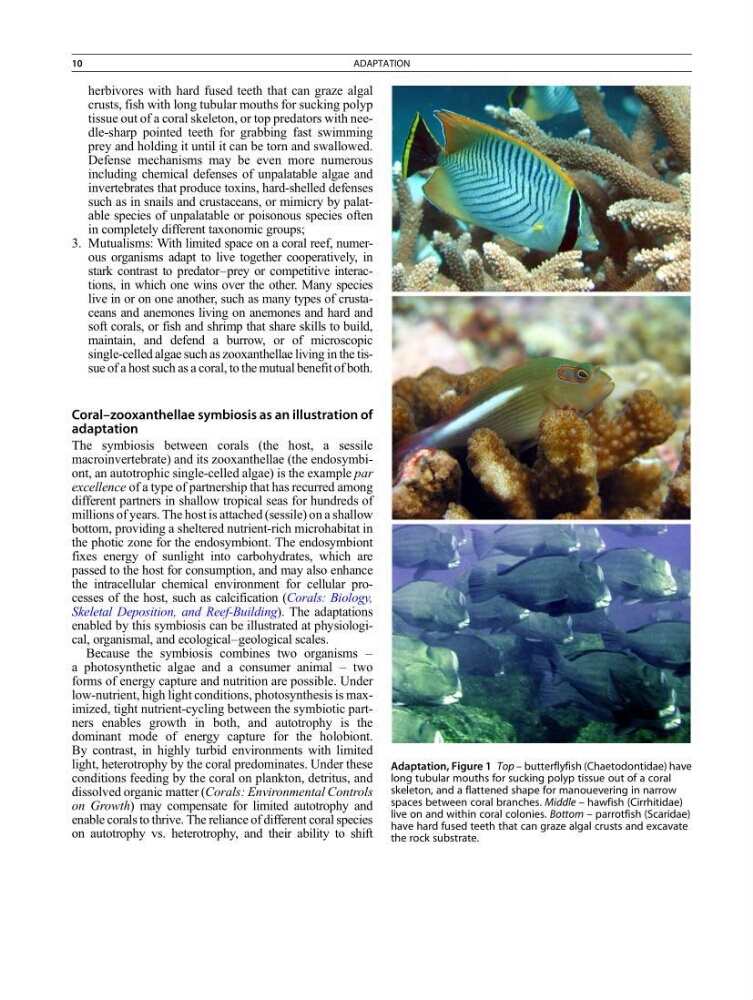
Adaptation, Figure 1 Top – butterflyfish (Chaetodontidae) have
long tubular mouths for sucking polyp tissue out of a coral
skeleton, and a flattened shape for manouevering in narrow
spaces between coral branches. Middle – hawfish (Cirrhitidae)
live on and within coral colonies. Bottom – parrotfish (Scaridae)
have hard fused teeth that can graze algal crusts and excavate
the rock substrate.
10
ADAPTATION
crusts, fish with long tubular mouths for sucking polyp
tissue out of a coral skeleton, or top predators with needle-sharp pointed teeth for grabbing fast swimming
prey and holding it until it can be torn and swallowed.
Defense mechanisms may be even more numerous
including chemical defenses of unpalatable algae and
invertebrates that produce toxins, hard-shelled defenses
such as in snails and crustaceans, or mimicry by palatable species of unpalatable or poisonous species often
in completely different taxonomic groups;
3. Mutualisms: With limited space on a coral reef, numerous organisms adapt to live together cooperatively, in
stark contrast to predator–prey or competitive interactions, in which one wins over the other. Many species
live in or on one another, such as many types of crustaceans and anemones living on anemones and hard and
soft corals, or fish and shrimp that share skills to build,
maintain, and defend a burrow, or of microscopic
single-celled algae such as zooxanthellae living in the tissue of a host such as a coral, to the mutual benefit of both.
Coral–zooxanthellae symbiosis as an illustration of
adaptation
The symbiosis between corals (the host, a sessile
macroinvertebrate) and its zooxanthellae (the endosymbiont, an autotrophic single-celled algae) is the example par
excellence of a type of partnership that has recurred among
different partners in shallow tropical seas for hundreds of
millions of years. The host is attached (sessile) on a shallow
bottom, providing a sheltered nutrient-rich microhabitat in
the photic zone for the endosymbiont. The endosymbiont
fixes energy of sunlight into carbohydrates, which are
passed to the host for consumption, and may also enhance
the intracellular chemical environment for cellular processes of the host, such as calcification (Corals: Biology,
Skeletal Deposition, and Reef-Building). The adaptations
enabled by this symbiosis can be illustrated at physiological, organismal, and ecological–geological scales.
Because the symbiosis combines two organisms –
a photosynthetic algae and a consumer animal – two
forms of energy capture and nutrition are possible. Under
low-nutrient, high light conditions, photosynthesis is maximized, tight nutrient-cycling between the symbiotic partners enables growth in both, and autotrophy is the
dominant mode of energy capture for the holobiont.
By contrast, in highly turbid environments with limited
light, heterotrophy by the coral predominates. Under these
conditions feeding by the coral on plankton, detritus, and
dissolved organic matter (Corals: Environmental Controls
on Growth) may compensate for limited autotrophy and
enable corals to thrive. The reliance of different coral species
on autotrophy vs. heterotrophy, and their ability to shift
Adaptation, Figure 1 Top – butterflyfish (Chaetodontidae) have
long tubular mouths for sucking polyp tissue out of a coral
skeleton, and a flattened shape for manouevering in narrow
spaces between coral branches. Middle – hawfish (Cirrhitidae)
live on and within coral colonies. Bottom – parrotfish (Scaridae)
have hard fused teeth that can graze algal crusts and excavate
the rock substrate.
10
ADAPTATION