

Donner, S. D., 2009. Coping with commitment: projected thermal
stress on Coral Reefs under different future scenarios. PLoS
one, 4(6), e5712, doi:10.1371/journal.pone.0005712.
Gould, S., and Lewontin, L., 1994. The spandrels of San Marco and
the Panglossian paradigm – a critique of the adaptationist
programme. In Sober, E. (ed.), Unifying Concepts in Ecology.
Cambridge: Massachussetts, MIT Press.
Hoegh-Guldberg, O., (ed.), 2005. Understanding the stress response
of corals and symbiodinium in a rapidly changing environment
(workshop proceedings). May 10–June 3 2005. Unidad
Académica Puerto Morelos, Instituto de Ciencias del
Mary Limnología, UNAM Mexico.
Hoegh-Guldberg, O., Mumby, P. J., Hooten, A. J., Steneck, R. S.,
Greenfield, P., Gomez, E., Harvell, C. D., Sale, P. F.,
Edwards, A. J., Caldeira, K., Knowlton, N., Eakin, C. M.,
Iglesias-Prieto, R., Muthiga, N., Bradbury, R. H., Dubi, A., and
Hatziolos, M. E., 2008. Coral reefs under rapid climate change
and ocean acidification. Science, 318, 1737–1742.
Hoffman, A., and Parsons, P., 1991. Evolutionary Genetics and
Environmental Stress. Oxford: Oxford University Press, 284 pp.
Hughes, T. P., Baird, A. H., Bellwood, D. R., Card, M., Connolly, S. R.,
Folke, C., Grosberg, R., Hoegh-Guldberg, O., Jackson, J. B.,
Kleypas, J., Lough, J. M., Marshall, P., Nyström, M., Palumbi,
S. R., Pandolfi, J. M., Rosen, B., and Roughgarden, J., 2003. Climate change, human impacts, and the resilience of coral reefs. Science, 301, 929–933.
Loya, Y., Sakai, K.,Yamazato, K., Nakano, Y., Samabali, H., and
van Woesik, R., 2001. Coral bleaching: the winners and the
losers. Ecology Letters, 4, 122–131.
Muscatine, L., 1990. The role of symbiotic algae in carbon and
energy flux in reef corals. Coral Reefs, 25, 1–29.
Obura, D. O., 2009. Corals bleach to resist stress. Marine Pollution
Bulletin, 58, 206–212, DOI 10.1016/j.marpolbul.2008.10.002.
Stearns, S., 1992. The Evolution of Life Histories. Oxford: Oxford
University Press.
Veron, J., 2000. Corals of the world. Townsville: Australian Institute of Marine Science, 489 pp.
Cross-references
Algae, Coralline
Algae-Macro
Algae, Turf
Climate Change and Coral Reefs
Coral Reef, Definition
Corals: Biology, Skeletal Deposition, and Reef-Building
Corals: Environmental Controls on Growth
Darwin, Charles (1809–1882)
Ocean Acidification, Effects on Calcification
Porites
Reef Structure
Temperature Change: Bleaching
AERIAL PHOTOGRAPHY OF CORAL REEFS
David Hopley
James Cook University, Townsville, Queensland,
Australia
Aerial photography of coral reefs
Because of the complexity of coral reefs and difficulties
in ground survey, the reef environment was one of the
earliest to take advantage of remote sensing techniques
(Hopley, 1978). Both aircraft and balloons (e.g., Rützler,
1978) formed the initial platforms, usually for vertically
mounted cameras using black and white film. On the Great
Barrier Reef (GBR), the earliest vertical aerial photography was in 1925, when the Royal Australian Air Force
photographed the Low Isles at a scale of 1:2,400 in 1928
for the Yonge Expedition (see Great Barrier Reef
Committee). Simultaneously, Umbgrove (1928, 1929)
was photographing reefs in Indonesia to aid the extensive
work he was carrying out there.
Aerial photography was used in many reef studies for
the next 50 years, though systematic approaches were rare
(Steers, 1945; Teichert and Fairbridge, 1948, 1950). Color
photography was used in some areas, especially those
related to tourism projects. Between 1964 and 1972, the
whole of the GBR was photographed at scales between
1:50,000 and 1:80,000 (later to be used in combination with
satellite imagery in providing the detail for the first zoning
maps of the GBR Marine Park, Hopley et al., 1989). In
the 1970s, experiments were made with emulsions outside
the visible range. For example, it was found that the near
infrared part of the spectrum (0.7–0.86 µm), though giving
poor water penetration, uses its whole tonal range over only
a meter or so of water depth, i.e., was ideal for mapping
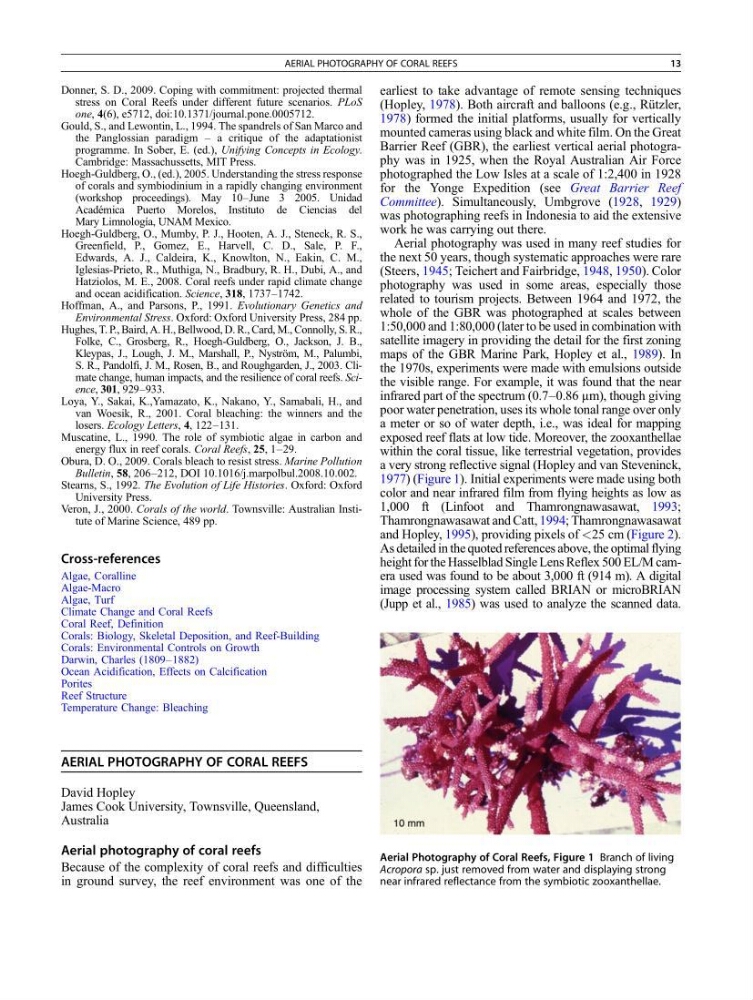
exposed reef flats at low tide. Moreover, the zooxanthellae
within the coral tissue, like terrestrial vegetation, provides
a very strong reflective signal (Hopley and van Steveninck,
1977) (Figure 1). Initial experiments were made using both
color and near infrared film from flying heights as low as
1,000 ft (Linfoot and Thamrongnawasawat, 1993;
Thamrongnawasawat and Catt, 1994; Thamrongnawasawat
and Hopley, 1995), providing pixels of <25 cm (Figure 2).
As detailed in the quoted references above, the optimal flying
height for the Hasselblad Single Lens Reflex 500 EL/M camera used was found to be about 3,000 ft (914 m). A digital
image processing system called BRIAN or microBRIAN
(Jupp et al., 1985) was used to analyze the scanned data.
Aerial Photography of Coral Reefs, Figure 1 Branch of living
Acropora sp. just removed from water and displaying strong
near infrared reflectance from the symbiotic zooxanthellae.
AERIAL PHOTOGRAPHY OF CORAL REEFS
13
stress on Coral Reefs under different future scenarios. PLoS
one, 4(6), e5712, doi:10.1371/journal.pone.0005712.
Gould, S., and Lewontin, L., 1994. The spandrels of San Marco and
the Panglossian paradigm – a critique of the adaptationist
programme. In Sober, E. (ed.), Unifying Concepts in Ecology.
Cambridge: Massachussetts, MIT Press.
Hoegh-Guldberg, O., (ed.), 2005. Understanding the stress response
of corals and symbiodinium in a rapidly changing environment
(workshop proceedings). May 10–June 3 2005. Unidad
Académica Puerto Morelos, Instituto de Ciencias del
Mary Limnología, UNAM Mexico.
Hoegh-Guldberg, O., Mumby, P. J., Hooten, A. J., Steneck, R. S.,
Greenfield, P., Gomez, E., Harvell, C. D., Sale, P. F.,
Edwards, A. J., Caldeira, K., Knowlton, N., Eakin, C. M.,
Iglesias-Prieto, R., Muthiga, N., Bradbury, R. H., Dubi, A., and
Hatziolos, M. E., 2008. Coral reefs under rapid climate change
and ocean acidification. Science, 318, 1737–1742.
Hoffman, A., and Parsons, P., 1991. Evolutionary Genetics and
Environmental Stress. Oxford: Oxford University Press, 284 pp.
Hughes, T. P., Baird, A. H., Bellwood, D. R., Card, M., Connolly, S. R.,
Folke, C., Grosberg, R., Hoegh-Guldberg, O., Jackson, J. B.,
Kleypas, J., Lough, J. M., Marshall, P., Nyström, M., Palumbi,
S. R., Pandolfi, J. M., Rosen, B., and Roughgarden, J., 2003. Climate change, human impacts, and the resilience of coral reefs. Science, 301, 929–933.
Loya, Y., Sakai, K.,Yamazato, K., Nakano, Y., Samabali, H., and
van Woesik, R., 2001. Coral bleaching: the winners and the
losers. Ecology Letters, 4, 122–131.
Muscatine, L., 1990. The role of symbiotic algae in carbon and
energy flux in reef corals. Coral Reefs, 25, 1–29.
Obura, D. O., 2009. Corals bleach to resist stress. Marine Pollution
Bulletin, 58, 206–212, DOI 10.1016/j.marpolbul.2008.10.002.
Stearns, S., 1992. The Evolution of Life Histories. Oxford: Oxford
University Press.
Veron, J., 2000. Corals of the world. Townsville: Australian Institute of Marine Science, 489 pp.
Cross-references
Algae, Coralline
Algae-Macro
Algae, Turf
Climate Change and Coral Reefs
Coral Reef, Definition
Corals: Biology, Skeletal Deposition, and Reef-Building
Corals: Environmental Controls on Growth
Darwin, Charles (1809–1882)
Ocean Acidification, Effects on Calcification
Porites
Reef Structure
Temperature Change: Bleaching
AERIAL PHOTOGRAPHY OF CORAL REEFS
David Hopley
James Cook University, Townsville, Queensland,
Australia
Aerial photography of coral reefs
Because of the complexity of coral reefs and difficulties
in ground survey, the reef environment was one of the
earliest to take advantage of remote sensing techniques
(Hopley, 1978). Both aircraft and balloons (e.g., Rützler,
1978) formed the initial platforms, usually for vertically
mounted cameras using black and white film. On the Great
Barrier Reef (GBR), the earliest vertical aerial photography was in 1925, when the Royal Australian Air Force
photographed the Low Isles at a scale of 1:2,400 in 1928
for the Yonge Expedition (see Great Barrier Reef
Committee). Simultaneously, Umbgrove (1928, 1929)
was photographing reefs in Indonesia to aid the extensive
work he was carrying out there.
Aerial photography was used in many reef studies for
the next 50 years, though systematic approaches were rare
(Steers, 1945; Teichert and Fairbridge, 1948, 1950). Color
photography was used in some areas, especially those
related to tourism projects. Between 1964 and 1972, the
whole of the GBR was photographed at scales between
1:50,000 and 1:80,000 (later to be used in combination with
satellite imagery in providing the detail for the first zoning
maps of the GBR Marine Park, Hopley et al., 1989). In
the 1970s, experiments were made with emulsions outside
the visible range. For example, it was found that the near
infrared part of the spectrum (0.7–0.86 µm), though giving
poor water penetration, uses its whole tonal range over only
a meter or so of water depth, i.e., was ideal for mapping
exposed reef flats at low tide. Moreover, the zooxanthellae
within the coral tissue, like terrestrial vegetation, provides
a very strong reflective signal (Hopley and van Steveninck,
1977) (Figure 1). Initial experiments were made using both
color and near infrared film from flying heights as low as
1,000 ft (Linfoot and Thamrongnawasawat, 1993;
Thamrongnawasawat and Catt, 1994; Thamrongnawasawat
and Hopley, 1995), providing pixels of <25 cm (Figure 2).
As detailed in the quoted references above, the optimal flying
height for the Hasselblad Single Lens Reflex 500 EL/M camera used was found to be about 3,000 ft (914 m). A digital
image processing system called BRIAN or microBRIAN
(Jupp et al., 1985) was used to analyze the scanned data.
Aerial Photography of Coral Reefs, Figure 1 Branch of living
Acropora sp. just removed from water and displaying strong
near infrared reflectance from the symbiotic zooxanthellae.
AERIAL PHOTOGRAPHY OF CORAL REEFS
13