

(Adey et al., 1977b; Hubbard et al., 1986, 1997, 2005,
2008; Macintyre et al., 1981) and abandoned Holocene
reefs that formed during the most rapid part of the Holocene
sea-level rise (Fairbanks, 1989; Bard et al., 1990).
Deep Holocene reefs
Along the steep slopes beneath many Caribbean shelf
margins, submerged ridges and terraces were flooded by
rapidly rising sea level (Jukes-Browne and Harrison,
1891; Vaughn, 1916; Davis, 1926; Macintyre, 1972).
Cores by Fairbanks (1989) have documented an early
Holocene origin for three submerged reefs off Barbados
(Figure 6b: RFG-7, 9, 12), and similar scenarios are
probable throughout the region (e.g., see Sherman et al.,
2010 for a discussion of deep mesophotic reefs off southwestern Puerto Rico). The ephemeral nature and sudden
back-stepping of the deep reefs off Barbados were
explained as responses to two decameter-scale jumps in
sea level starting ca. 14,000 and 11,400 years ago. This
was supported by isotopic data that suggested a rapid
release of meltwater at these times (Fairbanks, 1989).
Stanford et al. (2006) have proposed that the older 16 m rise
in sea level could have occurred in as little as 200 years.
Most recently, Bard et al. (2010) have called the second
jump into question based on new core data from Tahiti.
Regardless of their absolute history, these cores demonstrate that well-developed Holocene reefs built structures
10–20 m thick along the steep margin of Barbados under
a regime of rapidly rising sea level (avg. $5–7 m/ky).
Each reef was eventually abandoned and a new one
formed upslope (back-stepping). It should be noted that
the top of each abandoned reef and the base of its upslope
neighbor coexisted at similar depths (see Fig. 1 in Fairbanks, 1989). Furthermore, A. palmata remained dominant near the top of each abandoned reef as a similar
community was developing along the new, upslope feature. It has been suggested that Pleistocene lowstands have
necessitated a period of highstand “reassembly” in which
the zonation pattern was reestablished (Jackson, 1992;
Pandolfi, 1996). Inherent in this concept is a significant
disruption of community structure associated with lowstands of sea level. However, the potential for community
disruption even during the fastest sea-level change is
small on the temporal scale in which larval dispersal and
recruitment occur. The Barbados cores demonstrate
a clear connection between successive reefs that allowed
community structure to be transmitted upslope even when
individual reefs could not.
Shelf-edge reefs
The next major episode of reef building began with platform flooding throughout the region. Three cores along
the southern margin of Lang Bank, east of St. Croix, provided our first glimpse of these features and became the
0
0
–5
–10
–15
–20
–25
Depth (m)
–30
–35
–40
–12000
–9000
–6000
Dirty
water
Age (CalBP)
–3000
0 –12000
c
b
a
–9000
–6000
E STX (A palmata)
E STX (Massive)
PR (A palmata)
PR (Massive)
Other (A palmata)
Other (Massive)
Age (CalBP)
–3000
0
10
Lang bank scenario (Adey et al, 1977)
Lang bank
14 C dates (1977)
Caribbean
14 C dates
Today
ca. 8,000 CalBP
ca. 10,000 CalBP
ca. 11,000 CalBP
Sediment-laden water
Bank top floods
Water clears-too deep
20
0
10
20
0
10
20
0
10
20
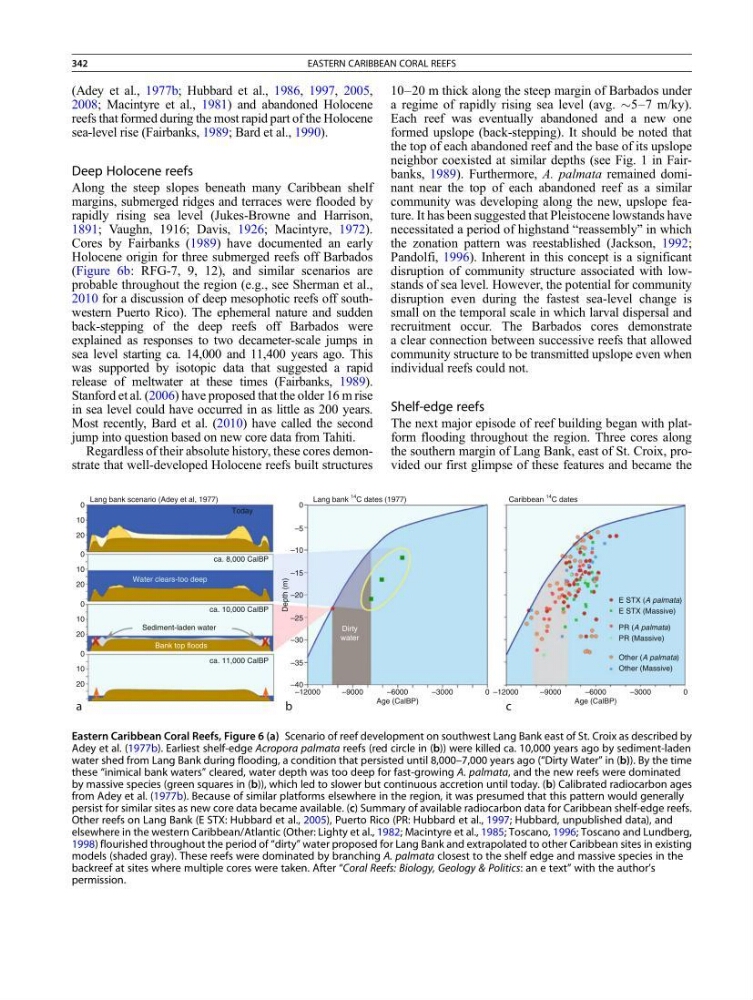
Eastern Caribbean Coral Reefs, Figure 6 (a) Scenario of reef development on southwest Lang Bank east of St. Croix as described by
Adey et al. (1977b). Earliest shelf-edge Acropora palmata reefs (red circle in (b)) were killed ca. 10,000 years ago by sediment-laden
water shed from Lang Bank during flooding, a condition that persisted until 8,000–7,000 years ago (“Dirty Water” in (b)). By the time
these “inimical bank waters” cleared, water depth was too deep for fast-growing A. palmata, and the new reefs were dominated
by massive species (green squares in (b)), which led to slower but continuous accretion until today. (b) Calibrated radiocarbon ages
from Adey et al. (1977b). Because of similar platforms elsewhere in the region, it was presumed that this pattern would generally
persist for similar sites as new core data became available. (c) Summary of available radiocarbon data for Caribbean shelf-edge reefs.
Other reefs on Lang Bank (E STX: Hubbard et al., 2005), Puerto Rico (PR: Hubbard et al., 1997; Hubbard, unpublished data), and
elsewhere in the western Caribbean/Atlantic (Other: Lighty et al., 1982; Macintyre et al., 1985; Toscano, 1996; Toscano and Lundberg,
1998) flourished throughout the period of “dirty” water proposed for Lang Bank and extrapolated to other Caribbean sites in existing
models (shaded gray). These reefs were dominated by branching A. palmata closest to the shelf edge and massive species in the
backreef at sites where multiple cores were taken. After “Coral Reefs: Biology, Geology & Politics: an e text” with the author’s
permission.
342
EASTERN CARIBBEAN CORAL REEFS
2008; Macintyre et al., 1981) and abandoned Holocene
reefs that formed during the most rapid part of the Holocene
sea-level rise (Fairbanks, 1989; Bard et al., 1990).
Deep Holocene reefs
Along the steep slopes beneath many Caribbean shelf
margins, submerged ridges and terraces were flooded by
rapidly rising sea level (Jukes-Browne and Harrison,
1891; Vaughn, 1916; Davis, 1926; Macintyre, 1972).
Cores by Fairbanks (1989) have documented an early
Holocene origin for three submerged reefs off Barbados
(Figure 6b: RFG-7, 9, 12), and similar scenarios are
probable throughout the region (e.g., see Sherman et al.,
2010 for a discussion of deep mesophotic reefs off southwestern Puerto Rico). The ephemeral nature and sudden
back-stepping of the deep reefs off Barbados were
explained as responses to two decameter-scale jumps in
sea level starting ca. 14,000 and 11,400 years ago. This
was supported by isotopic data that suggested a rapid
release of meltwater at these times (Fairbanks, 1989).
Stanford et al. (2006) have proposed that the older 16 m rise
in sea level could have occurred in as little as 200 years.
Most recently, Bard et al. (2010) have called the second
jump into question based on new core data from Tahiti.
Regardless of their absolute history, these cores demonstrate that well-developed Holocene reefs built structures
10–20 m thick along the steep margin of Barbados under
a regime of rapidly rising sea level (avg. $5–7 m/ky).
Each reef was eventually abandoned and a new one
formed upslope (back-stepping). It should be noted that
the top of each abandoned reef and the base of its upslope
neighbor coexisted at similar depths (see Fig. 1 in Fairbanks, 1989). Furthermore, A. palmata remained dominant near the top of each abandoned reef as a similar
community was developing along the new, upslope feature. It has been suggested that Pleistocene lowstands have
necessitated a period of highstand “reassembly” in which
the zonation pattern was reestablished (Jackson, 1992;
Pandolfi, 1996). Inherent in this concept is a significant
disruption of community structure associated with lowstands of sea level. However, the potential for community
disruption even during the fastest sea-level change is
small on the temporal scale in which larval dispersal and
recruitment occur. The Barbados cores demonstrate
a clear connection between successive reefs that allowed
community structure to be transmitted upslope even when
individual reefs could not.
Shelf-edge reefs
The next major episode of reef building began with platform flooding throughout the region. Three cores along
the southern margin of Lang Bank, east of St. Croix, provided our first glimpse of these features and became the
0
0
–5
–10
–15
–20
–25
Depth (m)
–30
–35
–40
–12000
–9000
–6000
Dirty
water
Age (CalBP)
–3000
0 –12000
c
b
a
–9000
–6000
E STX (A palmata)
E STX (Massive)
PR (A palmata)
PR (Massive)
Other (A palmata)
Other (Massive)
Age (CalBP)
–3000
0
10
Lang bank scenario (Adey et al, 1977)
Lang bank
14 C dates (1977)
Caribbean
14 C dates
Today
ca. 8,000 CalBP
ca. 10,000 CalBP
ca. 11,000 CalBP
Sediment-laden water
Bank top floods
Water clears-too deep
20
0
10
20
0
10
20
0
10
20
Eastern Caribbean Coral Reefs, Figure 6 (a) Scenario of reef development on southwest Lang Bank east of St. Croix as described by
Adey et al. (1977b). Earliest shelf-edge Acropora palmata reefs (red circle in (b)) were killed ca. 10,000 years ago by sediment-laden
water shed from Lang Bank during flooding, a condition that persisted until 8,000–7,000 years ago (“Dirty Water” in (b)). By the time
these “inimical bank waters” cleared, water depth was too deep for fast-growing A. palmata, and the new reefs were dominated
by massive species (green squares in (b)), which led to slower but continuous accretion until today. (b) Calibrated radiocarbon ages
from Adey et al. (1977b). Because of similar platforms elsewhere in the region, it was presumed that this pattern would generally
persist for similar sites as new core data became available. (c) Summary of available radiocarbon data for Caribbean shelf-edge reefs.
Other reefs on Lang Bank (E STX: Hubbard et al., 2005), Puerto Rico (PR: Hubbard et al., 1997; Hubbard, unpublished data), and
elsewhere in the western Caribbean/Atlantic (Other: Lighty et al., 1982; Macintyre et al., 1985; Toscano, 1996; Toscano and Lundberg,
1998) flourished throughout the period of “dirty” water proposed for Lang Bank and extrapolated to other Caribbean sites in existing
models (shaded gray). These reefs were dominated by branching A. palmata closest to the shelf edge and massive species in the
backreef at sites where multiple cores were taken. After “Coral Reefs: Biology, Geology & Politics: an e text” with the author’s
permission.
342
EASTERN CARIBBEAN CORAL REEFS