

foundation of a broader Caribbean model for Holocene
reef development. According to Adey et al. (1977b), early
A. palmata reefs formed near the shelf break by at least
10,500 cal BP, but were soon killed by turbid water
derived from the reworking of long-exposed terrestrial
silts and clays atop the platform and landward of their core
site (Figure 6a; “inimical bank waters” of Schlager, 1981).
Nutrients adsorbed to fine-grained sediments (especially
siliciclastic clays) could also have discouraged calcification (phosphorous) and encouraged algae (nitrogen), as
well as bioerosion, which is also favored by increased
nutrients (Moore and Shedd, 1977; Edinger and Risk,
1997). Based on the Lang Bank cores, Adey (1978) concluded that, “from about [10,200] to [5,800] years ago,
apparently very little reef development occurred on the
island of St. Croix.” (Bracketed values are corrected from
the raw
14
C measurements.) Reef accretion may have
started again on Lang Bank as early as 7,800–7,000 years
ago (adjusted from the raw
14
C ages in their Fig. 4 of Adey
et al., 1977b).
More recent shelf-edge cores from St. Croix (Hubbard
et al., 2004, 2005, 2008) confirm that the inhibition of reef
development around the island was not as dramatic as has
been assumed. This pattern is repeated in cores from similar systems off southwestern Puerto Rico (Hubbard et al.,
1997) and Florida (Lighty et al., 1978; Toscano and
Lundberg, 1998), where “inimical bank waters” played
a role that was more variable and of shorter duration than
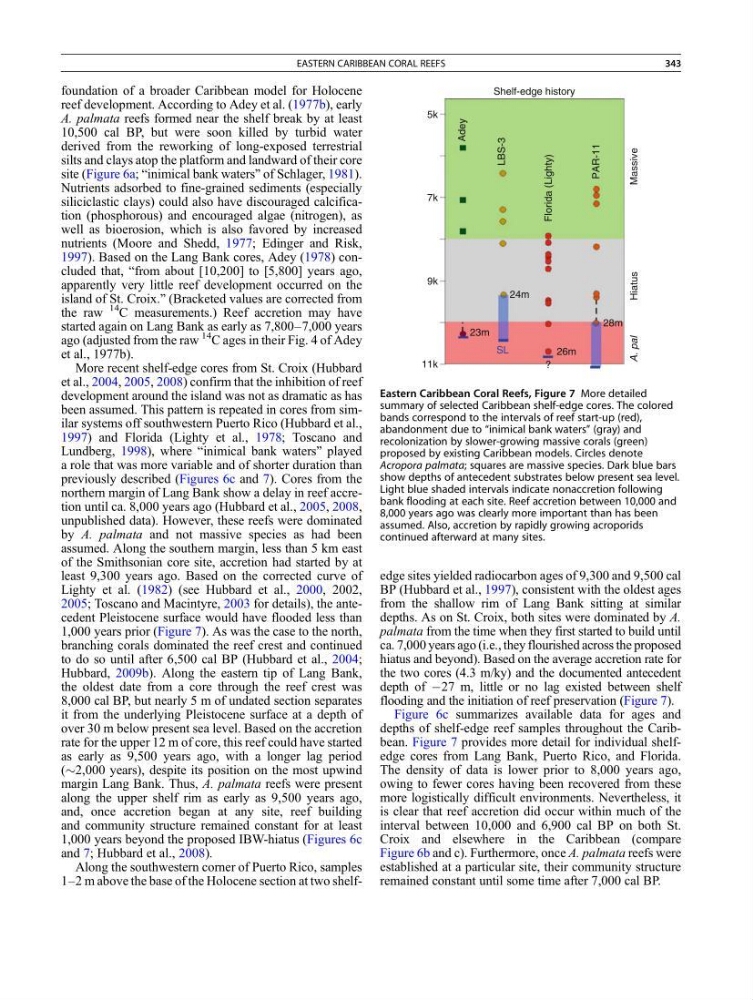
previously described (Figures 6c and 7). Cores from the
northern margin of Lang Bank show a delay in reef accretion until ca. 8,000 years ago (Hubbard et al., 2005, 2008,
unpublished data). However, these reefs were dominated
by A. palmata and not massive species as had been
assumed. Along the southern margin, less than 5 km east
of the Smithsonian core site, accretion had started by at
least 9,300 years ago. Based on the corrected curve of
Lighty et al. (1982) (see Hubbard et al., 2000, 2002,
2005; Toscano and Macintyre, 2003 for details), the antecedent Pleistocene surface would have flooded less than
1,000 years prior (Figure 7). As was the case to the north,
branching corals dominated the reef crest and continued
to do so until after 6,500 cal BP (Hubbard et al., 2004;
Hubbard, 2009b). Along the eastern tip of Lang Bank,
the oldest date from a core through the reef crest was
8,000 cal BP, but nearly 5 m of undated section separates
it from the underlying Pleistocene surface at a depth of
over 30 m below present sea level. Based on the accretion
rate for the upper 12 m of core, this reef could have started
as early as 9,500 years ago, with a longer lag period
($2,000 years), despite its position on the most upwind
margin Lang Bank. Thus, A. palmata reefs were present
along the upper shelf rim as early as 9,500 years ago,
and, once accretion began at any site, reef building
and community structure remained constant for at least
1,000 years beyond the proposed IBW-hiatus (Figures 6c
and 7; Hubbard et al., 2008).
Along the southwestern corner of Puerto Rico, samples
1–2 m above the base of the Holocene section at two shelfedge sites yielded radiocarbon ages of 9,300 and 9,500 cal
BP (Hubbard et al., 1997), consistent with the oldest ages
from the shallow rim of Lang Bank sitting at similar
depths. As on St. Croix, both sites were dominated by A.
palmata from the time when they first started to build until
ca. 7,000 years ago (i.e., they flourished across the proposed
hiatus and beyond). Based on the average accretion rate for
the two cores (4.3 m/ky) and the documented antecedent
depth of À27 m, little or no lag existed between shelf
flooding and the initiation of reef preservation (Figure 7).
Figure 6c summarizes available data for ages and
depths of shelf-edge reef samples throughout the Caribbean. Figure 7 provides more detail for individual shelfedge cores from Lang Bank, Puerto Rico, and Florida.
The density of data is lower prior to 8,000 years ago,
owing to fewer cores having been recovered from these
more logistically difficult environments. Nevertheless, it
is clear that reef accretion did occur within much of the
interval between 10,000 and 6,900 cal BP on both St.
Croix and elsewhere in the Caribbean (compare
Figure 6b and c). Furthermore, once A. palmata reefs were
established at a particular site, their community structure
remained constant until some time after 7,000 cal BP.
5k
7k
9k
11k
23m
24m
26m
28m
A. pal
Hiatus
Massive
PAR-11
Florida (Lighty)
Shelf-edge history
LBS-3
Adey
?
SL
Eastern Caribbean Coral Reefs, Figure 7 More detailed
summary of selected Caribbean shelf-edge cores. The colored
bands correspond to the intervals of reef start-up (red),
abandonment due to “inimical bank waters” (gray) and
recolonization by slower-growing massive corals (green)
proposed by existing Caribbean models. Circles denote
Acropora palmata; squares are massive species. Dark blue bars
show depths of antecedent substrates below present sea level.
Light blue shaded intervals indicate nonaccretion following
bank flooding at each site. Reef accretion between 10,000 and
8,000 years ago was clearly more important than has been
assumed. Also, accretion by rapidly growing acroporids
continued afterward at many sites.
EASTERN CARIBBEAN CORAL REEFS
343
reef development. According to Adey et al. (1977b), early
A. palmata reefs formed near the shelf break by at least
10,500 cal BP, but were soon killed by turbid water
derived from the reworking of long-exposed terrestrial
silts and clays atop the platform and landward of their core
site (Figure 6a; “inimical bank waters” of Schlager, 1981).
Nutrients adsorbed to fine-grained sediments (especially
siliciclastic clays) could also have discouraged calcification (phosphorous) and encouraged algae (nitrogen), as
well as bioerosion, which is also favored by increased
nutrients (Moore and Shedd, 1977; Edinger and Risk,
1997). Based on the Lang Bank cores, Adey (1978) concluded that, “from about [10,200] to [5,800] years ago,
apparently very little reef development occurred on the
island of St. Croix.” (Bracketed values are corrected from
the raw
14
C measurements.) Reef accretion may have
started again on Lang Bank as early as 7,800–7,000 years
ago (adjusted from the raw
14
C ages in their Fig. 4 of Adey
et al., 1977b).
More recent shelf-edge cores from St. Croix (Hubbard
et al., 2004, 2005, 2008) confirm that the inhibition of reef
development around the island was not as dramatic as has
been assumed. This pattern is repeated in cores from similar systems off southwestern Puerto Rico (Hubbard et al.,
1997) and Florida (Lighty et al., 1978; Toscano and
Lundberg, 1998), where “inimical bank waters” played
a role that was more variable and of shorter duration than
previously described (Figures 6c and 7). Cores from the
northern margin of Lang Bank show a delay in reef accretion until ca. 8,000 years ago (Hubbard et al., 2005, 2008,
unpublished data). However, these reefs were dominated
by A. palmata and not massive species as had been
assumed. Along the southern margin, less than 5 km east
of the Smithsonian core site, accretion had started by at
least 9,300 years ago. Based on the corrected curve of
Lighty et al. (1982) (see Hubbard et al., 2000, 2002,
2005; Toscano and Macintyre, 2003 for details), the antecedent Pleistocene surface would have flooded less than
1,000 years prior (Figure 7). As was the case to the north,
branching corals dominated the reef crest and continued
to do so until after 6,500 cal BP (Hubbard et al., 2004;
Hubbard, 2009b). Along the eastern tip of Lang Bank,
the oldest date from a core through the reef crest was
8,000 cal BP, but nearly 5 m of undated section separates
it from the underlying Pleistocene surface at a depth of
over 30 m below present sea level. Based on the accretion
rate for the upper 12 m of core, this reef could have started
as early as 9,500 years ago, with a longer lag period
($2,000 years), despite its position on the most upwind
margin Lang Bank. Thus, A. palmata reefs were present
along the upper shelf rim as early as 9,500 years ago,
and, once accretion began at any site, reef building
and community structure remained constant for at least
1,000 years beyond the proposed IBW-hiatus (Figures 6c
and 7; Hubbard et al., 2008).
Along the southwestern corner of Puerto Rico, samples
1–2 m above the base of the Holocene section at two shelfedge sites yielded radiocarbon ages of 9,300 and 9,500 cal
BP (Hubbard et al., 1997), consistent with the oldest ages
from the shallow rim of Lang Bank sitting at similar
depths. As on St. Croix, both sites were dominated by A.
palmata from the time when they first started to build until
ca. 7,000 years ago (i.e., they flourished across the proposed
hiatus and beyond). Based on the average accretion rate for
the two cores (4.3 m/ky) and the documented antecedent
depth of À27 m, little or no lag existed between shelf
flooding and the initiation of reef preservation (Figure 7).
Figure 6c summarizes available data for ages and
depths of shelf-edge reef samples throughout the Caribbean. Figure 7 provides more detail for individual shelfedge cores from Lang Bank, Puerto Rico, and Florida.
The density of data is lower prior to 8,000 years ago,
owing to fewer cores having been recovered from these
more logistically difficult environments. Nevertheless, it
is clear that reef accretion did occur within much of the
interval between 10,000 and 6,900 cal BP on both St.
Croix and elsewhere in the Caribbean (compare
Figure 6b and c). Furthermore, once A. palmata reefs were
established at a particular site, their community structure
remained constant until some time after 7,000 cal BP.
5k
7k
9k
11k
23m
24m
26m
28m
A. pal
Hiatus
Massive
PAR-11
Florida (Lighty)
Shelf-edge history
LBS-3
Adey
?
SL
Eastern Caribbean Coral Reefs, Figure 7 More detailed
summary of selected Caribbean shelf-edge cores. The colored
bands correspond to the intervals of reef start-up (red),
abandonment due to “inimical bank waters” (gray) and
recolonization by slower-growing massive corals (green)
proposed by existing Caribbean models. Circles denote
Acropora palmata; squares are massive species. Dark blue bars
show depths of antecedent substrates below present sea level.
Light blue shaded intervals indicate nonaccretion following
bank flooding at each site. Reef accretion between 10,000 and
8,000 years ago was clearly more important than has been
assumed. Also, accretion by rapidly growing acroporids
continued afterward at many sites.
EASTERN CARIBBEAN CORAL REEFS
343