

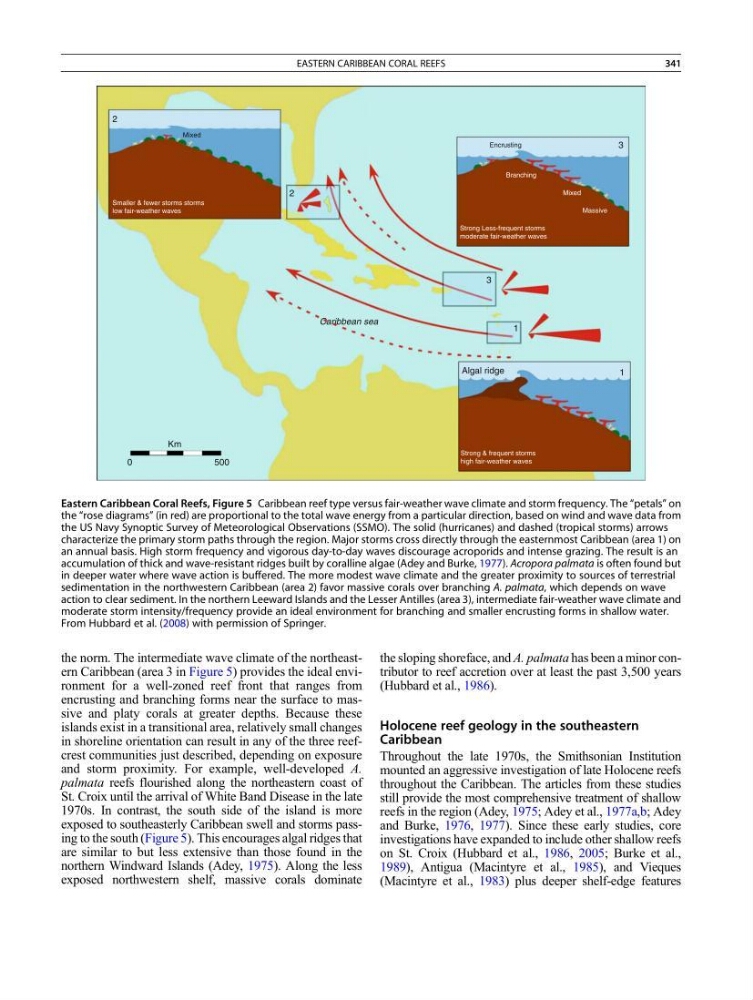
the norm. The intermediate wave climate of the northeastern Caribbean (area 3 in Figure 5) provides the ideal environment for a well-zoned reef front that ranges from
encrusting and branching forms near the surface to massive and platy corals at greater depths. Because these
islands exist in a transitional area, relatively small changes
in shoreline orientation can result in any of the three reefcrest communities just described, depending on exposure
and storm proximity. For example, well-developed A.
palmata reefs flourished along the northeastern coast of
St. Croix until the arrival of White Band Disease in the late
1970s. In contrast, the south side of the island is more
exposed to southeasterly Caribbean swell and storms passing to the south (Figure 5). This encourages algal ridges that
are similar to but less extensive than those found in the
northern Windward Islands (Adey, 1975). Along the less
exposed northwestern shelf, massive corals dominate
the sloping shoreface, and A. palmata has been a minor contributor to reef accretion over at least the past 3,500 years
(Hubbard et al., 1986).
Holocene reef geology in the southeastern
Caribbean
Throughout the late 1970s, the Smithsonian Institution
mounted an aggressive investigation of late Holocene reefs
throughout the Caribbean. The articles from these studies
still provide the most comprehensive treatment of shallow
reefs in the region (Adey, 1975; Adey et al., 1977a,b; Adey
and Burke, 1976, 1977). Since these early studies, core
investigations have expanded to include other shallow reefs
on St. Croix (Hubbard et al., 1986, 2005; Burke et al.,
1989), Antigua (Macintyre et al., 1985), and Vieques
(Macintyre et al., 1983) plus deeper shelf-edge features
Smaller & fewer storms storms
low fair-weather waves
Mixed
2
2
Km
500
0
3
3
Algal ridge
Caribbean sea
Strong & frequent storms
high fair-weather waves
Strong Less-frequent storms
moderate fair-weather waves
Massive
Mixed
Branching
Encrusting
1
1
Eastern Caribbean Coral Reefs, Figure 5 Caribbean reef type versus fair-weather wave climate and storm frequency. The “petals” on
the “rose diagrams” (in red) are proportional to the total wave energy from a particular direction, based on wind and wave data from
the US Navy Synoptic Survey of Meteorological Observations (SSMO). The solid (hurricanes) and dashed (tropical storms) arrows
characterize the primary storm paths through the region. Major storms cross directly through the easternmost Caribbean (area 1) on
an annual basis. High storm frequency and vigorous day-to-day waves discourage acroporids and intense grazing. The result is an
accumulation of thick and wave-resistant ridges built by coralline algae (Adey and Burke, 1977). Acropora palmata is often found but
in deeper water where wave action is buffered. The more modest wave climate and the greater proximity to sources of terrestrial
sedimentation in the northwestern Caribbean (area 2) favor massive corals over branching A. palmata, which depends on wave
action to clear sediment. In the northern Leeward Islands and the Lesser Antilles (area 3), intermediate fair-weather wave climate and
moderate storm intensity/frequency provide an ideal environment for branching and smaller encrusting forms in shallow water.
From Hubbard et al. (2008) with permission of Springer.
EASTERN CARIBBEAN CORAL REEFS
341
encrusting and branching forms near the surface to massive and platy corals at greater depths. Because these
islands exist in a transitional area, relatively small changes
in shoreline orientation can result in any of the three reefcrest communities just described, depending on exposure
and storm proximity. For example, well-developed A.
palmata reefs flourished along the northeastern coast of
St. Croix until the arrival of White Band Disease in the late
1970s. In contrast, the south side of the island is more
exposed to southeasterly Caribbean swell and storms passing to the south (Figure 5). This encourages algal ridges that
are similar to but less extensive than those found in the
northern Windward Islands (Adey, 1975). Along the less
exposed northwestern shelf, massive corals dominate
the sloping shoreface, and A. palmata has been a minor contributor to reef accretion over at least the past 3,500 years
(Hubbard et al., 1986).
Holocene reef geology in the southeastern
Caribbean
Throughout the late 1970s, the Smithsonian Institution
mounted an aggressive investigation of late Holocene reefs
throughout the Caribbean. The articles from these studies
still provide the most comprehensive treatment of shallow
reefs in the region (Adey, 1975; Adey et al., 1977a,b; Adey
and Burke, 1976, 1977). Since these early studies, core
investigations have expanded to include other shallow reefs
on St. Croix (Hubbard et al., 1986, 2005; Burke et al.,
1989), Antigua (Macintyre et al., 1985), and Vieques
(Macintyre et al., 1983) plus deeper shelf-edge features
Smaller & fewer storms storms
low fair-weather waves
Mixed
2
2
Km
500
0
3
3
Algal ridge
Caribbean sea
Strong & frequent storms
high fair-weather waves
Strong Less-frequent storms
moderate fair-weather waves
Massive
Mixed
Branching
Encrusting
1
1
Eastern Caribbean Coral Reefs, Figure 5 Caribbean reef type versus fair-weather wave climate and storm frequency. The “petals” on
the “rose diagrams” (in red) are proportional to the total wave energy from a particular direction, based on wind and wave data from
the US Navy Synoptic Survey of Meteorological Observations (SSMO). The solid (hurricanes) and dashed (tropical storms) arrows
characterize the primary storm paths through the region. Major storms cross directly through the easternmost Caribbean (area 1) on
an annual basis. High storm frequency and vigorous day-to-day waves discourage acroporids and intense grazing. The result is an
accumulation of thick and wave-resistant ridges built by coralline algae (Adey and Burke, 1977). Acropora palmata is often found but
in deeper water where wave action is buffered. The more modest wave climate and the greater proximity to sources of terrestrial
sedimentation in the northwestern Caribbean (area 2) favor massive corals over branching A. palmata, which depends on wave
action to clear sediment. In the northern Leeward Islands and the Lesser Antilles (area 3), intermediate fair-weather wave climate and
moderate storm intensity/frequency provide an ideal environment for branching and smaller encrusting forms in shallow water.
From Hubbard et al. (2008) with permission of Springer.
EASTERN CARIBBEAN CORAL REEFS
341