

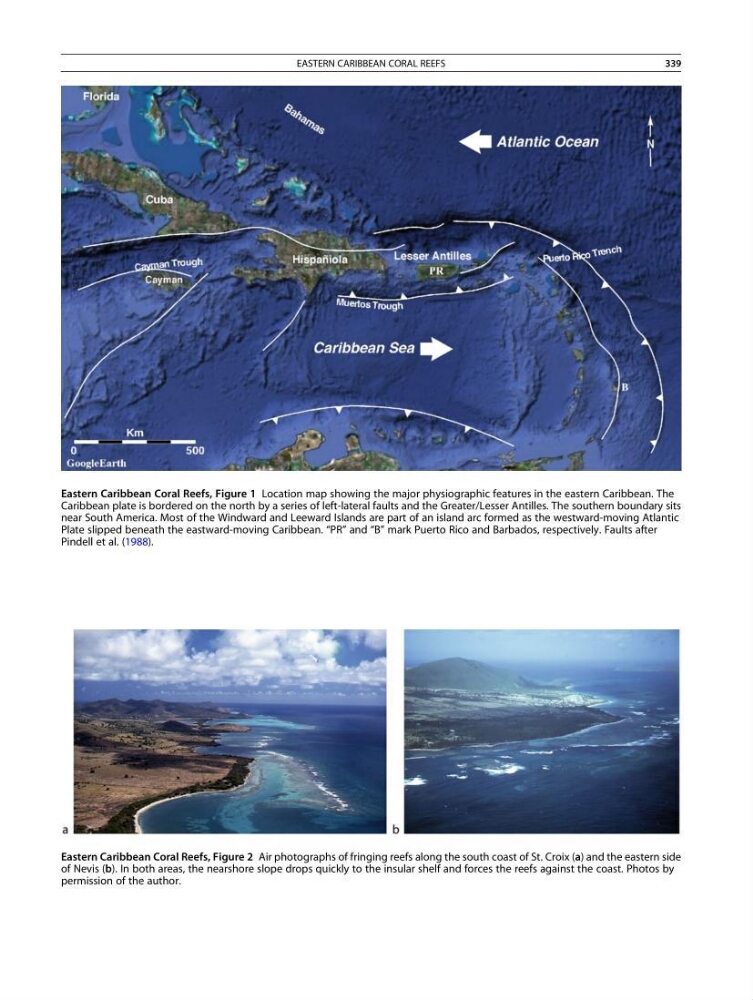
Eastern Caribbean Coral Reefs, Figure 2 Air photographs of fringing reefs along the south coast of St. Croix (a) and the eastern side
of Nevis (b). In both areas, the nearshore slope drops quickly to the insular shelf and forces the reefs against the coast. Photos by
permission of the author.
Eastern Caribbean Coral Reefs, Figure 1 Location map showing the major physiographic features in the eastern Caribbean. The
Caribbean plate is bordered on the north by a series of left-lateral faults and the Greater/Lesser Antilles. The southern boundary sits
near South America. Most of the Windward and Leeward Islands are part of an island arc formed as the westward-moving Atlantic
Plate slipped beneath the eastward-moving Caribbean. “PR” and “B” mark Puerto Rico and Barbados, respectively. Faults after
Pindell et al. (1988).
EASTERN CARIBBEAN CORAL REEFS
339
of Nevis (b). In both areas, the nearshore slope drops quickly to the insular shelf and forces the reefs against the coast. Photos by
permission of the author.
Eastern Caribbean Coral Reefs, Figure 1 Location map showing the major physiographic features in the eastern Caribbean. The
Caribbean plate is bordered on the north by a series of left-lateral faults and the Greater/Lesser Antilles. The southern boundary sits
near South America. Most of the Windward and Leeward Islands are part of an island arc formed as the westward-moving Atlantic
Plate slipped beneath the eastward-moving Caribbean. “PR” and “B” mark Puerto Rico and Barbados, respectively. Faults after
Pindell et al. (1988).
EASTERN CARIBBEAN CORAL REEFS
339