

of 100 m that periodically left the shelf reefs and their own
shallow portions high and dry. Another key feature of the
region is its oceanography (see entry Indonesian Reefs).
The most significant feature of which is the Indonesian
through-flow, a seasonably varying flow of water which
travels southwestward from the Pacific Ocean through
central Indonesia into the Indian Ocean (Gordon and Fine,
1996; Shriver and Hurlburt, 1997). A third feature of the
area is the great variety of habitat types it affords for
populations of coral reef species and reef development,
from shallow sheltered bays to deep swell-exposed outer
slopes (see entry Corals: Environmental Controls on
Growth). This range of environments and habitats is
a critical contemporary determinant of the EITB’s diversity, distribution, and abundance of reef species, as
outlined, for example, in a distribution study of mushroom
corals (family Fungiidae) by Hoeksema (2007).
The EITB’s richness of coral species (Veron, 1995;
Paulay, 1997; Hoeksema, 2007) is also exemplified by
staghorn Acropora corals, whose greatest diversity of species per area occurs there (Wallace and Wolstenholme,
1998; Wallace et al., 2001). These authors postulate three
major evolutionary and biogeographic influences on the
current species richness and distribution patterns of
Acropora, which are also likely applicable to the majority
of coral reef genera (Figure 2). Present Acropora species
patterns appear to reflect speciation in the Indian and
Pacific Oceans due to genetic isolation of subpopulations
caused by Mid Miocene tectonic events, leading to
a barrier between the oceans (Figure 2a). At the same time,
deep ocean basins were formed (Hall, 1998), which are
proposed to have influenced the origination and retention
of endemic species (Figure 2a). Last, in more recent time,
the Indonesian through-flow current (Gordon and Fine,
1996) would have allowed larval dispersal of Pacific species into the Indo-Australian Arc and through to the eastern edge of the Indian Ocean, while central and western
Indian Ocean species remain isolated because of the
absence of a return flow (Figure 2b).
Coral triangle conservation initiative
Concerns have been raised for the future of the EITB,
based on the recognition of the general effects on coral
reefs of decades of destructive fishing, overfishing, and
pollution (Wilkinson, 1998), compounded by severe
bleaching events in the Indian and Pacific oceans (1998
and 2002) and the 2004 Asian tsunami (Wilkinson et al.,
2006) and other major changes in sea-surface temperature
and ocean chemistry due to global climate change (Lough,
2000; Kleypas et al., 2001). To indicate more accurately
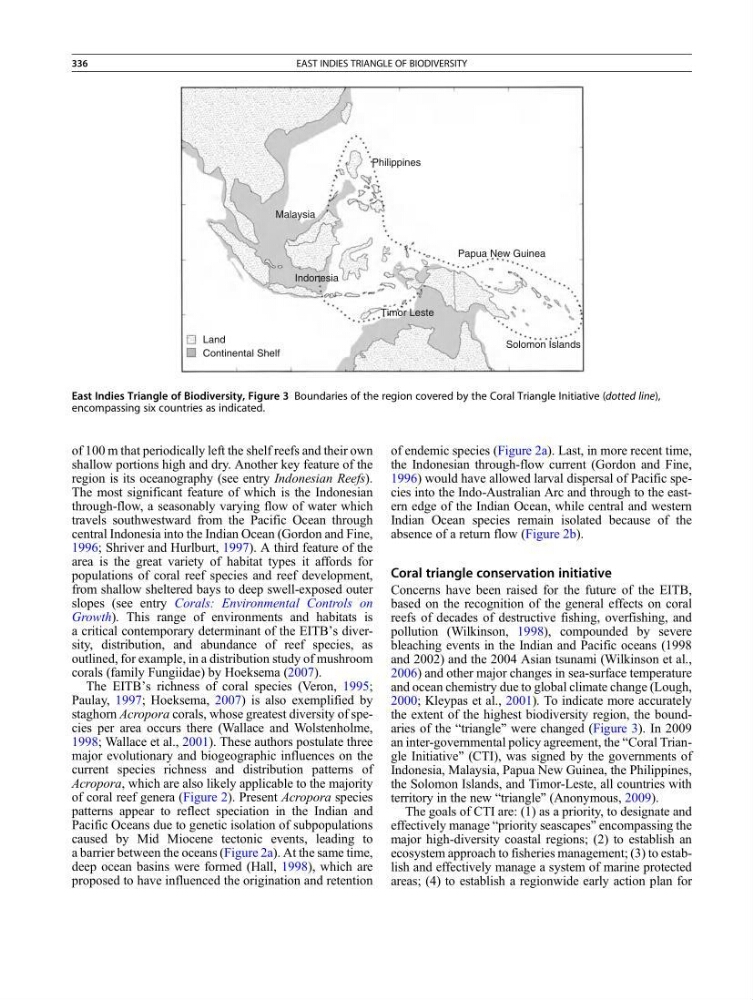
the extent of the highest biodiversity region, the boundaries of the “triangle” were changed (Figure 3). In 2009
an inter-governmental policy agreement, the “Coral Triangle Initiative” (CTI), was signed by the governments of
Indonesia, Malaysia, Papua New Guinea, the Philippines,
the Solomon Islands, and Timor-Leste, all countries with
territory in the new “triangle” (Anonymous, 2009).
The goals of CTI are: (1) as a priority, to designate and
effectively manage “priority seascapes” encompassing the
major high-diversity coastal regions; (2) to establish an
ecosystem approach to fisheries management; (3) to establish and effectively manage a system of marine protected
areas; (4) to establish a regionwide early action plan for
Philippines
Malaysia
Indonesia
Papua New Guinea
Timor Leste
Solomon Islands
Land
Continental Shelf
East Indies Triangle of Biodiversity, Figure 3 Boundaries of the region covered by the Coral Triangle Initiative (dotted line),
encompassing six countries as indicated.
336
EAST INDIES TRIANGLE OF BIODIVERSITY
shallow portions high and dry. Another key feature of the
region is its oceanography (see entry Indonesian Reefs).
The most significant feature of which is the Indonesian
through-flow, a seasonably varying flow of water which
travels southwestward from the Pacific Ocean through
central Indonesia into the Indian Ocean (Gordon and Fine,
1996; Shriver and Hurlburt, 1997). A third feature of the
area is the great variety of habitat types it affords for
populations of coral reef species and reef development,
from shallow sheltered bays to deep swell-exposed outer
slopes (see entry Corals: Environmental Controls on
Growth). This range of environments and habitats is
a critical contemporary determinant of the EITB’s diversity, distribution, and abundance of reef species, as
outlined, for example, in a distribution study of mushroom
corals (family Fungiidae) by Hoeksema (2007).
The EITB’s richness of coral species (Veron, 1995;
Paulay, 1997; Hoeksema, 2007) is also exemplified by
staghorn Acropora corals, whose greatest diversity of species per area occurs there (Wallace and Wolstenholme,
1998; Wallace et al., 2001). These authors postulate three
major evolutionary and biogeographic influences on the
current species richness and distribution patterns of
Acropora, which are also likely applicable to the majority
of coral reef genera (Figure 2). Present Acropora species
patterns appear to reflect speciation in the Indian and
Pacific Oceans due to genetic isolation of subpopulations
caused by Mid Miocene tectonic events, leading to
a barrier between the oceans (Figure 2a). At the same time,
deep ocean basins were formed (Hall, 1998), which are
proposed to have influenced the origination and retention
of endemic species (Figure 2a). Last, in more recent time,
the Indonesian through-flow current (Gordon and Fine,
1996) would have allowed larval dispersal of Pacific species into the Indo-Australian Arc and through to the eastern edge of the Indian Ocean, while central and western
Indian Ocean species remain isolated because of the
absence of a return flow (Figure 2b).
Coral triangle conservation initiative
Concerns have been raised for the future of the EITB,
based on the recognition of the general effects on coral
reefs of decades of destructive fishing, overfishing, and
pollution (Wilkinson, 1998), compounded by severe
bleaching events in the Indian and Pacific oceans (1998
and 2002) and the 2004 Asian tsunami (Wilkinson et al.,
2006) and other major changes in sea-surface temperature
and ocean chemistry due to global climate change (Lough,
2000; Kleypas et al., 2001). To indicate more accurately
the extent of the highest biodiversity region, the boundaries of the “triangle” were changed (Figure 3). In 2009
an inter-governmental policy agreement, the “Coral Triangle Initiative” (CTI), was signed by the governments of
Indonesia, Malaysia, Papua New Guinea, the Philippines,
the Solomon Islands, and Timor-Leste, all countries with
territory in the new “triangle” (Anonymous, 2009).
The goals of CTI are: (1) as a priority, to designate and
effectively manage “priority seascapes” encompassing the
major high-diversity coastal regions; (2) to establish an
ecosystem approach to fisheries management; (3) to establish and effectively manage a system of marine protected
areas; (4) to establish a regionwide early action plan for
Philippines
Malaysia
Indonesia
Papua New Guinea
Timor Leste
Solomon Islands
Land
Continental Shelf
East Indies Triangle of Biodiversity, Figure 3 Boundaries of the region covered by the Coral Triangle Initiative (dotted line),
encompassing six countries as indicated.
336
EAST INDIES TRIANGLE OF BIODIVERSITY