

areas” in the Early Miocene (Wilson, 2008). The collision
of the Asian and Australian plates produced today’s island
archipelagos of SE Asia – the EITB – a composite of fragments which came from various locations throughout the
now Indo-Pacific (Michaux, 1991; Hall and Blundell,
1996; Hall and Holloway, 1998). Volcanism and localized
dynamic change due to earthquakes and tsunami still
impact on coral reefs in the region (see Wilkinson et al.,
2006 and entry Tsunami).
The EITB archipelago consists of two broad types of
islands and reefs. Some sit on the continental shelf of the
Asian and Australian continental plates, and their surrounding seas are shallow (<200 m). Others rise from
the deep waters between the shelves (depths to 3,000 m).
The greatest diversity of corals and fishes is in the latter
non-continental area (“Wallacea”), where the deep seas
have allowed reefs to persist continuously for thousands
to millions of years, through sea-level changes in excess
10 Ma
Late Miocene
Pacific Ocean
Deep Ocean
Basins
Indian Ocean
Land
Highland
Carbonate platforms
Shallow Sea
Deep Sea
Volcanoes
Present day
Indonesian through-flow current
Land
Continental shelf
a
b
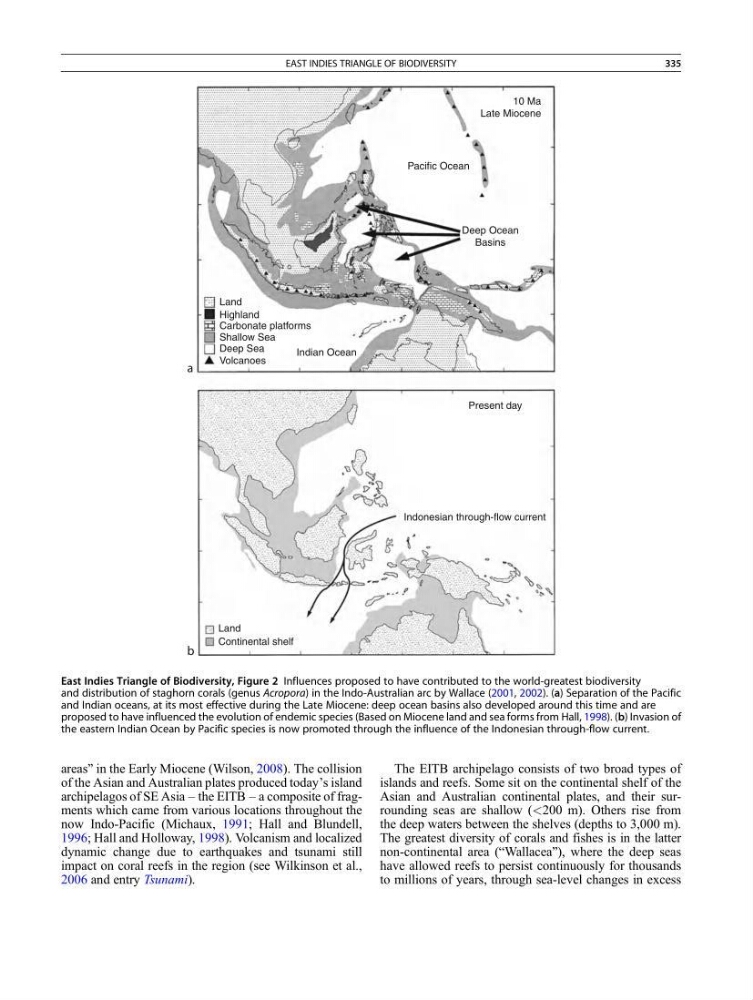
East Indies Triangle of Biodiversity, Figure 2 Influences proposed to have contributed to the world-greatest biodiversity
and distribution of staghorn corals (genus Acropora) in the Indo-Australian arc by Wallace (2001, 2002). (a) Separation of the Pacific
and Indian oceans, at its most effective during the Late Miocene: deep ocean basins also developed around this time and are
proposed to have influenced the evolution of endemic species (Based on Miocene land and sea forms from Hall, 1998). (b) Invasion of
the eastern Indian Ocean by Pacific species is now promoted through the influence of the Indonesian through-flow current.
EAST INDIES TRIANGLE OF BIODIVERSITY
335
of the Asian and Australian plates produced today’s island
archipelagos of SE Asia – the EITB – a composite of fragments which came from various locations throughout the
now Indo-Pacific (Michaux, 1991; Hall and Blundell,
1996; Hall and Holloway, 1998). Volcanism and localized
dynamic change due to earthquakes and tsunami still
impact on coral reefs in the region (see Wilkinson et al.,
2006 and entry Tsunami).
The EITB archipelago consists of two broad types of
islands and reefs. Some sit on the continental shelf of the
Asian and Australian continental plates, and their surrounding seas are shallow (<200 m). Others rise from
the deep waters between the shelves (depths to 3,000 m).
The greatest diversity of corals and fishes is in the latter
non-continental area (“Wallacea”), where the deep seas
have allowed reefs to persist continuously for thousands
to millions of years, through sea-level changes in excess
10 Ma
Late Miocene
Pacific Ocean
Deep Ocean
Basins
Indian Ocean
Land
Highland
Carbonate platforms
Shallow Sea
Deep Sea
Volcanoes
Present day
Indonesian through-flow current
Land
Continental shelf
a
b
East Indies Triangle of Biodiversity, Figure 2 Influences proposed to have contributed to the world-greatest biodiversity
and distribution of staghorn corals (genus Acropora) in the Indo-Australian arc by Wallace (2001, 2002). (a) Separation of the Pacific
and Indian oceans, at its most effective during the Late Miocene: deep ocean basins also developed around this time and are
proposed to have influenced the evolution of endemic species (Based on Miocene land and sea forms from Hall, 1998). (b) Invasion of
the eastern Indian Ocean by Pacific species is now promoted through the influence of the Indonesian through-flow current.
EAST INDIES TRIANGLE OF BIODIVERSITY
335