

Definition
The East Indies Triangle of biodiversity (EITB) refers
to the region between the Indian and Pacific Oceans,
including Indonesia, the Philippines, Papua New Guinea,
Solomon Islands, Timor Leste, part of Malaysia, and some
adjacent land and sea. The boundaries of the region have
been variously drawn over time, based on estimations
of where the greatest marine biodiversity is found
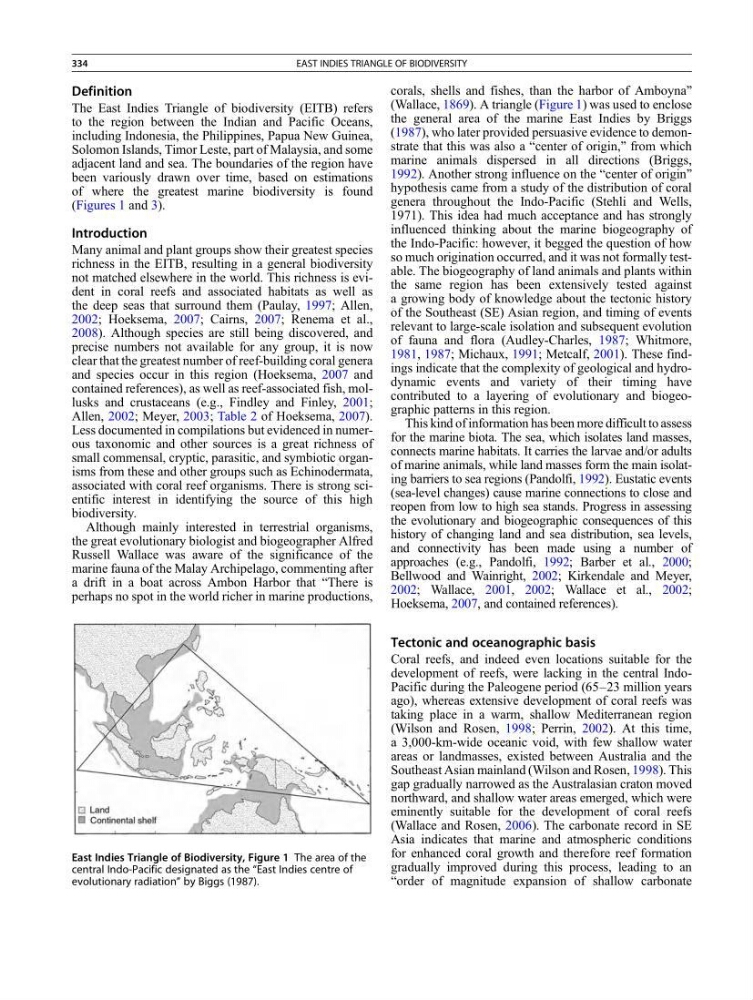
(Figures 1 and 3).
Introduction
Many animal and plant groups show their greatest species
richness in the EITB, resulting in a general biodiversity
not matched elsewhere in the world. This richness is evident in coral reefs and associated habitats as well as
the deep seas that surround them (Paulay, 1997; Allen,
2002; Hoeksema, 2007; Cairns, 2007; Renema et al.,
2008). Although species are still being discovered, and
precise numbers not available for any group, it is now
clear that the greatest number of reef-building coral genera
and species occur in this region (Hoeksema, 2007 and
contained references), as well as reef-associated fish, mollusks and crustaceans (e.g., Findley and Finley, 2001;
Allen, 2002; Meyer, 2003; Table 2 of Hoeksema, 2007).
Less documented in compilations but evidenced in numerous taxonomic and other sources is a great richness of
small commensal, cryptic, parasitic, and symbiotic organisms from these and other groups such as Echinodermata,
associated with coral reef organisms. There is strong scientific interest in identifying the source of this high
biodiversity.
Although mainly interested in terrestrial organisms,
the great evolutionary biologist and biogeographer Alfred
Russell Wallace was aware of the significance of the
marine fauna of the Malay Archipelago, commenting after
a drift in a boat across Ambon Harbor that “There is
perhaps no spot in the world richer in marine productions,
corals, shells and fishes, than the harbor of Amboyna”
(Wallace, 1869). A triangle (Figure 1) was used to enclose
the general area of the marine East Indies by Briggs
(1987), who later provided persuasive evidence to demonstrate that this was also a “center of origin,” from which
marine animals dispersed in all directions (Briggs,
1992). Another strong influence on the “center of origin”
hypothesis came from a study of the distribution of coral
genera throughout the Indo-Pacific (Stehli and Wells,
1971). This idea had much acceptance and has strongly
influenced thinking about the marine biogeography of
the Indo-Pacific: however, it begged the question of how
so much origination occurred, and it was not formally testable. The biogeography of land animals and plants within
the same region has been extensively tested against
a growing body of knowledge about the tectonic history
of the Southeast (SE) Asian region, and timing of events
relevant to large-scale isolation and subsequent evolution
of fauna and flora (Audley-Charles, 1987; Whitmore,
1981, 1987; Michaux, 1991; Metcalf, 2001). These findings indicate that the complexity of geological and hydrodynamic events and variety of their timing have
contributed to a layering of evolutionary and biogeographic patterns in this region.
This kind of information has been more difficult to assess
for the marine biota. The sea, which isolates land masses,
connects marine habitats. It carries the larvae and/or adults
of marine animals, while land masses form the main isolating barriers to sea regions (Pandolfi, 1992). Eustatic events
(sea-level changes) cause marine connections to close and
reopen from low to high sea stands. Progress in assessing
the evolutionary and biogeographic consequences of this
history of changing land and sea distribution, sea levels,
and connectivity has been made using a number of
approaches (e.g., Pandolfi, 1992; Barber et al., 2000;
Bellwood and Wainright, 2002; Kirkendale and Meyer,
2002; Wallace, 2001, 2002; Wallace et al., 2002;
Hoeksema, 2007, and contained references).
Tectonic and oceanographic basis
Coral reefs, and indeed even locations suitable for the
development of reefs, were lacking in the central IndoPacific during the Paleogene period (65–23 million years
ago), whereas extensive development of coral reefs was
taking place in a warm, shallow Mediterranean region
(Wilson and Rosen, 1998; Perrin, 2002). At this time,
a 3,000-km-wide oceanic void, with few shallow water
areas or landmasses, existed between Australia and the
Southeast Asian mainland (Wilson and Rosen, 1998). This
gap gradually narrowed as the Australasian craton moved
northward, and shallow water areas emerged, which were
eminently suitable for the development of coral reefs
(Wallace and Rosen, 2006). The carbonate record in SE
Asia indicates that marine and atmospheric conditions
for enhanced coral growth and therefore reef formation
gradually improved during this process, leading to an
“order of magnitude expansion of shallow carbonate
East Indies Triangle of Biodiversity, Figure 1 The area of the
central Indo-Pacific designated as the “East Indies centre of
evolutionary radiation” by Biggs (1987).
334
EAST INDIES TRIANGLE OF BIODIVERSITY
The East Indies Triangle of biodiversity (EITB) refers
to the region between the Indian and Pacific Oceans,
including Indonesia, the Philippines, Papua New Guinea,
Solomon Islands, Timor Leste, part of Malaysia, and some
adjacent land and sea. The boundaries of the region have
been variously drawn over time, based on estimations
of where the greatest marine biodiversity is found
(Figures 1 and 3).
Introduction
Many animal and plant groups show their greatest species
richness in the EITB, resulting in a general biodiversity
not matched elsewhere in the world. This richness is evident in coral reefs and associated habitats as well as
the deep seas that surround them (Paulay, 1997; Allen,
2002; Hoeksema, 2007; Cairns, 2007; Renema et al.,
2008). Although species are still being discovered, and
precise numbers not available for any group, it is now
clear that the greatest number of reef-building coral genera
and species occur in this region (Hoeksema, 2007 and
contained references), as well as reef-associated fish, mollusks and crustaceans (e.g., Findley and Finley, 2001;
Allen, 2002; Meyer, 2003; Table 2 of Hoeksema, 2007).
Less documented in compilations but evidenced in numerous taxonomic and other sources is a great richness of
small commensal, cryptic, parasitic, and symbiotic organisms from these and other groups such as Echinodermata,
associated with coral reef organisms. There is strong scientific interest in identifying the source of this high
biodiversity.
Although mainly interested in terrestrial organisms,
the great evolutionary biologist and biogeographer Alfred
Russell Wallace was aware of the significance of the
marine fauna of the Malay Archipelago, commenting after
a drift in a boat across Ambon Harbor that “There is
perhaps no spot in the world richer in marine productions,
corals, shells and fishes, than the harbor of Amboyna”
(Wallace, 1869). A triangle (Figure 1) was used to enclose
the general area of the marine East Indies by Briggs
(1987), who later provided persuasive evidence to demonstrate that this was also a “center of origin,” from which
marine animals dispersed in all directions (Briggs,
1992). Another strong influence on the “center of origin”
hypothesis came from a study of the distribution of coral
genera throughout the Indo-Pacific (Stehli and Wells,
1971). This idea had much acceptance and has strongly
influenced thinking about the marine biogeography of
the Indo-Pacific: however, it begged the question of how
so much origination occurred, and it was not formally testable. The biogeography of land animals and plants within
the same region has been extensively tested against
a growing body of knowledge about the tectonic history
of the Southeast (SE) Asian region, and timing of events
relevant to large-scale isolation and subsequent evolution
of fauna and flora (Audley-Charles, 1987; Whitmore,
1981, 1987; Michaux, 1991; Metcalf, 2001). These findings indicate that the complexity of geological and hydrodynamic events and variety of their timing have
contributed to a layering of evolutionary and biogeographic patterns in this region.
This kind of information has been more difficult to assess
for the marine biota. The sea, which isolates land masses,
connects marine habitats. It carries the larvae and/or adults
of marine animals, while land masses form the main isolating barriers to sea regions (Pandolfi, 1992). Eustatic events
(sea-level changes) cause marine connections to close and
reopen from low to high sea stands. Progress in assessing
the evolutionary and biogeographic consequences of this
history of changing land and sea distribution, sea levels,
and connectivity has been made using a number of
approaches (e.g., Pandolfi, 1992; Barber et al., 2000;
Bellwood and Wainright, 2002; Kirkendale and Meyer,
2002; Wallace, 2001, 2002; Wallace et al., 2002;
Hoeksema, 2007, and contained references).
Tectonic and oceanographic basis
Coral reefs, and indeed even locations suitable for the
development of reefs, were lacking in the central IndoPacific during the Paleogene period (65–23 million years
ago), whereas extensive development of coral reefs was
taking place in a warm, shallow Mediterranean region
(Wilson and Rosen, 1998; Perrin, 2002). At this time,
a 3,000-km-wide oceanic void, with few shallow water
areas or landmasses, existed between Australia and the
Southeast Asian mainland (Wilson and Rosen, 1998). This
gap gradually narrowed as the Australasian craton moved
northward, and shallow water areas emerged, which were
eminently suitable for the development of coral reefs
(Wallace and Rosen, 2006). The carbonate record in SE
Asia indicates that marine and atmospheric conditions
for enhanced coral growth and therefore reef formation
gradually improved during this process, leading to an
“order of magnitude expansion of shallow carbonate
East Indies Triangle of Biodiversity, Figure 1 The area of the
central Indo-Pacific designated as the “East Indies centre of
evolutionary radiation” by Biggs (1987).
334
EAST INDIES TRIANGLE OF BIODIVERSITY