

sometimes possible to infer that a prehistoric earthquake
caused uplift. On Malakula Island, Vanuatu, we find corals
that were uplifted about 1.2 m in 1965. A $1.2 m higher
than the 1965 corals are older corals that were uplifted during a previous event in about A.D.1729 (Taylor et al.,
1990). The preservation of these higher-level corals is evidence that the uplift that killed them was about $1 m. Had
the initial uplift been only $0.5 m, then the corals would
have been submerged during high tides and would have
been exposed to severe bioerosion.
Determining the ages of vertical displacements
recorded by corals
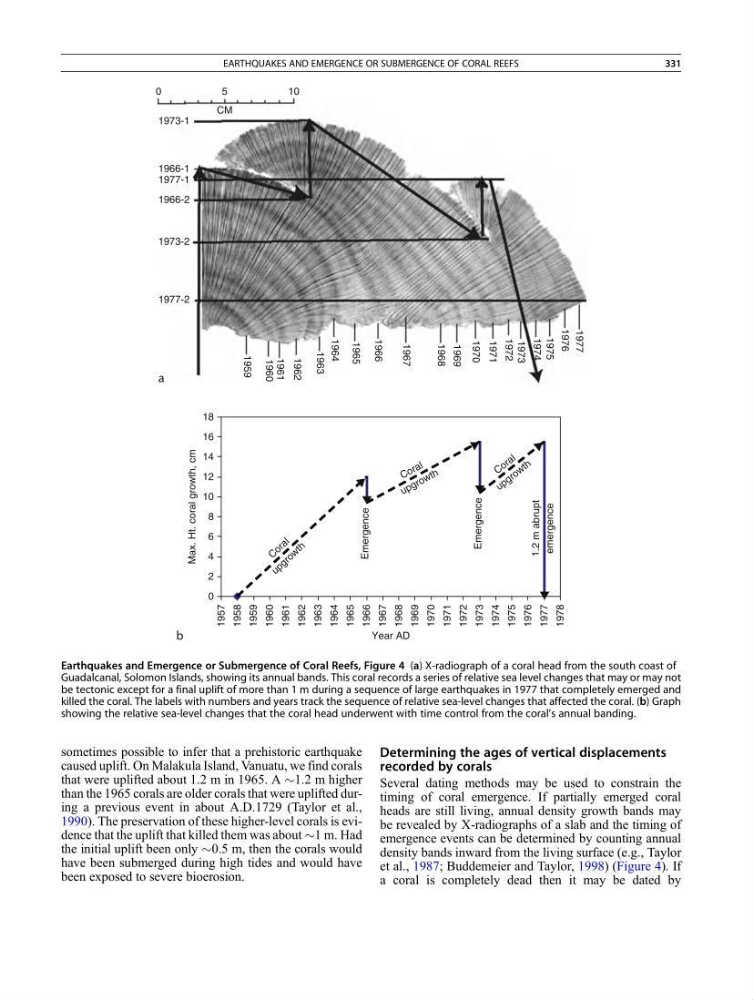
Several dating methods may be used to constrain the
timing of coral emergence. If partially emerged coral
heads are still living, annual density growth bands may
be revealed by X-radiographs of a slab and the timing of
emergence events can be determined by counting annual
density bands inward from the living surface (e.g., Taylor
et al., 1987; Buddemeier and Taylor, 1998) (Figure 4). If
a coral is completely dead then it may be dated by
1959
1977-2
1973-2
1966-2
1977-1
1966-1
1973-1
0
5
CM
10
1960
1961
1962
1963
1964
1965
1966
1967
1968
1969
1970
1971
1972
1973
1974
1976
1977
1975
b
a
0
2
4
6
8
10
12
14
16
18
1957
1958
1959
1960
1961
1962
1963
1964
1965
1966
1967
1968
1969
1970
1971
1972
1973
1974
1975
1976
1977
1978
Year AD
Max. Ht. coral growth, cm
C o r a l
u p g r o w t h
1.2 m abrupt
emergence
C o r a l
u p g r o w t h
C o r a l
u p g r o w t h
Emergence
Emergence
Earthquakes and Emergence or Submergence of Coral Reefs, Figure 4 (a) X-radiograph of a coral head from the south coast of
Guadalcanal, Solomon Islands, showing its annual bands. This coral records a series of relative sea level changes that may or may not
be tectonic except for a final uplift of more than 1 m during a sequence of large earthquakes in 1977 that completely emerged and
killed the coral. The labels with numbers and years track the sequence of relative sea-level changes that affected the coral. (b) Graph
showing the relative sea-level changes that the coral head underwent with time control from the coral’s annual banding.
EARTHQUAKES AND EMERGENCE OR SUBMERGENCE OF CORAL REEFS
331
caused uplift. On Malakula Island, Vanuatu, we find corals
that were uplifted about 1.2 m in 1965. A $1.2 m higher
than the 1965 corals are older corals that were uplifted during a previous event in about A.D.1729 (Taylor et al.,
1990). The preservation of these higher-level corals is evidence that the uplift that killed them was about $1 m. Had
the initial uplift been only $0.5 m, then the corals would
have been submerged during high tides and would have
been exposed to severe bioerosion.
Determining the ages of vertical displacements
recorded by corals
Several dating methods may be used to constrain the
timing of coral emergence. If partially emerged coral
heads are still living, annual density growth bands may
be revealed by X-radiographs of a slab and the timing of
emergence events can be determined by counting annual
density bands inward from the living surface (e.g., Taylor
et al., 1987; Buddemeier and Taylor, 1998) (Figure 4). If
a coral is completely dead then it may be dated by
1959
1977-2
1973-2
1966-2
1977-1
1966-1
1973-1
0
5
CM
10
1960
1961
1962
1963
1964
1965
1966
1967
1968
1969
1970
1971
1972
1973
1974
1976
1977
1975
b
a
0
2
4
6
8
10
12
14
16
18
1957
1958
1959
1960
1961
1962
1963
1964
1965
1966
1967
1968
1969
1970
1971
1972
1973
1974
1975
1976
1977
1978
Year AD
Max. Ht. coral growth, cm
C o r a l
u p g r o w t h
1.2 m abrupt
emergence
C o r a l
u p g r o w t h
C o r a l
u p g r o w t h
Emergence
Emergence
Earthquakes and Emergence or Submergence of Coral Reefs, Figure 4 (a) X-radiograph of a coral head from the south coast of
Guadalcanal, Solomon Islands, showing its annual bands. This coral records a series of relative sea level changes that may or may not
be tectonic except for a final uplift of more than 1 m during a sequence of large earthquakes in 1977 that completely emerged and
killed the coral. The labels with numbers and years track the sequence of relative sea-level changes that affected the coral. (b) Graph
showing the relative sea-level changes that the coral head underwent with time control from the coral’s annual banding.
EARTHQUAKES AND EMERGENCE OR SUBMERGENCE OF CORAL REEFS
331