

subjected to fissuring in response to contemporary earthquake shaking, slippage along underlying marginal-slope
deposits, and differential compaction over buried basement topography. The fissures were filled with sediment,
calcite cement, and organic growths, forming networks
of neptunian dykes.
The lithologies of the reef complexes have remained
essentially unaltered since deposition, other than in about
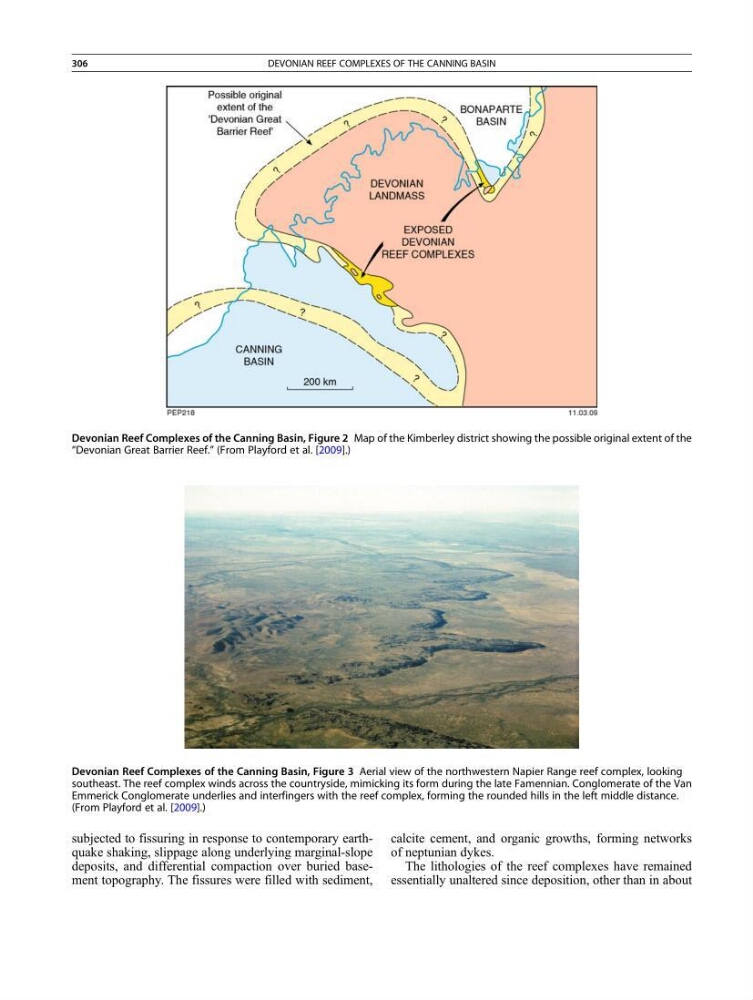
Devonian Reef Complexes of the Canning Basin, Figure 2 Map of the Kimberley district showing the possible original extent of the
“Devonian Great Barrier Reef.” (From Playford et al. [2009].)
Devonian Reef Complexes of the Canning Basin, Figure 3 Aerial view of the northwestern Napier Range reef complex, looking
southeast. The reef complex winds across the countryside, mimicking its form during the late Famennian. Conglomerate of the Van
Emmerick Conglomerate underlies and interfingers with the reef complex, forming the rounded hills in the left middle distance.
(From Playford et al. [2009].)
306
DEVONIAN REEF COMPLEXES OF THE CANNING BASIN
deposits, and differential compaction over buried basement topography. The fissures were filled with sediment,
calcite cement, and organic growths, forming networks
of neptunian dykes.
The lithologies of the reef complexes have remained
essentially unaltered since deposition, other than in about
Devonian Reef Complexes of the Canning Basin, Figure 2 Map of the Kimberley district showing the possible original extent of the
“Devonian Great Barrier Reef.” (From Playford et al. [2009].)
Devonian Reef Complexes of the Canning Basin, Figure 3 Aerial view of the northwestern Napier Range reef complex, looking
southeast. The reef complex winds across the countryside, mimicking its form during the late Famennian. Conglomerate of the Van
Emmerick Conglomerate underlies and interfingers with the reef complex, forming the rounded hills in the left middle distance.
(From Playford et al. [2009].)
306
DEVONIAN REEF COMPLEXES OF THE CANNING BASIN