

DEVONIAN REEF COMPLEXES OF THE CANNING
BASIN
Phillip E. Playford
Geological Survey of Western Australia
Middle and Upper Devonian reef complexes are spectacularly exposed along the northern margin of the Canning
Basin. They form rugged limestone ranges, in a belt some
350 km long and up to 50 km wide, that have become
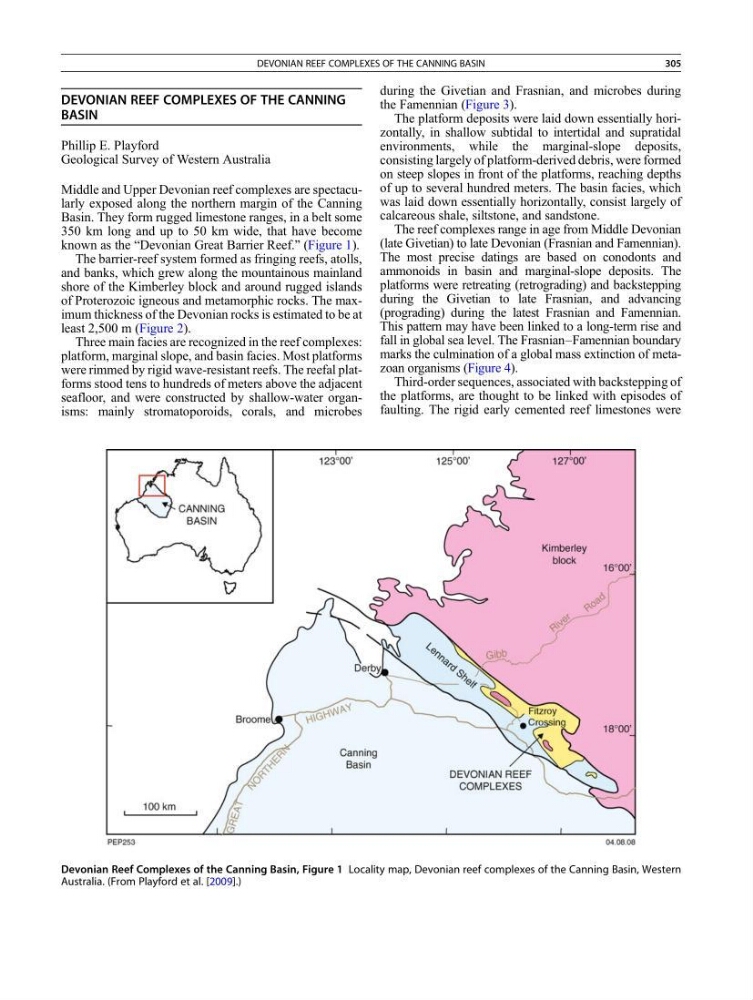
known as the “Devonian Great Barrier Reef.” (Figure 1).
The barrier-reef system formed as fringing reefs, atolls,
and banks, which grew along the mountainous mainland
shore of the Kimberley block and around rugged islands
of Proterozoic igneous and metamorphic rocks. The maximum thickness of the Devonian rocks is estimated to be at
least 2,500 m (Figure 2).
Three main facies are recognized in the reef complexes:
platform, marginal slope, and basin facies. Most platforms
were rimmed by rigid wave-resistant reefs. The reefal platforms stood tens to hundreds of meters above the adjacent
seafloor, and were constructed by shallow-water organisms: mainly stromatoporoids, corals, and microbes
during the Givetian and Frasnian, and microbes during
the Famennian (Figure 3).
The platform deposits were laid down essentially horizontally, in shallow subtidal to intertidal and supratidal
environments, while the marginal-slope deposits,
consisting largely of platform-derived debris, were formed
on steep slopes in front of the platforms, reaching depths
of up to several hundred meters. The basin facies, which
was laid down essentially horizontally, consist largely of
calcareous shale, siltstone, and sandstone.
The reef complexes range in age from Middle Devonian
(late Givetian) to late Devonian (Frasnian and Famennian).
The most precise datings are based on conodonts and
ammonoids in basin and marginal-slope deposits. The
platforms were retreating (retrograding) and backstepping
during the Givetian to late Frasnian, and advancing
(prograding) during the latest Frasnian and Famennian.
This pattern may have been linked to a long-term rise and
fall in global sea level. The Frasnian–Famennian boundary
marks the culmination of a global mass extinction of metazoan organisms (Figure 4).
Third-order sequences, associated with backstepping of
the platforms, are thought to be linked with episodes of
faulting. The rigid early cemented reef limestones were
Devonian Reef Complexes of the Canning Basin, Figure 1 Locality map, Devonian reef complexes of the Canning Basin, Western
Australia. (From Playford et al. [2009].)
DEVONIAN REEF COMPLEXES OF THE CANNING BASIN
305
BASIN
Phillip E. Playford
Geological Survey of Western Australia
Middle and Upper Devonian reef complexes are spectacularly exposed along the northern margin of the Canning
Basin. They form rugged limestone ranges, in a belt some
350 km long and up to 50 km wide, that have become
known as the “Devonian Great Barrier Reef.” (Figure 1).
The barrier-reef system formed as fringing reefs, atolls,
and banks, which grew along the mountainous mainland
shore of the Kimberley block and around rugged islands
of Proterozoic igneous and metamorphic rocks. The maximum thickness of the Devonian rocks is estimated to be at
least 2,500 m (Figure 2).
Three main facies are recognized in the reef complexes:
platform, marginal slope, and basin facies. Most platforms
were rimmed by rigid wave-resistant reefs. The reefal platforms stood tens to hundreds of meters above the adjacent
seafloor, and were constructed by shallow-water organisms: mainly stromatoporoids, corals, and microbes
during the Givetian and Frasnian, and microbes during
the Famennian (Figure 3).
The platform deposits were laid down essentially horizontally, in shallow subtidal to intertidal and supratidal
environments, while the marginal-slope deposits,
consisting largely of platform-derived debris, were formed
on steep slopes in front of the platforms, reaching depths
of up to several hundred meters. The basin facies, which
was laid down essentially horizontally, consist largely of
calcareous shale, siltstone, and sandstone.
The reef complexes range in age from Middle Devonian
(late Givetian) to late Devonian (Frasnian and Famennian).
The most precise datings are based on conodonts and
ammonoids in basin and marginal-slope deposits. The
platforms were retreating (retrograding) and backstepping
during the Givetian to late Frasnian, and advancing
(prograding) during the latest Frasnian and Famennian.
This pattern may have been linked to a long-term rise and
fall in global sea level. The Frasnian–Famennian boundary
marks the culmination of a global mass extinction of metazoan organisms (Figure 4).
Third-order sequences, associated with backstepping of
the platforms, are thought to be linked with episodes of
faulting. The rigid early cemented reef limestones were
Devonian Reef Complexes of the Canning Basin, Figure 1 Locality map, Devonian reef complexes of the Canning Basin, Western
Australia. (From Playford et al. [2009].)
DEVONIAN REEF COMPLEXES OF THE CANNING BASIN
305