

15% of the section where early dolomitization occurred. In
some areas, the reef complexes are cut by normal faults,
with associated tilting and folding, but over large areas,
they remain almost undeformed (Figures 5 and 6).
Masses of terrigenous conglomerate interfinger with
and extend through the reef complexes at various localities along the outcrop belt. They were laid down as
alluvial-fan, fan-delta, and submarine-fan deposits in front
of the scarps of active faults. Large volumes of sand and
mud were poured into basins adjoining the conglomerate
bodies (Figure 7).
The area was subjected to glaciation during the late
Carboniferous and early Permian, by continental ice
sheets, possibly up to several kilometers thick. Glaciation
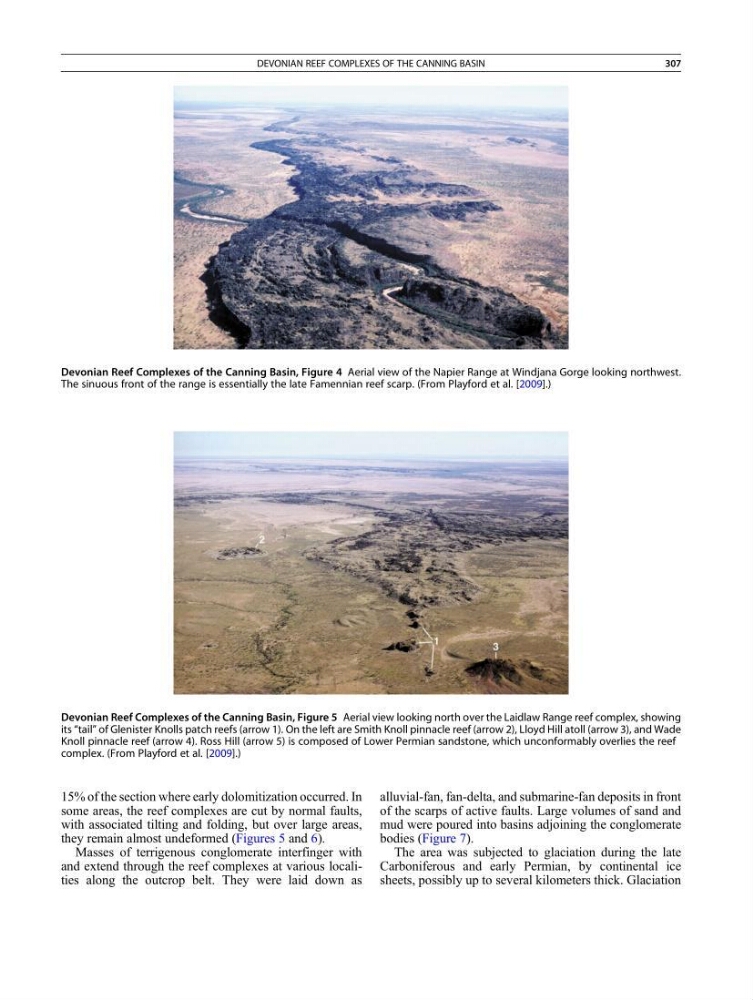
Devonian Reef Complexes of the Canning Basin, Figure 4 Aerial view of the Napier Range at Windjana Gorge looking northwest.
The sinuous front of the range is essentially the late Famennian reef scarp. (From Playford et al. [2009].)
Devonian Reef Complexes of the Canning Basin, Figure 5 Aerial view looking north over the Laidlaw Range reef complex, showing
its “tail” of Glenister Knolls patch reefs (arrow 1). On the left are Smith Knoll pinnacle reef (arrow 2), Lloyd Hill atoll (arrow 3), and Wade
Knoll pinnacle reef (arrow 4). Ross Hill (arrow 5) is composed of Lower Permian sandstone, which unconformably overlies the reef
complex. (From Playford et al. [2009].)
DEVONIAN REEF COMPLEXES OF THE CANNING BASIN
307
some areas, the reef complexes are cut by normal faults,
with associated tilting and folding, but over large areas,
they remain almost undeformed (Figures 5 and 6).
Masses of terrigenous conglomerate interfinger with
and extend through the reef complexes at various localities along the outcrop belt. They were laid down as
alluvial-fan, fan-delta, and submarine-fan deposits in front
of the scarps of active faults. Large volumes of sand and
mud were poured into basins adjoining the conglomerate
bodies (Figure 7).
The area was subjected to glaciation during the late
Carboniferous and early Permian, by continental ice
sheets, possibly up to several kilometers thick. Glaciation
Devonian Reef Complexes of the Canning Basin, Figure 4 Aerial view of the Napier Range at Windjana Gorge looking northwest.
The sinuous front of the range is essentially the late Famennian reef scarp. (From Playford et al. [2009].)
Devonian Reef Complexes of the Canning Basin, Figure 5 Aerial view looking north over the Laidlaw Range reef complex, showing
its “tail” of Glenister Knolls patch reefs (arrow 1). On the left are Smith Knoll pinnacle reef (arrow 2), Lloyd Hill atoll (arrow 3), and Wade
Knoll pinnacle reef (arrow 4). Ross Hill (arrow 5) is composed of Lower Permian sandstone, which unconformably overlies the reef
complex. (From Playford et al. [2009].)
DEVONIAN REEF COMPLEXES OF THE CANNING BASIN
307