

algae, sponges, and molluscs. In many Palaeozoic reefs,
sponges rather than corals were the dominant builders
and in some late Mesozoic reefs, the same role was played
by molluscs (rudist bivalves).
Even modern reefs are not necessarily coral dominated.
Some, forming intertidal structures in the Caribbean and
Bermuda, are made by vermetid “worms” (molluscs).
There are also widespread subtidal structures dominated
by serpulid worms (annelids) and odd reefs everywhere
owe their existence to other organisms, especially oysters.
However, in terms of quantity, the reefs dominated by
organisms other than scleractinian corals and their allies
(including a few small taxa such as the blue coral
Heliopora and the fire coral Millepora) are insignificant
and have little in common with coral reefs other than in
the material of which they are made. Such structures
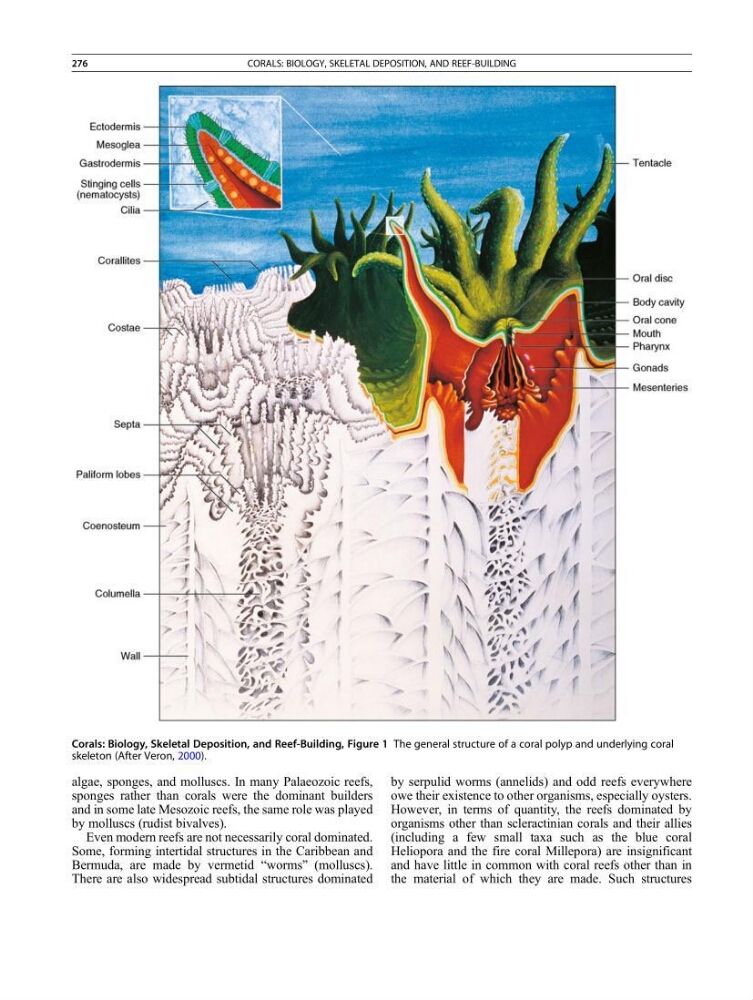
Corals: Biology, Skeletal Deposition, and Reef-Building, Figure 1 The general structure of a coral polyp and underlying coral
skeleton (After Veron, 2000).
276
CORALS: BIOLOGY, SKELETAL DEPOSITION, AND REEF-BUILDING
sponges rather than corals were the dominant builders
and in some late Mesozoic reefs, the same role was played
by molluscs (rudist bivalves).
Even modern reefs are not necessarily coral dominated.
Some, forming intertidal structures in the Caribbean and
Bermuda, are made by vermetid “worms” (molluscs).
There are also widespread subtidal structures dominated
by serpulid worms (annelids) and odd reefs everywhere
owe their existence to other organisms, especially oysters.
However, in terms of quantity, the reefs dominated by
organisms other than scleractinian corals and their allies
(including a few small taxa such as the blue coral
Heliopora and the fire coral Millepora) are insignificant
and have little in common with coral reefs other than in
the material of which they are made. Such structures
Corals: Biology, Skeletal Deposition, and Reef-Building, Figure 1 The general structure of a coral polyp and underlying coral
skeleton (After Veron, 2000).
276
CORALS: BIOLOGY, SKELETAL DEPOSITION, AND REEF-BUILDING