

excluded, the term “coral reef ” still needs constraining,
for some deep ocean corals form extensive structures, built
by one type of coral (Lophelia). These are commonly
called reefs, but they have none of the characteristics of
coral reefs as geological structures (they do not form solid
limestone) or as biological structures (they do not depend
on photosynthesis nor are they biologically diverse).
There is one further distinguishing characteristic of
coral reefs: although they are principally made of calcium
carbonate derived from coral, coral skeletons need to be
cemented into solid rock by coralline algae. Coralline
algae generally have a wider distribution range than
corals, but those that cement coral debris into reefs flourish in shallow, turbulent, well-lit environments and thus
it is they as much as corals that determine where highly
consolidated reefs best grow. They may also have
a dominant influence on how fast they grow or if they
grow at all in deeper water.
Reef carbonates
Although most (90–95%) of terrestrial limestone is
derived from reefs built by a variety of animals in shallow
marine environments, this by no means reflects the principal source of carbonates on Earth. Around 90% of all
today’s marine carbonates are deep-sea sediments derived
primarily from plankton (mostly foraminifera and
coccolithophores). Due to their deep water location, these
are rarely uplifted to form geological rock formations on
land; rather they are either dissolved in the ocean or
subducted into the Earth’s mantle. Another 5% of carbonates are of mixed composition and are found on continental slopes. In a few regions, these carbonates have been
consolidated and uplifted or otherwise exposed on land.
Perhaps surprisingly, only 5% of all carbonates today
are of coral reef origin although this small proportion
includes vast tracts of mountain slopes like the calcareous
reefs of Austria. The proportion of total carbonates which
are represented by living reefs is much less than 1%.
Nevertheless, this small proportion is all important.
Reef building
If corals grow in sufficient quantity, and the rate of both
skeleton production (calcification) and algal cementation
exceeds that of erosion, the resulting accumulation of calcium carbonate can form limestone reefs. The success of
the process depends on speed, which is why reef-building
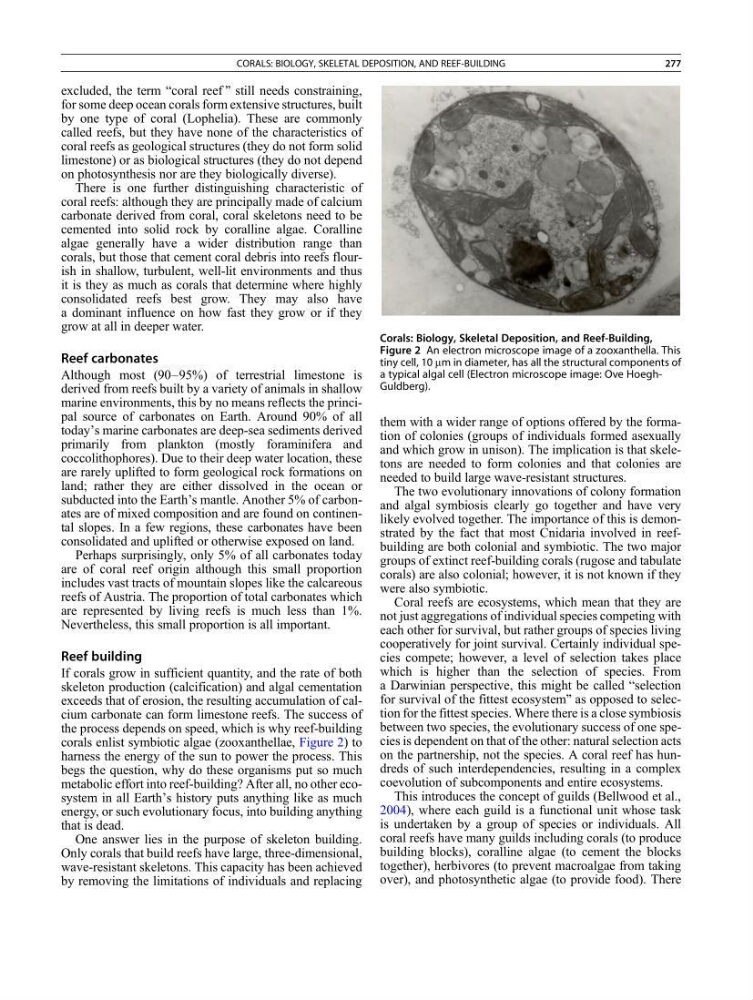
corals enlist symbiotic algae (zooxanthellae, Figure 2) to
harness the energy of the sun to power the process. This
begs the question, why do these organisms put so much
metabolic effort into reef-building? After all, no other ecosystem in all Earth’s history puts anything like as much
energy, or such evolutionary focus, into building anything
that is dead.
One answer lies in the purpose of skeleton building.
Only corals that build reefs have large, three-dimensional,
wave-resistant skeletons. This capacity has been achieved
by removing the limitations of individuals and replacing
them with a wider range of options offered by the formation of colonies (groups of individuals formed asexually
and which grow in unison). The implication is that skeletons are needed to form colonies and that colonies are
needed to build large wave-resistant structures.
The two evolutionary innovations of colony formation
and algal symbiosis clearly go together and have very
likely evolved together. The importance of this is demonstrated by the fact that most Cnidaria involved in reefbuilding are both colonial and symbiotic. The two major
groups of extinct reef-building corals (rugose and tabulate
corals) are also colonial; however, it is not known if they
were also symbiotic.
Coral reefs are ecosystems, which mean that they are
not just aggregations of individual species competing with
each other for survival, but rather groups of species living
cooperatively for joint survival. Certainly individual species compete; however, a level of selection takes place
which is higher than the selection of species. From
a Darwinian perspective, this might be called “selection
for survival of the fittest ecosystem” as opposed to selection for the fittest species. Where there is a close symbiosis
between two species, the evolutionary success of one species is dependent on that of the other: natural selection acts
on the partnership, not the species. A coral reef has hundreds of such interdependencies, resulting in a complex
coevolution of subcomponents and entire ecosystems.
This introduces the concept of guilds (Bellwood et al.,
2004), where each guild is a functional unit whose task
is undertaken by a group of species or individuals. All
coral reefs have many guilds including corals (to produce
building blocks), coralline algae (to cement the blocks
together), herbivores (to prevent macroalgae from taking
over), and photosynthetic algae (to provide food). There
Corals: Biology, Skeletal Deposition, and Reef-Building,
Figure 2 An electron microscope image of a zooxanthella. This
tiny cell, 10 mm in diameter, has all the structural components of
a typical algal cell (Electron microscope image: Ove HoeghGuldberg).
CORALS: BIOLOGY, SKELETAL DEPOSITION, AND REEF-BUILDING
277
for some deep ocean corals form extensive structures, built
by one type of coral (Lophelia). These are commonly
called reefs, but they have none of the characteristics of
coral reefs as geological structures (they do not form solid
limestone) or as biological structures (they do not depend
on photosynthesis nor are they biologically diverse).
There is one further distinguishing characteristic of
coral reefs: although they are principally made of calcium
carbonate derived from coral, coral skeletons need to be
cemented into solid rock by coralline algae. Coralline
algae generally have a wider distribution range than
corals, but those that cement coral debris into reefs flourish in shallow, turbulent, well-lit environments and thus
it is they as much as corals that determine where highly
consolidated reefs best grow. They may also have
a dominant influence on how fast they grow or if they
grow at all in deeper water.
Reef carbonates
Although most (90–95%) of terrestrial limestone is
derived from reefs built by a variety of animals in shallow
marine environments, this by no means reflects the principal source of carbonates on Earth. Around 90% of all
today’s marine carbonates are deep-sea sediments derived
primarily from plankton (mostly foraminifera and
coccolithophores). Due to their deep water location, these
are rarely uplifted to form geological rock formations on
land; rather they are either dissolved in the ocean or
subducted into the Earth’s mantle. Another 5% of carbonates are of mixed composition and are found on continental slopes. In a few regions, these carbonates have been
consolidated and uplifted or otherwise exposed on land.
Perhaps surprisingly, only 5% of all carbonates today
are of coral reef origin although this small proportion
includes vast tracts of mountain slopes like the calcareous
reefs of Austria. The proportion of total carbonates which
are represented by living reefs is much less than 1%.
Nevertheless, this small proportion is all important.
Reef building
If corals grow in sufficient quantity, and the rate of both
skeleton production (calcification) and algal cementation
exceeds that of erosion, the resulting accumulation of calcium carbonate can form limestone reefs. The success of
the process depends on speed, which is why reef-building
corals enlist symbiotic algae (zooxanthellae, Figure 2) to
harness the energy of the sun to power the process. This
begs the question, why do these organisms put so much
metabolic effort into reef-building? After all, no other ecosystem in all Earth’s history puts anything like as much
energy, or such evolutionary focus, into building anything
that is dead.
One answer lies in the purpose of skeleton building.
Only corals that build reefs have large, three-dimensional,
wave-resistant skeletons. This capacity has been achieved
by removing the limitations of individuals and replacing
them with a wider range of options offered by the formation of colonies (groups of individuals formed asexually
and which grow in unison). The implication is that skeletons are needed to form colonies and that colonies are
needed to build large wave-resistant structures.
The two evolutionary innovations of colony formation
and algal symbiosis clearly go together and have very
likely evolved together. The importance of this is demonstrated by the fact that most Cnidaria involved in reefbuilding are both colonial and symbiotic. The two major
groups of extinct reef-building corals (rugose and tabulate
corals) are also colonial; however, it is not known if they
were also symbiotic.
Coral reefs are ecosystems, which mean that they are
not just aggregations of individual species competing with
each other for survival, but rather groups of species living
cooperatively for joint survival. Certainly individual species compete; however, a level of selection takes place
which is higher than the selection of species. From
a Darwinian perspective, this might be called “selection
for survival of the fittest ecosystem” as opposed to selection for the fittest species. Where there is a close symbiosis
between two species, the evolutionary success of one species is dependent on that of the other: natural selection acts
on the partnership, not the species. A coral reef has hundreds of such interdependencies, resulting in a complex
coevolution of subcomponents and entire ecosystems.
This introduces the concept of guilds (Bellwood et al.,
2004), where each guild is a functional unit whose task
is undertaken by a group of species or individuals. All
coral reefs have many guilds including corals (to produce
building blocks), coralline algae (to cement the blocks
together), herbivores (to prevent macroalgae from taking
over), and photosynthetic algae (to provide food). There
Corals: Biology, Skeletal Deposition, and Reef-Building,
Figure 2 An electron microscope image of a zooxanthella. This
tiny cell, 10 mm in diameter, has all the structural components of
a typical algal cell (Electron microscope image: Ove HoeghGuldberg).
CORALS: BIOLOGY, SKELETAL DEPOSITION, AND REEF-BUILDING
277