

late Holocene as structures widely referred to among scientists as “coral reefs.” Their smaller dependence on algal
cementation and strong framework is evident in a number
of modes of growth in fringing coral reefs (Kennedy and
Woodroffe, 2002), in which lateral reef growth over
unconsolidated coral debris is prominent. In summary,
the first definition (see section ‘Definition’) is preferred
here because it accommodates both the “classic” coral–
algal reef style defined by James and Macintyre
(1985) and also coral tracts established on less strongly
consolidated substrata.
Coral community: geological and ecological
definitions
Further differentiation is provided by Buddemeier and
Hopley (1988), who distinguish between “coral reef,”
“coral reef community,” and “coral community.” They
use “coral reef community” to refer to an incipient coral
reef (Figure 1b) – not yet a massive wave-resistant structure, but on a developmental trajectory toward that state.
Their “coral community” is on no such trajectory: it refers
to a local assemblage of corals that are attached directly to
nonreef substrata and provide no indication that their
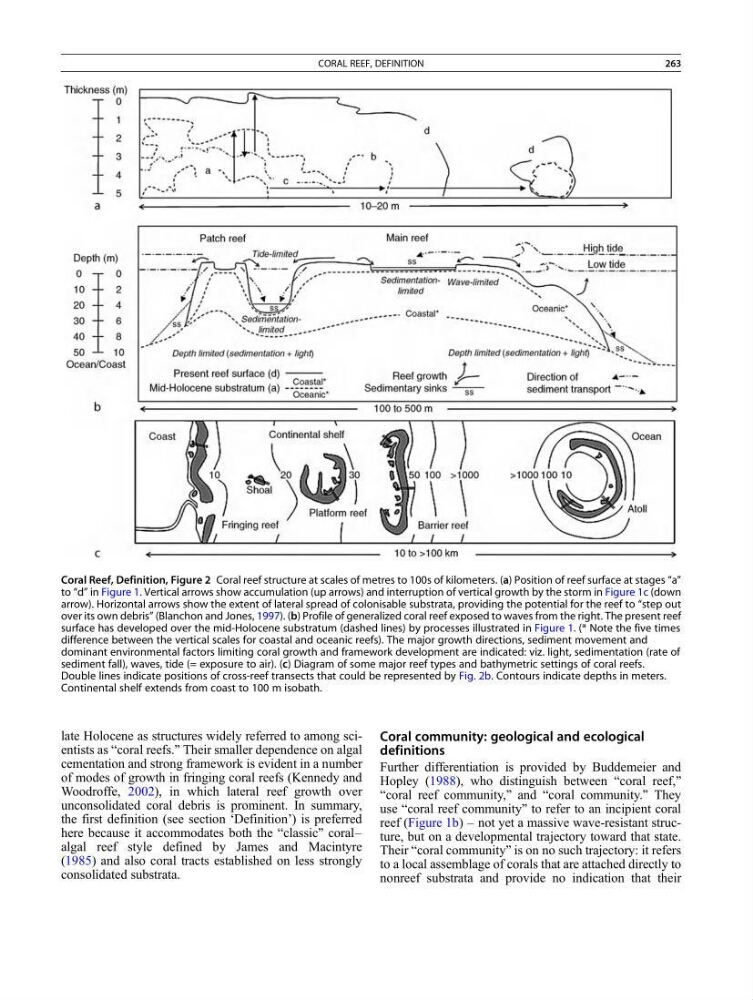
Coral Reef, Definition, Figure 2 Coral reef structure at scales of metres to 100s of kilometers. (a) Position of reef surface at stages “a”
to “d” in Figure 1. Vertical arrows show accumulation (up arrows) and interruption of vertical growth by the storm in Figure 1c (down
arrow). Horizontal arrows show the extent of lateral spread of colonisable substrata, providing the potential for the reef to “step out
over its own debris” (Blanchon and Jones, 1997). (b) Profile of generalized coral reef exposed to waves from the right. The present reef
surface has developed over the mid-Holocene substratum (dashed lines) by processes illustrated in Figure 1. (* Note the five times
difference between the vertical scales for coastal and oceanic reefs). The major growth directions, sediment movement and
dominant environmental factors limiting coral growth and framework development are indicated: viz. light, sedimentation (rate of
sediment fall), waves, tide (= exposure to air). (c) Diagram of some major reef types and bathymetric settings of coral reefs.
Double lines indicate positions of cross-reef transects that could be represented by Fig. 2b. Contours indicate depths in meters.
Continental shelf extends from coast to 100 m isobath.
CORAL REEF, DEFINITION
263
cementation and strong framework is evident in a number
of modes of growth in fringing coral reefs (Kennedy and
Woodroffe, 2002), in which lateral reef growth over
unconsolidated coral debris is prominent. In summary,
the first definition (see section ‘Definition’) is preferred
here because it accommodates both the “classic” coral–
algal reef style defined by James and Macintyre
(1985) and also coral tracts established on less strongly
consolidated substrata.
Coral community: geological and ecological
definitions
Further differentiation is provided by Buddemeier and
Hopley (1988), who distinguish between “coral reef,”
“coral reef community,” and “coral community.” They
use “coral reef community” to refer to an incipient coral
reef (Figure 1b) – not yet a massive wave-resistant structure, but on a developmental trajectory toward that state.
Their “coral community” is on no such trajectory: it refers
to a local assemblage of corals that are attached directly to
nonreef substrata and provide no indication that their
Coral Reef, Definition, Figure 2 Coral reef structure at scales of metres to 100s of kilometers. (a) Position of reef surface at stages “a”
to “d” in Figure 1. Vertical arrows show accumulation (up arrows) and interruption of vertical growth by the storm in Figure 1c (down
arrow). Horizontal arrows show the extent of lateral spread of colonisable substrata, providing the potential for the reef to “step out
over its own debris” (Blanchon and Jones, 1997). (b) Profile of generalized coral reef exposed to waves from the right. The present reef
surface has developed over the mid-Holocene substratum (dashed lines) by processes illustrated in Figure 1. (* Note the five times
difference between the vertical scales for coastal and oceanic reefs). The major growth directions, sediment movement and
dominant environmental factors limiting coral growth and framework development are indicated: viz. light, sedimentation (rate of
sediment fall), waves, tide (= exposure to air). (c) Diagram of some major reef types and bathymetric settings of coral reefs.
Double lines indicate positions of cross-reef transects that could be represented by Fig. 2b. Contours indicate depths in meters.
Continental shelf extends from coast to 100 m isobath.
CORAL REEF, DEFINITION
263