

The James and Macintyre definition of “coral-algal
reef ” (above) gives coralline algae equal prominence with
stony corals, recognizing their role both in accreting thick
algal ridges and in cementing coral skeletons together into
a framework. Their definition works extremely well for
oceanic reefs worldwide, in which the necessary resistance to powerful ocean waves is inconceivable without
the major contribution made by coralline algae. However,
the term “coral reef ” is also used to describe coral tracts
sitting atop accumulations of coral debris with little or
no submarine cementation: e.g., cold water reefs (Roberts
et al., 2006) and many tropical fringing reefs, shoals,
mounds, and banks. This raises the question of whether
these latter forms should be excluded and called something else, or included under a more generic definition
such as the first one presented above. It would be difficult
to apply the James and Macintyre definition – with its
emphasis on cementation by coralline algae – to many
of the mega-diverse coral reefs in sheltered waters of
South-East Asia (Spalding et al., 2001; see East Indies Triangle of Biodiversity), the Great Barrier Reef lagoon
(Johnson and Risk, 1987; Hopley et al., 2007; Perry
et al., 2008), or the rhomboid shoals behind the Belize
Barrier Reef. The latter have been described in terms that
could be used to describe reefs in sheltered waters in many
parts of the world: little submarine cementation; corals stabilized by interlocking of their skeletons; colonies growing to the point of oversteepening and toppling down
slope; debris fans at their base; only occasional storm disturbance (Aronson and Ellner, 2007). Lacking major
cementation, and lacking exposure to the ocean’s strongest waves, their wave-resistance is less in absolute terms
than that of oceanic coral–algal reefs. They have, nevertheless, like “coral–algal” reefs, elaborated in the mid- to
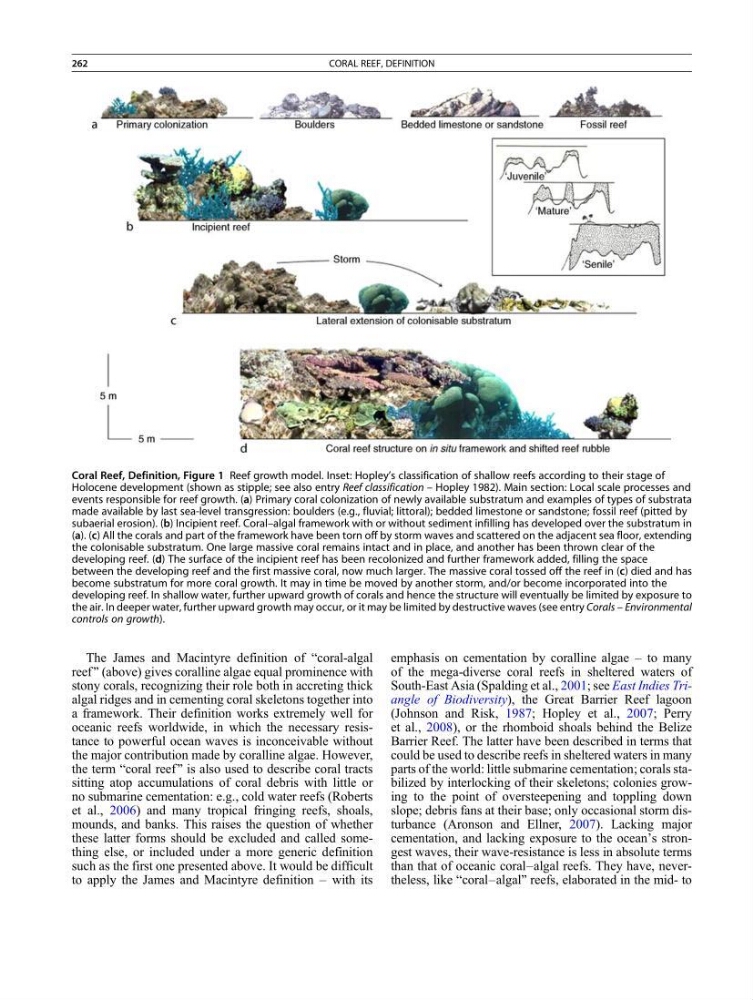
Coral Reef, Definition, Figure 1 Reef growth model. Inset: Hopley’s classification of shallow reefs according to their stage of
Holocene development (shown as stipple; see also entry Reef classification – Hopley 1982). Main section: Local scale processes and
events responsible for reef growth. (a) Primary coral colonization of newly available substratum and examples of types of substrata
made available by last sea-level transgression: boulders (e.g., fluvial; littoral); bedded limestone or sandstone; fossil reef (pitted by
subaerial erosion). (b) Incipient reef. Coral–algal framework with or without sediment infilling has developed over the substratum in
(a). (c) All the corals and part of the framework have been torn off by storm waves and scattered on the adjacent sea floor, extending
the colonisable substratum. One large massive coral remains intact and in place, and another has been thrown clear of the
developing reef. (d) The surface of the incipient reef has been recolonized and further framework added, filling the space
between the developing reef and the first massive coral, now much larger. The massive coral tossed off the reef in (c) died and has
become substratum for more coral growth. It may in time be moved by another storm, and/or become incorporated into the
developing reef. In shallow water, further upward growth of corals and hence the structure will eventually be limited by exposure to
the air. In deeper water, further upward growth may occur, or it may be limited by destructive waves (see entry Corals – Environmental
controls on growth).
262
CORAL REEF, DEFINITION
reef ” (above) gives coralline algae equal prominence with
stony corals, recognizing their role both in accreting thick
algal ridges and in cementing coral skeletons together into
a framework. Their definition works extremely well for
oceanic reefs worldwide, in which the necessary resistance to powerful ocean waves is inconceivable without
the major contribution made by coralline algae. However,
the term “coral reef ” is also used to describe coral tracts
sitting atop accumulations of coral debris with little or
no submarine cementation: e.g., cold water reefs (Roberts
et al., 2006) and many tropical fringing reefs, shoals,
mounds, and banks. This raises the question of whether
these latter forms should be excluded and called something else, or included under a more generic definition
such as the first one presented above. It would be difficult
to apply the James and Macintyre definition – with its
emphasis on cementation by coralline algae – to many
of the mega-diverse coral reefs in sheltered waters of
South-East Asia (Spalding et al., 2001; see East Indies Triangle of Biodiversity), the Great Barrier Reef lagoon
(Johnson and Risk, 1987; Hopley et al., 2007; Perry
et al., 2008), or the rhomboid shoals behind the Belize
Barrier Reef. The latter have been described in terms that
could be used to describe reefs in sheltered waters in many
parts of the world: little submarine cementation; corals stabilized by interlocking of their skeletons; colonies growing to the point of oversteepening and toppling down
slope; debris fans at their base; only occasional storm disturbance (Aronson and Ellner, 2007). Lacking major
cementation, and lacking exposure to the ocean’s strongest waves, their wave-resistance is less in absolute terms
than that of oceanic coral–algal reefs. They have, nevertheless, like “coral–algal” reefs, elaborated in the mid- to
Coral Reef, Definition, Figure 1 Reef growth model. Inset: Hopley’s classification of shallow reefs according to their stage of
Holocene development (shown as stipple; see also entry Reef classification – Hopley 1982). Main section: Local scale processes and
events responsible for reef growth. (a) Primary coral colonization of newly available substratum and examples of types of substrata
made available by last sea-level transgression: boulders (e.g., fluvial; littoral); bedded limestone or sandstone; fossil reef (pitted by
subaerial erosion). (b) Incipient reef. Coral–algal framework with or without sediment infilling has developed over the substratum in
(a). (c) All the corals and part of the framework have been torn off by storm waves and scattered on the adjacent sea floor, extending
the colonisable substratum. One large massive coral remains intact and in place, and another has been thrown clear of the
developing reef. (d) The surface of the incipient reef has been recolonized and further framework added, filling the space
between the developing reef and the first massive coral, now much larger. The massive coral tossed off the reef in (c) died and has
become substratum for more coral growth. It may in time be moved by another storm, and/or become incorporated into the
developing reef. In shallow water, further upward growth of corals and hence the structure will eventually be limited by exposure to
the air. In deeper water, further upward growth may occur, or it may be limited by destructive waves (see entry Corals – Environmental
controls on growth).
262
CORAL REEF, DEFINITION