

predecessors have, or they and their successors will, substantially expand the substratum the way incipient reefs
do. The state illustrated in Figure 1a, assuming it was representative of an area of at least hundreds of meters, would
be referred to as “just a coral community” so long the
corals failed to add to a wave-resistant framework, either
in situ or by ending up in a congruent rubble bank.
These terms are useful in placing “coral reef” on a “notreef” to “reef” continuum, defined in terms of realized or
potential “structure.” However ecologists use these terms
differently: “community ecology” is a rich and long
established discipline that focuses on environmental and
biological drivers of “structure” in plant and animal communities (May, 1985). “Structure” in a community refers
not to physical form, but rather to spatial pattern, species
composition, population dynamics and the like. As
a simple descriptive term within reef ecology, “a coral
community” refers to the corals occupying a local area,
irrespective of its substratum (e.g., Done, 1982), and
a “coral reef community” refers to the entire ensemble of
marine species that occupy a coral reef, and among which
the “coral community” is a part. Coral reef communities
are extraordinarily rich in species and co-evolved relationships, with important functional roles that facilitate tight
recycling of nutrients in nutrient-poor waters (Hallock,
2001), survival in turbid seas (Perry et al., 2008a), and
high per unit area productivity of protein, reef building
blocks and sediments (Done et al., 1996). The terms “coral
community” and “coral reef community” thus have
contrasting nuances for earth scientists and biologists.
However, their meaning will usually be clear according
to the context in which they are used.
The measure of a good definition is the extent to which
it eliminates similar entities. In the following sections, the
definition is dissected and the terms elaborated using both
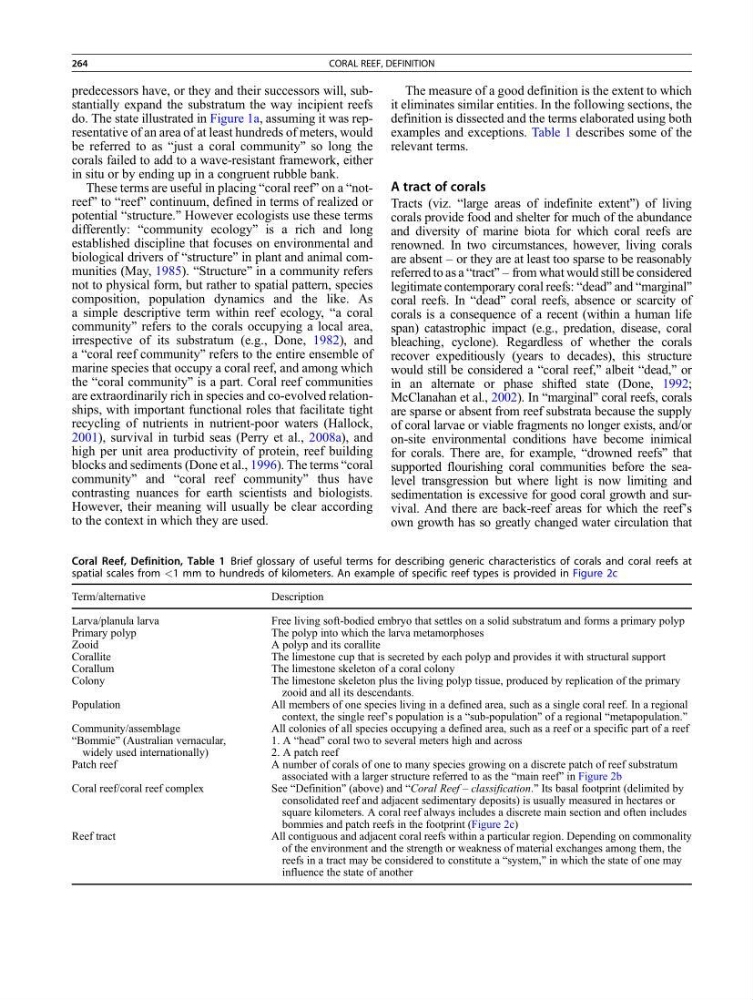
examples and exceptions. Table 1 describes some of the
relevant terms.
A tract of corals
Tracts (viz. “large areas of indefinite extent”) of living
corals provide food and shelter for much of the abundance
and diversity of marine biota for which coral reefs are
renowned. In two circumstances, however, living corals
are absent – or they are at least too sparse to be reasonably
referred to as a “tract” – from what would still be considered
legitimate contemporary coral reefs: “dead” and “marginal”
coral reefs. In “dead” coral reefs, absence or scarcity of
corals is a consequence of a recent (within a human life
span) catastrophic impact (e.g., predation, disease, coral
bleaching, cyclone). Regardless of whether the corals
recover expeditiously (years to decades), this structure
would still be considered a “coral reef,” albeit “dead,” or
in an alternate or phase shifted state (Done, 1992;
McClanahan et al., 2002). In “marginal” coral reefs, corals
are sparse or absent from reef substrata because the supply
of coral larvae or viable fragments no longer exists, and/or
on-site environmental conditions have become inimical
for corals. There are, for example, “drowned reefs” that
supported flourishing coral communities before the sealevel transgression but where light is now limiting and
sedimentation is excessive for good coral growth and survival. And there are back-reef areas for which the reef’s
own growth has so greatly changed water circulation that
Coral Reef, Definition, Table 1 Brief glossary of useful terms for describing generic characteristics of corals and coral reefs at
spatial scales from <1 mm to hundreds of kilometers. An example of specific reef types is provided in Figure 2c
Term/alternative
Description
Larva/planula larva
Free living soft-bodied embryo that settles on a solid substratum and forms a primary polyp
Primary polyp
The polyp into which the larva metamorphoses
Zooid
A polyp and its corallite
Corallite
The limestone cup that is secreted by each polyp and provides it with structural support
Corallum
The limestone skeleton of a coral colony
Colony
The limestone skeleton plus the living polyp tissue, produced by replication of the primary
zooid and all its descendants.
Population
All members of one species living in a defined area, such as a single coral reef. In a regional
context, the single reef’s population is a “sub-population” of a regional “metapopulation.”
Community/assemblage
All colonies of all species occupying a defined area, such as a reef or a specific part of a reef
“Bommie” (Australian vernacular,
widely used internationally)
1. A “head” coral two to several meters high and across
2. A patch reef
Patch reef
A number of corals of one to many species growing on a discrete patch of reef substratum
associated with a larger structure referred to as the “main reef” in Figure 2b
Coral reef/coral reef complex
See “Definition” (above) and “Coral Reef – classification.” Its basal footprint (delimited by
consolidated reef and adjacent sedimentary deposits) is usually measured in hectares or
square kilometers. A coral reef always includes a discrete main section and often includes
bommies and patch reefs in the footprint (Figure 2c)
Reef tract
All contiguous and adjacent coral reefs within a particular region. Depending on commonality
of the environment and the strength or weakness of material exchanges among them, the
reefs in a tract may be considered to constitute a “system,” in which the state of one may
influence the state of another
264
CORAL REEF, DEFINITION
do. The state illustrated in Figure 1a, assuming it was representative of an area of at least hundreds of meters, would
be referred to as “just a coral community” so long the
corals failed to add to a wave-resistant framework, either
in situ or by ending up in a congruent rubble bank.
These terms are useful in placing “coral reef” on a “notreef” to “reef” continuum, defined in terms of realized or
potential “structure.” However ecologists use these terms
differently: “community ecology” is a rich and long
established discipline that focuses on environmental and
biological drivers of “structure” in plant and animal communities (May, 1985). “Structure” in a community refers
not to physical form, but rather to spatial pattern, species
composition, population dynamics and the like. As
a simple descriptive term within reef ecology, “a coral
community” refers to the corals occupying a local area,
irrespective of its substratum (e.g., Done, 1982), and
a “coral reef community” refers to the entire ensemble of
marine species that occupy a coral reef, and among which
the “coral community” is a part. Coral reef communities
are extraordinarily rich in species and co-evolved relationships, with important functional roles that facilitate tight
recycling of nutrients in nutrient-poor waters (Hallock,
2001), survival in turbid seas (Perry et al., 2008a), and
high per unit area productivity of protein, reef building
blocks and sediments (Done et al., 1996). The terms “coral
community” and “coral reef community” thus have
contrasting nuances for earth scientists and biologists.
However, their meaning will usually be clear according
to the context in which they are used.
The measure of a good definition is the extent to which
it eliminates similar entities. In the following sections, the
definition is dissected and the terms elaborated using both
examples and exceptions. Table 1 describes some of the
relevant terms.
A tract of corals
Tracts (viz. “large areas of indefinite extent”) of living
corals provide food and shelter for much of the abundance
and diversity of marine biota for which coral reefs are
renowned. In two circumstances, however, living corals
are absent – or they are at least too sparse to be reasonably
referred to as a “tract” – from what would still be considered
legitimate contemporary coral reefs: “dead” and “marginal”
coral reefs. In “dead” coral reefs, absence or scarcity of
corals is a consequence of a recent (within a human life
span) catastrophic impact (e.g., predation, disease, coral
bleaching, cyclone). Regardless of whether the corals
recover expeditiously (years to decades), this structure
would still be considered a “coral reef,” albeit “dead,” or
in an alternate or phase shifted state (Done, 1992;
McClanahan et al., 2002). In “marginal” coral reefs, corals
are sparse or absent from reef substrata because the supply
of coral larvae or viable fragments no longer exists, and/or
on-site environmental conditions have become inimical
for corals. There are, for example, “drowned reefs” that
supported flourishing coral communities before the sealevel transgression but where light is now limiting and
sedimentation is excessive for good coral growth and survival. And there are back-reef areas for which the reef’s
own growth has so greatly changed water circulation that
Coral Reef, Definition, Table 1 Brief glossary of useful terms for describing generic characteristics of corals and coral reefs at
spatial scales from <1 mm to hundreds of kilometers. An example of specific reef types is provided in Figure 2c
Term/alternative
Description
Larva/planula larva
Free living soft-bodied embryo that settles on a solid substratum and forms a primary polyp
Primary polyp
The polyp into which the larva metamorphoses
Zooid
A polyp and its corallite
Corallite
The limestone cup that is secreted by each polyp and provides it with structural support
Corallum
The limestone skeleton of a coral colony
Colony
The limestone skeleton plus the living polyp tissue, produced by replication of the primary
zooid and all its descendants.
Population
All members of one species living in a defined area, such as a single coral reef. In a regional
context, the single reef’s population is a “sub-population” of a regional “metapopulation.”
Community/assemblage
All colonies of all species occupying a defined area, such as a reef or a specific part of a reef
“Bommie” (Australian vernacular,
widely used internationally)
1. A “head” coral two to several meters high and across
2. A patch reef
Patch reef
A number of corals of one to many species growing on a discrete patch of reef substratum
associated with a larger structure referred to as the “main reef” in Figure 2b
Coral reef/coral reef complex
See “Definition” (above) and “Coral Reef – classification.” Its basal footprint (delimited by
consolidated reef and adjacent sedimentary deposits) is usually measured in hectares or
square kilometers. A coral reef always includes a discrete main section and often includes
bommies and patch reefs in the footprint (Figure 2c)
Reef tract
All contiguous and adjacent coral reefs within a particular region. Depending on commonality
of the environment and the strength or weakness of material exchanges among them, the
reefs in a tract may be considered to constitute a “system,” in which the state of one may
influence the state of another
264
CORAL REEF, DEFINITION