

Erosion
The pattern of zonation of vegetation, described above,
can be obliterated by erosion. As direction of prevailing
winds shift, or local patterns of sea currents change,
beaches on one side of an island may erode and encroach
into a herb meadow or even a forest. Often, the beach on
the opposite side of an eroding island is prograding and
widening the zone available for pioneer vegetation. Thus,
instead of concentric vegetation zones, they are off center
and lopsided. In extreme cases, cays can move across the
reef, eroding on one side and prograding on the other, until
eventually, the position of the cay scarcely overlaps that of
its former location (Flood and Heatwole, 1986), or a cay
may go over the edge of its reef into deep water and disappear altogether (Figure 3).
Marine washover
Severe storms may result in a cay being washed over by
waves and the terrestrial vegetation destroyed (Flood and
Heatwole, 1986), with succession having to start over
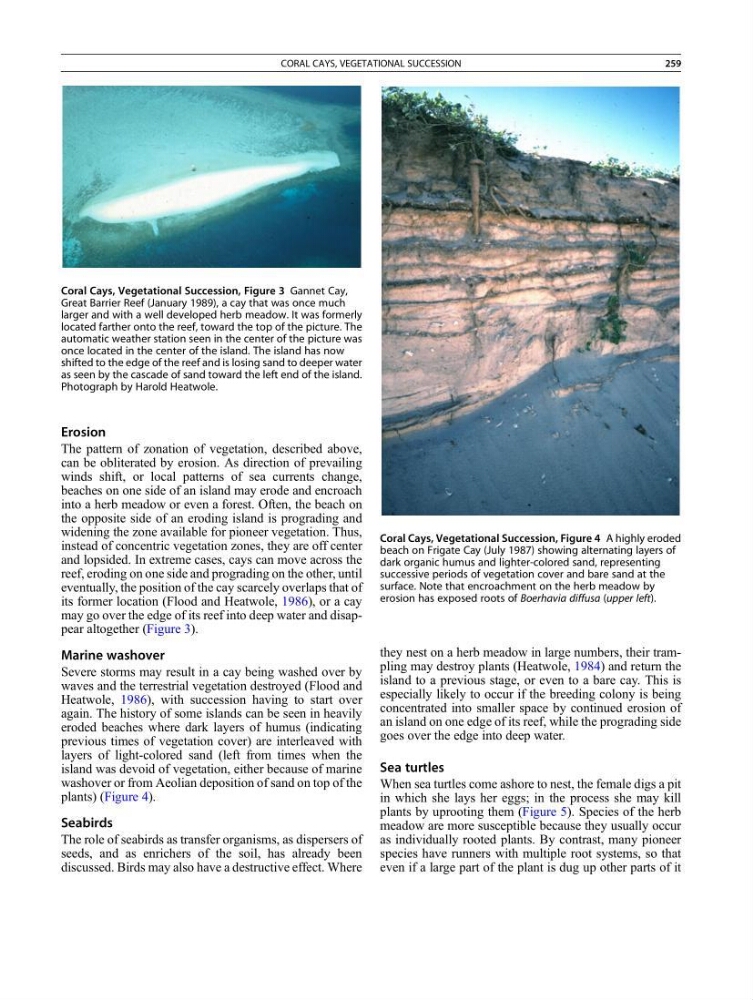
again. The history of some islands can be seen in heavily
eroded beaches where dark layers of humus (indicating
previous times of vegetation cover) are interleaved with
layers of light-colored sand (left from times when the
island was devoid of vegetation, either because of marine
washover or from Aeolian deposition of sand on top of the
plants) (Figure 4).
Seabirds
The role of seabirds as transfer organisms, as dispersers of
seeds, and as enrichers of the soil, has already been
discussed. Birds may also have a destructive effect. Where
they nest on a herb meadow in large numbers, their trampling may destroy plants (Heatwole, 1984) and return the
island to a previous stage, or even to a bare cay. This is
especially likely to occur if the breeding colony is being
concentrated into smaller space by continued erosion of
an island on one edge of its reef, while the prograding side
goes over the edge into deep water.
Sea turtles
When sea turtles come ashore to nest, the female digs a pit
in which she lays her eggs; in the process she may kill
plants by uprooting them (Figure 5). Species of the herb
meadow are more susceptible because they usually occur
as individually rooted plants. By contrast, many pioneer
species have runners with multiple root systems, so that
even if a large part of the plant is dug up other parts of it
Coral Cays, Vegetational Succession, Figure 4 A highly eroded
beach on Frigate Cay (July 1987) showing alternating layers of
dark organic humus and lighter-colored sand, representing
successive periods of vegetation cover and bare sand at the
surface. Note that encroachment on the herb meadow by
erosion has exposed roots of Boerhavia diffusa (upper left).
Coral Cays, Vegetational Succession, Figure 3 Gannet Cay,
Great Barrier Reef (January 1989), a cay that was once much
larger and with a well developed herb meadow. It was formerly
located farther onto the reef, toward the top of the picture. The
automatic weather station seen in the center of the picture was
once located in the center of the island. The island has now
shifted to the edge of the reef and is losing sand to deeper water
as seen by the cascade of sand toward the left end of the island.
Photograph by Harold Heatwole.
CORAL CAYS, VEGETATIONAL SUCCESSION
259
The pattern of zonation of vegetation, described above,
can be obliterated by erosion. As direction of prevailing
winds shift, or local patterns of sea currents change,
beaches on one side of an island may erode and encroach
into a herb meadow or even a forest. Often, the beach on
the opposite side of an eroding island is prograding and
widening the zone available for pioneer vegetation. Thus,
instead of concentric vegetation zones, they are off center
and lopsided. In extreme cases, cays can move across the
reef, eroding on one side and prograding on the other, until
eventually, the position of the cay scarcely overlaps that of
its former location (Flood and Heatwole, 1986), or a cay
may go over the edge of its reef into deep water and disappear altogether (Figure 3).
Marine washover
Severe storms may result in a cay being washed over by
waves and the terrestrial vegetation destroyed (Flood and
Heatwole, 1986), with succession having to start over
again. The history of some islands can be seen in heavily
eroded beaches where dark layers of humus (indicating
previous times of vegetation cover) are interleaved with
layers of light-colored sand (left from times when the
island was devoid of vegetation, either because of marine
washover or from Aeolian deposition of sand on top of the
plants) (Figure 4).
Seabirds
The role of seabirds as transfer organisms, as dispersers of
seeds, and as enrichers of the soil, has already been
discussed. Birds may also have a destructive effect. Where
they nest on a herb meadow in large numbers, their trampling may destroy plants (Heatwole, 1984) and return the
island to a previous stage, or even to a bare cay. This is
especially likely to occur if the breeding colony is being
concentrated into smaller space by continued erosion of
an island on one edge of its reef, while the prograding side
goes over the edge into deep water.
Sea turtles
When sea turtles come ashore to nest, the female digs a pit
in which she lays her eggs; in the process she may kill
plants by uprooting them (Figure 5). Species of the herb
meadow are more susceptible because they usually occur
as individually rooted plants. By contrast, many pioneer
species have runners with multiple root systems, so that
even if a large part of the plant is dug up other parts of it
Coral Cays, Vegetational Succession, Figure 4 A highly eroded
beach on Frigate Cay (July 1987) showing alternating layers of
dark organic humus and lighter-colored sand, representing
successive periods of vegetation cover and bare sand at the
surface. Note that encroachment on the herb meadow by
erosion has exposed roots of Boerhavia diffusa (upper left).
Coral Cays, Vegetational Succession, Figure 3 Gannet Cay,
Great Barrier Reef (January 1989), a cay that was once much
larger and with a well developed herb meadow. It was formerly
located farther onto the reef, toward the top of the picture. The
automatic weather station seen in the center of the picture was
once located in the center of the island. The island has now
shifted to the edge of the reef and is losing sand to deeper water
as seen by the cascade of sand toward the left end of the island.
Photograph by Harold Heatwole.
CORAL CAYS, VEGETATIONAL SUCCESSION
259