

Herb meadows
Pioneer species stabilize shifting sand, shade the surface
of the ground, and through adding dead leaves and other
organic matter enrich the soil (Wiens, 1962) and begin to
form a soil profile. In addition, the shrub ring serves as
a windbreak, provides more extensive shade, and screens
out salt spray. Providing sufficient fresh water becomes
available, these changes facilitate inland conditions that
are favorable for species that could not colonize a beach
or a bare cay. Very small sand cays have little permanent
fresh water but as they grow larger through further accumulation of sand, they surpass the critical size for retaining
rain as a lens of freshwater in the soil (Wiens, 1962). The
stage is now set for the establishment of species of nonpioneer plants. Most of these new colonists are dispersed
by birds, either attaching by hooks or sticky secretions to
feathers of a variety of birds, including seabirds, or are carried in the digestive tracts of seed-eating or fruit-eating
birds. Once deposited in their new home, they grow and
form a meadow of herbs and grasses (Heatwole et al.,
1981) (Figure 1). The pioneers either find the new conditions unfavorable to them, or are out competed by the
new arrivals and they decline, leaving the center of the
island covered by the second wave of colonists. The cay
is now zoned, with pioneer species still dominating the
upper beach, followed behind by a shrub ring and with
a central meadow of herbs and grasses.
Savannah
With increasing bird traffic attracted to the greater plant
cover in the interior, the number of species of plants there
builds up, including a variety of trees and shrubs that
shade the island’s central habitat still further and contribute greater amounts of organic matter to the soil. In this
way the herb meadow becomes dotted by scattered shrubs
and trees to form a savannah (Figure 1), sometimes called
parkland. Trees that are common in the savannahs on cays
are Cordia subcordata, Calophyllum inophyllum,
Hernandia peltata, and Guettarda speciosa. Humans have
often contributed to this zone by plantations of coconuts
(Cocos nucifera).
Forests
Over time, the density of arborescent vegetation increases
until a forest forms, complete with a ground cover of leaf
litter and a more mature soil profile. Species of sea birds,
such as the Black Noddy (Anous minutus) that require
trees for nesting, roost in large numbers in these forests
and contribute massive amounts of guano to the soil. Most
species of low vegetation of the herb meadow or savannah
cannot tolerate the dense shade and high nitrogen levels
under the forest and accordingly they disappear, leaving
only a sparse cover of nitrophilous plants. Now, the zonation includes a peripheral ring of pioneer species surrounding a shrub ring, with the interior of the island
covered by forest or a combination of forest and savannah.
All of these stages in the succession of vegetation can be
seen on islands on reefs (Figure 2). The forested islands
seem to be the end stage in this sequence as no further
stages have been witnessed. This does not mean that
change ceases, however, or that all islands inevitably reach
this final stage. Because of that, some ecologists dispute
the validity of the concept of succession. Further changes,
however, can be viewed as intervention by forces or
agents that halt or reverse what would otherwise be an
orderly progression. Some of these retrograde, destructive
influences are known (Heatwole, 1984) and are as follow:
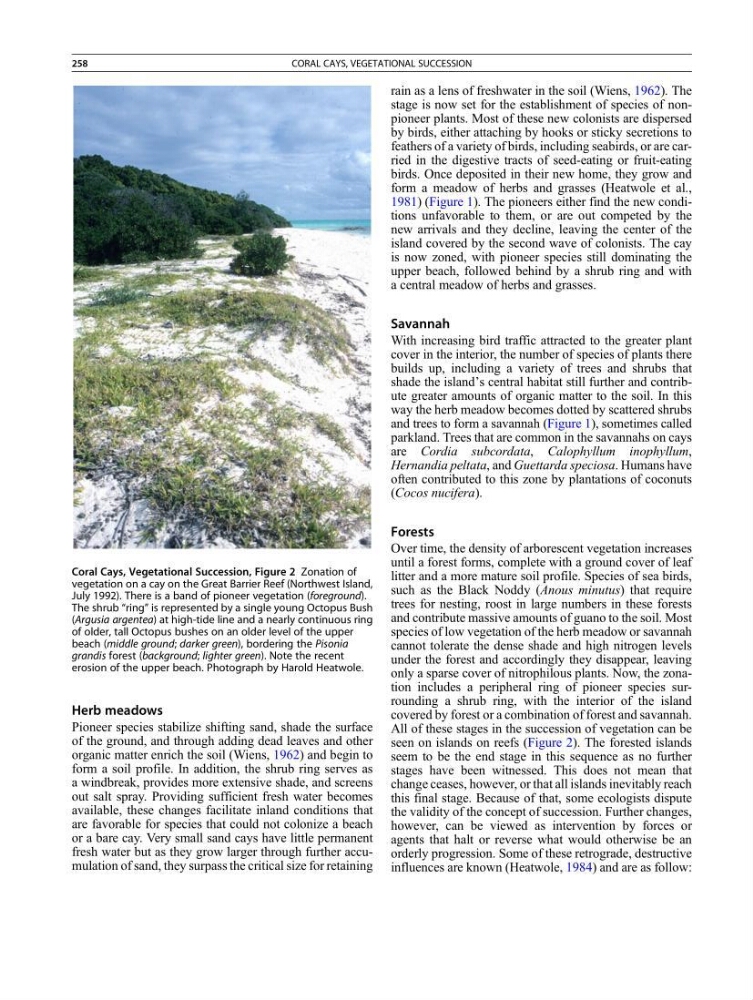
Coral Cays, Vegetational Succession, Figure 2 Zonation of
vegetation on a cay on the Great Barrier Reef (Northwest Island,
July 1992). There is a band of pioneer vegetation (foreground).
The shrub “ring” is represented by a single young Octopus Bush
(Argusia argentea) at high-tide line and a nearly continuous ring
of older, tall Octopus bushes on an older level of the upper
beach (middle ground; darker green), bordering the Pisonia
grandis forest (background; lighter green). Note the recent
erosion of the upper beach. Photograph by Harold Heatwole.
258
CORAL CAYS, VEGETATIONAL SUCCESSION
Pioneer species stabilize shifting sand, shade the surface
of the ground, and through adding dead leaves and other
organic matter enrich the soil (Wiens, 1962) and begin to
form a soil profile. In addition, the shrub ring serves as
a windbreak, provides more extensive shade, and screens
out salt spray. Providing sufficient fresh water becomes
available, these changes facilitate inland conditions that
are favorable for species that could not colonize a beach
or a bare cay. Very small sand cays have little permanent
fresh water but as they grow larger through further accumulation of sand, they surpass the critical size for retaining
rain as a lens of freshwater in the soil (Wiens, 1962). The
stage is now set for the establishment of species of nonpioneer plants. Most of these new colonists are dispersed
by birds, either attaching by hooks or sticky secretions to
feathers of a variety of birds, including seabirds, or are carried in the digestive tracts of seed-eating or fruit-eating
birds. Once deposited in their new home, they grow and
form a meadow of herbs and grasses (Heatwole et al.,
1981) (Figure 1). The pioneers either find the new conditions unfavorable to them, or are out competed by the
new arrivals and they decline, leaving the center of the
island covered by the second wave of colonists. The cay
is now zoned, with pioneer species still dominating the
upper beach, followed behind by a shrub ring and with
a central meadow of herbs and grasses.
Savannah
With increasing bird traffic attracted to the greater plant
cover in the interior, the number of species of plants there
builds up, including a variety of trees and shrubs that
shade the island’s central habitat still further and contribute greater amounts of organic matter to the soil. In this
way the herb meadow becomes dotted by scattered shrubs
and trees to form a savannah (Figure 1), sometimes called
parkland. Trees that are common in the savannahs on cays
are Cordia subcordata, Calophyllum inophyllum,
Hernandia peltata, and Guettarda speciosa. Humans have
often contributed to this zone by plantations of coconuts
(Cocos nucifera).
Forests
Over time, the density of arborescent vegetation increases
until a forest forms, complete with a ground cover of leaf
litter and a more mature soil profile. Species of sea birds,
such as the Black Noddy (Anous minutus) that require
trees for nesting, roost in large numbers in these forests
and contribute massive amounts of guano to the soil. Most
species of low vegetation of the herb meadow or savannah
cannot tolerate the dense shade and high nitrogen levels
under the forest and accordingly they disappear, leaving
only a sparse cover of nitrophilous plants. Now, the zonation includes a peripheral ring of pioneer species surrounding a shrub ring, with the interior of the island
covered by forest or a combination of forest and savannah.
All of these stages in the succession of vegetation can be
seen on islands on reefs (Figure 2). The forested islands
seem to be the end stage in this sequence as no further
stages have been witnessed. This does not mean that
change ceases, however, or that all islands inevitably reach
this final stage. Because of that, some ecologists dispute
the validity of the concept of succession. Further changes,
however, can be viewed as intervention by forces or
agents that halt or reverse what would otherwise be an
orderly progression. Some of these retrograde, destructive
influences are known (Heatwole, 1984) and are as follow:
Coral Cays, Vegetational Succession, Figure 2 Zonation of
vegetation on a cay on the Great Barrier Reef (Northwest Island,
July 1992). There is a band of pioneer vegetation (foreground).
The shrub “ring” is represented by a single young Octopus Bush
(Argusia argentea) at high-tide line and a nearly continuous ring
of older, tall Octopus bushes on an older level of the upper
beach (middle ground; darker green), bordering the Pisonia
grandis forest (background; lighter green). Note the recent
erosion of the upper beach. Photograph by Harold Heatwole.
258
CORAL CAYS, VEGETATIONAL SUCCESSION