

nutrients from allochthonous marine sources, rather than
from insular terrestrial ones. The organisms, such as seabirds or crabs that connect the marine and terrestrial ecosystems and relay food from one to the other are known
as “transfer” species.
The first plants to become established on bare cays are
called “pioneer” species. They are usually transported
there as seeds carried by sea currents. Many have special
adaptations that improve their chances of dispersal in this
way, such as devices that keep them afloat for long periods
of time. In addition they need to be either impervious to
seawater or resistant to high salinities. Not all species of
seeds that are transported by water, however, are capable
of becoming established on a bare island. Indeed, the
beach wrack of many islands contains abundant seeds of
species that have floated ashore but are not otherwise
represented in the flora, either because the seeds did not
survive the voyage, or because they were unable to germinate under the conditions they encountered upon arrival
(Smith et al., 1990).
The successful pioneer species are those that combine
the qualities of being able to withstand high salinities
and salt spray, scarcity of water, shifting sands, low levels
of nutrients in the soil, high temperatures, and bright sunlight. These are the conditions found on bare cays. The
earliest pioneer vegetation consists of low herbs, grasses,
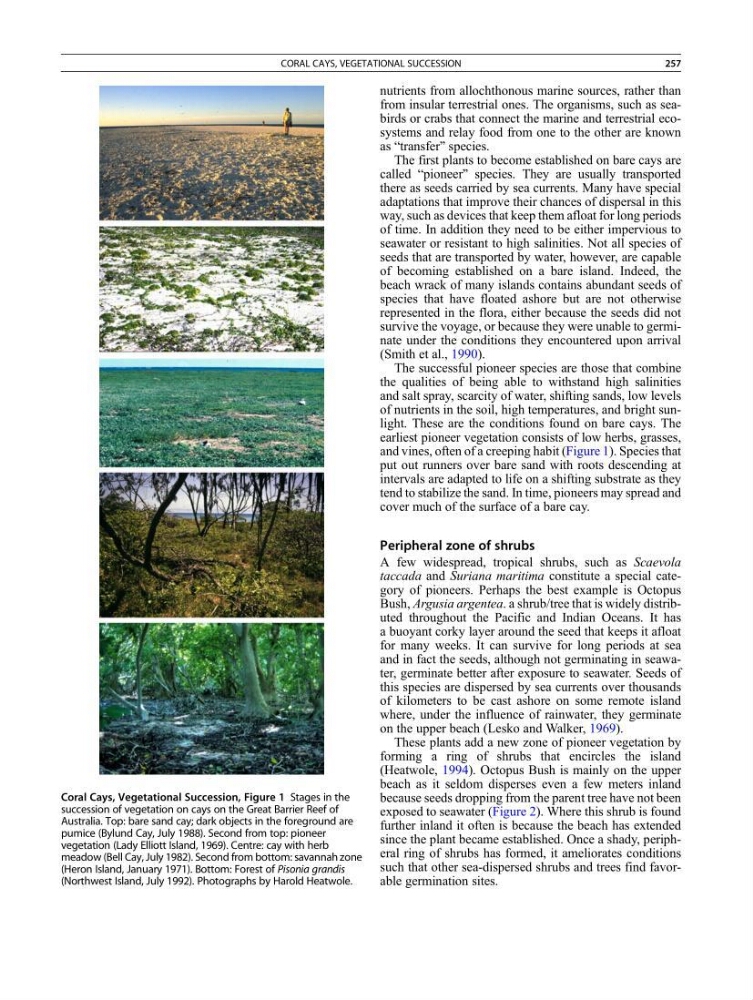
and vines, often of a creeping habit (Figure 1). Species that
put out runners over bare sand with roots descending at
intervals are adapted to life on a shifting substrate as they
tend to stabilize the sand. In time, pioneers may spread and
cover much of the surface of a bare cay.
Peripheral zone of shrubs
A few widespread, tropical shrubs, such as Scaevola
taccada and Suriana maritima constitute a special category of pioneers. Perhaps the best example is Octopus
Bush, Argusia argentea. a shrub/tree that is widely distributed throughout the Pacific and Indian Oceans. It has
a buoyant corky layer around the seed that keeps it afloat
for many weeks. It can survive for long periods at sea
and in fact the seeds, although not germinating in seawater, germinate better after exposure to seawater. Seeds of
this species are dispersed by sea currents over thousands
of kilometers to be cast ashore on some remote island
where, under the influence of rainwater, they germinate
on the upper beach (Lesko and Walker, 1969).
These plants add a new zone of pioneer vegetation by
forming a ring of shrubs that encircles the island
(Heatwole, 1994). Octopus Bush is mainly on the upper
beach as it seldom disperses even a few meters inland
because seeds dropping from the parent tree have not been
exposed to seawater (Figure 2). Where this shrub is found
further inland it often is because the beach has extended
since the plant became established. Once a shady, peripheral ring of shrubs has formed, it ameliorates conditions
such that other sea-dispersed shrubs and trees find favorable germination sites.
Coral Cays, Vegetational Succession, Figure 1 Stages in the
succession of vegetation on cays on the Great Barrier Reef of
Australia. Top: bare sand cay; dark objects in the foreground are
pumice (Bylund Cay, July 1988). Second from top: pioneer
vegetation (Lady Elliott Island, 1969). Centre: cay with herb
meadow (Bell Cay, July 1982). Second from bottom: savannah zone
(Heron Island, January 1971). Bottom: Forest of Pisonia grandis
(Northwest Island, July 1992). Photographs by Harold Heatwole.
CORAL CAYS, VEGETATIONAL SUCCESSION
257
from insular terrestrial ones. The organisms, such as seabirds or crabs that connect the marine and terrestrial ecosystems and relay food from one to the other are known
as “transfer” species.
The first plants to become established on bare cays are
called “pioneer” species. They are usually transported
there as seeds carried by sea currents. Many have special
adaptations that improve their chances of dispersal in this
way, such as devices that keep them afloat for long periods
of time. In addition they need to be either impervious to
seawater or resistant to high salinities. Not all species of
seeds that are transported by water, however, are capable
of becoming established on a bare island. Indeed, the
beach wrack of many islands contains abundant seeds of
species that have floated ashore but are not otherwise
represented in the flora, either because the seeds did not
survive the voyage, or because they were unable to germinate under the conditions they encountered upon arrival
(Smith et al., 1990).
The successful pioneer species are those that combine
the qualities of being able to withstand high salinities
and salt spray, scarcity of water, shifting sands, low levels
of nutrients in the soil, high temperatures, and bright sunlight. These are the conditions found on bare cays. The
earliest pioneer vegetation consists of low herbs, grasses,
and vines, often of a creeping habit (Figure 1). Species that
put out runners over bare sand with roots descending at
intervals are adapted to life on a shifting substrate as they
tend to stabilize the sand. In time, pioneers may spread and
cover much of the surface of a bare cay.
Peripheral zone of shrubs
A few widespread, tropical shrubs, such as Scaevola
taccada and Suriana maritima constitute a special category of pioneers. Perhaps the best example is Octopus
Bush, Argusia argentea. a shrub/tree that is widely distributed throughout the Pacific and Indian Oceans. It has
a buoyant corky layer around the seed that keeps it afloat
for many weeks. It can survive for long periods at sea
and in fact the seeds, although not germinating in seawater, germinate better after exposure to seawater. Seeds of
this species are dispersed by sea currents over thousands
of kilometers to be cast ashore on some remote island
where, under the influence of rainwater, they germinate
on the upper beach (Lesko and Walker, 1969).
These plants add a new zone of pioneer vegetation by
forming a ring of shrubs that encircles the island
(Heatwole, 1994). Octopus Bush is mainly on the upper
beach as it seldom disperses even a few meters inland
because seeds dropping from the parent tree have not been
exposed to seawater (Figure 2). Where this shrub is found
further inland it often is because the beach has extended
since the plant became established. Once a shady, peripheral ring of shrubs has formed, it ameliorates conditions
such that other sea-dispersed shrubs and trees find favorable germination sites.
Coral Cays, Vegetational Succession, Figure 1 Stages in the
succession of vegetation on cays on the Great Barrier Reef of
Australia. Top: bare sand cay; dark objects in the foreground are
pumice (Bylund Cay, July 1988). Second from top: pioneer
vegetation (Lady Elliott Island, 1969). Centre: cay with herb
meadow (Bell Cay, July 1982). Second from bottom: savannah zone
(Heron Island, January 1971). Bottom: Forest of Pisonia grandis
(Northwest Island, July 1992). Photographs by Harold Heatwole.
CORAL CAYS, VEGETATIONAL SUCCESSION
257