

still have roots in the soil and the plant can survive. For
this reason, where turtles nest in high numbers, succession
may be halted or herb meadow even reversed to pioneer
vegetation (Heatwole, 1984; Rogers 1989).
Drought
Even in such an equable environment as a tropical island,
the weather is not constant. There are year-to-year changes
in the amount of rainfall, and these can affect the trajectory
of vegetational succession on cays. There has been only
one detailed study of this phenomenon and that was on
One Tree Island at the southern end of Australia’s Great
Barrier Reef from 1968 to 1978 (Heatwole, 1981;
Heatwole et al., 1981). Rainfall was plentiful for most of
the time, but there was a drought of four months, that
killed a lot of vegetation. No species of plant went extinct
because of the drought, but the most abundant species of
the herb meadow (Melanthera biflora) declined to less
than a quarter of its former biomass. By contrast,
a pioneer species (Ipomoea pes-caprae) that had been rare
in the herb meadow before the drought thrived and
increased greatly in biomass to become the dominant species. Thus, the drought caused vegetation in the center of
the island to revert to a previous successional stage.
Humans
Humans have a major effect on cays, through direct
destruction of vegetation and fauna, construction of buildings, mining guano, altering patterns of erosion, planting
gardens and coconut groves, and introduction, intentional
or otherwise, of weeds. Lady Elliott Island on the Great
Barrier Reef is an example of both good and bad effects
of humans. It was first nearly denuded by guano miners
who destroyed the vegetation and stripped the soil. Later,
it was restored to nearly its former condition by replanting
native vegetation as part of the development of an ecofriendly resort.
Summary
As a bare cay forms and increases in size, its vegetation
goes through a predictable progression of successional
stages: bare cay ! pioneer vegetation ! pioneer vegetation plus encirclement by shrubs ! herb meadow !
savannah (parkland) ! forest. Plants of the earliest stages
tend to be sea-dispersed whereas later the vegetation consists mostly of bird-dispersed species. The vegetation
becomes progressively organized into concentric zones
with earlier successional stages located peripherally and
later ones successively toward the center. This sequence
can be altered, or reversed, by various destructive forces,
including trampling by seabirds, uprooting of vegetation
by sea turtles, drought, erosion of beaches, washover during storms, and human activities.
Bibliography
Flood, P. G., and Heatwole, H., 1986. Coral cay instability and species-turnover of plants at Swain Reefs, southern Great Barrier
Reef, Australia. Journal of Coastal Research, 2, 479–496.
Heatwole, H., 1971. Marine-dependent terrestrial biotic communities on some cays in the Coral Sea. Ecology, 52, 363–366.
Heatwole, H., 1981. A coral island, Sydney: Collins.
Heatwole, H., 1984. Terrestrial vegetation of the coral cays,
Capricornia section, Great Barrier Reef marine park. In Ward,
W. T., and Saeger, P., (eds.) (misprint for Saenger), The
Capricornia section of the Great Barrier Reef past, present
and future. St. Lucia: the Royal Society of Queensland and the
Australian Coral Reef Society, pp. 87–139.
Heatwole, H., Done, T., and Cameron, E., 1981. Community ecology of a coral cay, a study of One Tree island, Great Barrier
Reef, Australia (Monographiae Biologicae). The Hague: Dr. W.
Junk Publishers, 43, 1–379.
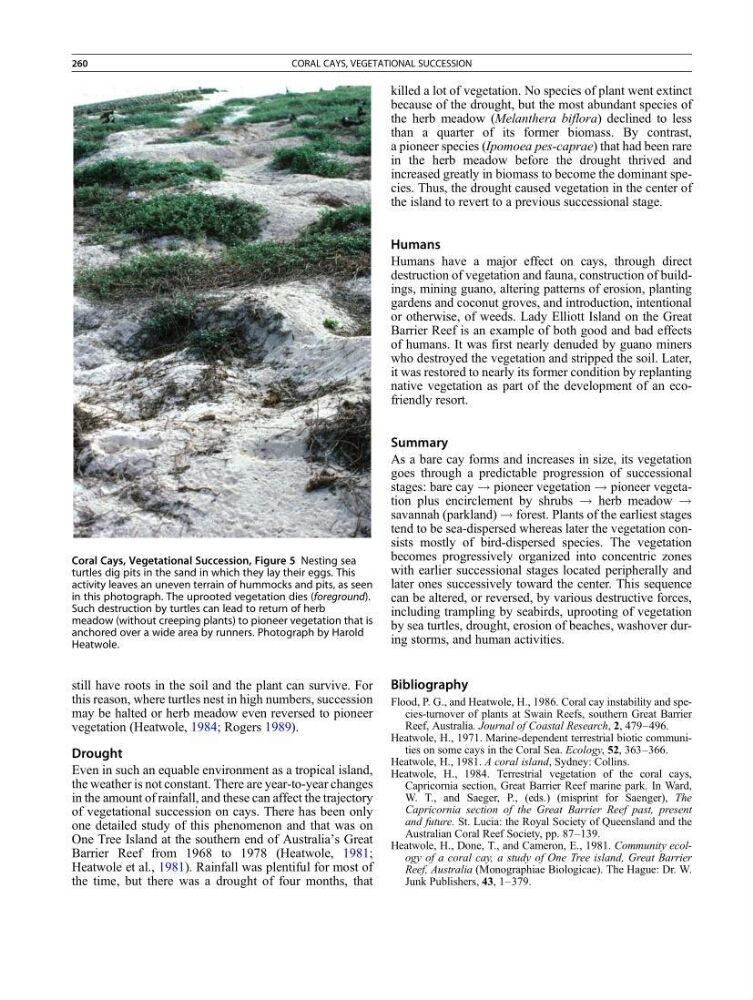
Coral Cays, Vegetational Succession, Figure 5 Nesting sea
turtles dig pits in the sand in which they lay their eggs. This
activity leaves an uneven terrain of hummocks and pits, as seen
in this photograph. The uprooted vegetation dies (foreground).
Such destruction by turtles can lead to return of herb
meadow (without creeping plants) to pioneer vegetation that is
anchored over a wide area by runners. Photograph by Harold
Heatwole.
260
CORAL CAYS, VEGETATIONAL SUCCESSION
this reason, where turtles nest in high numbers, succession
may be halted or herb meadow even reversed to pioneer
vegetation (Heatwole, 1984; Rogers 1989).
Drought
Even in such an equable environment as a tropical island,
the weather is not constant. There are year-to-year changes
in the amount of rainfall, and these can affect the trajectory
of vegetational succession on cays. There has been only
one detailed study of this phenomenon and that was on
One Tree Island at the southern end of Australia’s Great
Barrier Reef from 1968 to 1978 (Heatwole, 1981;
Heatwole et al., 1981). Rainfall was plentiful for most of
the time, but there was a drought of four months, that
killed a lot of vegetation. No species of plant went extinct
because of the drought, but the most abundant species of
the herb meadow (Melanthera biflora) declined to less
than a quarter of its former biomass. By contrast,
a pioneer species (Ipomoea pes-caprae) that had been rare
in the herb meadow before the drought thrived and
increased greatly in biomass to become the dominant species. Thus, the drought caused vegetation in the center of
the island to revert to a previous successional stage.
Humans
Humans have a major effect on cays, through direct
destruction of vegetation and fauna, construction of buildings, mining guano, altering patterns of erosion, planting
gardens and coconut groves, and introduction, intentional
or otherwise, of weeds. Lady Elliott Island on the Great
Barrier Reef is an example of both good and bad effects
of humans. It was first nearly denuded by guano miners
who destroyed the vegetation and stripped the soil. Later,
it was restored to nearly its former condition by replanting
native vegetation as part of the development of an ecofriendly resort.
Summary
As a bare cay forms and increases in size, its vegetation
goes through a predictable progression of successional
stages: bare cay ! pioneer vegetation ! pioneer vegetation plus encirclement by shrubs ! herb meadow !
savannah (parkland) ! forest. Plants of the earliest stages
tend to be sea-dispersed whereas later the vegetation consists mostly of bird-dispersed species. The vegetation
becomes progressively organized into concentric zones
with earlier successional stages located peripherally and
later ones successively toward the center. This sequence
can be altered, or reversed, by various destructive forces,
including trampling by seabirds, uprooting of vegetation
by sea turtles, drought, erosion of beaches, washover during storms, and human activities.
Bibliography
Flood, P. G., and Heatwole, H., 1986. Coral cay instability and species-turnover of plants at Swain Reefs, southern Great Barrier
Reef, Australia. Journal of Coastal Research, 2, 479–496.
Heatwole, H., 1971. Marine-dependent terrestrial biotic communities on some cays in the Coral Sea. Ecology, 52, 363–366.
Heatwole, H., 1981. A coral island, Sydney: Collins.
Heatwole, H., 1984. Terrestrial vegetation of the coral cays,
Capricornia section, Great Barrier Reef marine park. In Ward,
W. T., and Saeger, P., (eds.) (misprint for Saenger), The
Capricornia section of the Great Barrier Reef past, present
and future. St. Lucia: the Royal Society of Queensland and the
Australian Coral Reef Society, pp. 87–139.
Heatwole, H., Done, T., and Cameron, E., 1981. Community ecology of a coral cay, a study of One Tree island, Great Barrier
Reef, Australia (Monographiae Biologicae). The Hague: Dr. W.
Junk Publishers, 43, 1–379.
Coral Cays, Vegetational Succession, Figure 5 Nesting sea
turtles dig pits in the sand in which they lay their eggs. This
activity leaves an uneven terrain of hummocks and pits, as seen
in this photograph. The uprooted vegetation dies (foreground).
Such destruction by turtles can lead to return of herb
meadow (without creeping plants) to pioneer vegetation that is
anchored over a wide area by runners. Photograph by Harold
Heatwole.
260
CORAL CAYS, VEGETATIONAL SUCCESSION