

generally 1–2 m below low tide. Typically, perhaps half of
any single reef flat was covered by tall branching corals
which, by the early 2000s, were dead and slowly
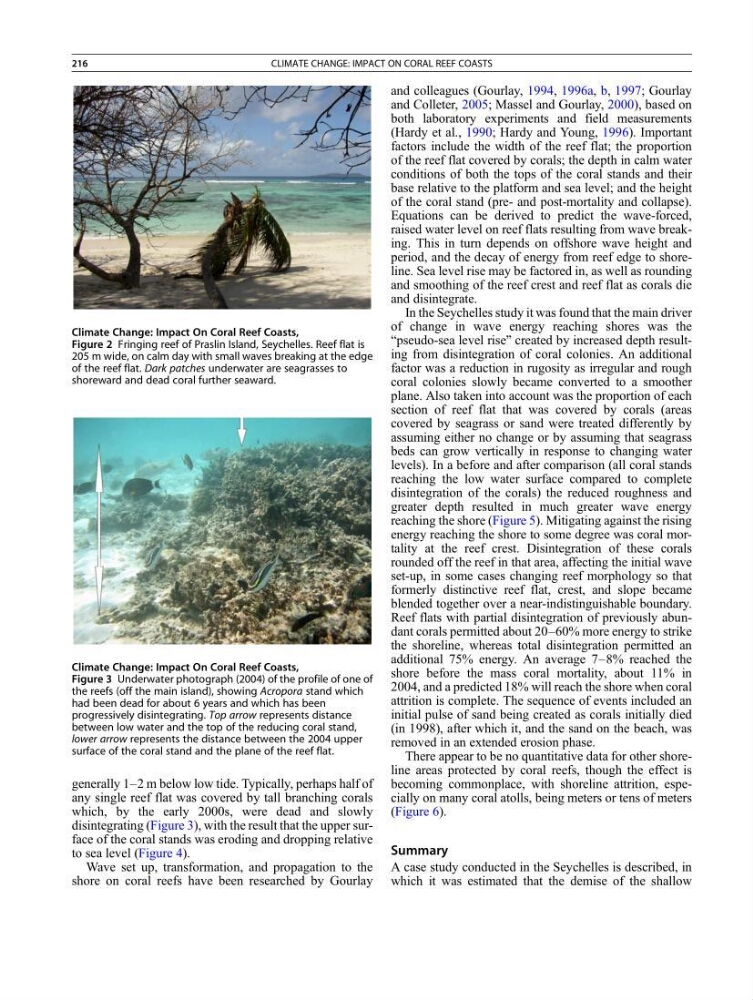
disintegrating (Figure 3), with the result that the upper surface of the coral stands was eroding and dropping relative
to sea level (Figure 4).
Wave set up, transformation, and propagation to the
shore on coral reefs have been researched by Gourlay
and colleagues (Gourlay, 1994, 1996a, b, 1997; Gourlay
and Colleter, 2005; Massel and Gourlay, 2000), based on
both laboratory experiments and field measurements
(Hardy et al., 1990; Hardy and Young, 1996). Important
factors include the width of the reef flat; the proportion
of the reef flat covered by corals; the depth in calm water
conditions of both the tops of the coral stands and their
base relative to the platform and sea level; and the height
of the coral stand (pre- and post-mortality and collapse).
Equations can be derived to predict the wave-forced,
raised water level on reef flats resulting from wave breaking. This in turn depends on offshore wave height and
period, and the decay of energy from reef edge to shoreline. Sea level rise may be factored in, as well as rounding
and smoothing of the reef crest and reef flat as corals die
and disintegrate.
In the Seychelles study it was found that the main driver
of change in wave energy reaching shores was the
“pseudo-sea level rise” created by increased depth resulting from disintegration of coral colonies. An additional
factor was a reduction in rugosity as irregular and rough
coral colonies slowly became converted to a smoother
plane. Also taken into account was the proportion of each
section of reef flat that was covered by corals (areas
covered by seagrass or sand were treated differently by
assuming either no change or by assuming that seagrass
beds can grow vertically in response to changing water
levels). In a before and after comparison (all coral stands
reaching the low water surface compared to complete
disintegration of the corals) the reduced roughness and
greater depth resulted in much greater wave energy
reaching the shore (Figure 5). Mitigating against the rising
energy reaching the shore to some degree was coral mortality at the reef crest. Disintegration of these corals
rounded off the reef in that area, affecting the initial wave
set-up, in some cases changing reef morphology so that
formerly distinctive reef flat, crest, and slope became
blended together over a near-indistinguishable boundary.
Reef flats with partial disintegration of previously abundant corals permitted about 20–60% more energy to strike
the shoreline, whereas total disintegration permitted an
additional 75% energy. An average 7–8% reached the
shore before the mass coral mortality, about 11% in
2004, and a predicted 18% will reach the shore when coral
attrition is complete. The sequence of events included an
initial pulse of sand being created as corals initially died
(in 1998), after which it, and the sand on the beach, was
removed in an extended erosion phase.
There appear to be no quantitative data for other shoreline areas protected by coral reefs, though the effect is
becoming commonplace, with shoreline attrition, especially on many coral atolls, being meters or tens of meters
(Figure 6).
Summary
A case study conducted in the Seychelles is described, in
which it was estimated that the demise of the shallow
Climate Change: Impact On Coral Reef Coasts,
Figure 2 Fringing reef of Praslin Island, Seychelles. Reef flat is
205 m wide, on calm day with small waves breaking at the edge
of the reef flat. Dark patches underwater are seagrasses to
shoreward and dead coral further seaward.
Climate Change: Impact On Coral Reef Coasts,
Figure 3 Underwater photograph (2004) of the profile of one of
the reefs (off the main island), showing Acropora stand which
had been dead for about 6 years and which has been
progressively disintegrating. Top arrow represents distance
between low water and the top of the reducing coral stand,
lower arrow represents the distance between the 2004 upper
surface of the coral stand and the plane of the reef flat.
216
CLIMATE CHANGE: IMPACT ON CORAL REEF COASTS
any single reef flat was covered by tall branching corals
which, by the early 2000s, were dead and slowly
disintegrating (Figure 3), with the result that the upper surface of the coral stands was eroding and dropping relative
to sea level (Figure 4).
Wave set up, transformation, and propagation to the
shore on coral reefs have been researched by Gourlay
and colleagues (Gourlay, 1994, 1996a, b, 1997; Gourlay
and Colleter, 2005; Massel and Gourlay, 2000), based on
both laboratory experiments and field measurements
(Hardy et al., 1990; Hardy and Young, 1996). Important
factors include the width of the reef flat; the proportion
of the reef flat covered by corals; the depth in calm water
conditions of both the tops of the coral stands and their
base relative to the platform and sea level; and the height
of the coral stand (pre- and post-mortality and collapse).
Equations can be derived to predict the wave-forced,
raised water level on reef flats resulting from wave breaking. This in turn depends on offshore wave height and
period, and the decay of energy from reef edge to shoreline. Sea level rise may be factored in, as well as rounding
and smoothing of the reef crest and reef flat as corals die
and disintegrate.
In the Seychelles study it was found that the main driver
of change in wave energy reaching shores was the
“pseudo-sea level rise” created by increased depth resulting from disintegration of coral colonies. An additional
factor was a reduction in rugosity as irregular and rough
coral colonies slowly became converted to a smoother
plane. Also taken into account was the proportion of each
section of reef flat that was covered by corals (areas
covered by seagrass or sand were treated differently by
assuming either no change or by assuming that seagrass
beds can grow vertically in response to changing water
levels). In a before and after comparison (all coral stands
reaching the low water surface compared to complete
disintegration of the corals) the reduced roughness and
greater depth resulted in much greater wave energy
reaching the shore (Figure 5). Mitigating against the rising
energy reaching the shore to some degree was coral mortality at the reef crest. Disintegration of these corals
rounded off the reef in that area, affecting the initial wave
set-up, in some cases changing reef morphology so that
formerly distinctive reef flat, crest, and slope became
blended together over a near-indistinguishable boundary.
Reef flats with partial disintegration of previously abundant corals permitted about 20–60% more energy to strike
the shoreline, whereas total disintegration permitted an
additional 75% energy. An average 7–8% reached the
shore before the mass coral mortality, about 11% in
2004, and a predicted 18% will reach the shore when coral
attrition is complete. The sequence of events included an
initial pulse of sand being created as corals initially died
(in 1998), after which it, and the sand on the beach, was
removed in an extended erosion phase.
There appear to be no quantitative data for other shoreline areas protected by coral reefs, though the effect is
becoming commonplace, with shoreline attrition, especially on many coral atolls, being meters or tens of meters
(Figure 6).
Summary
A case study conducted in the Seychelles is described, in
which it was estimated that the demise of the shallow
Climate Change: Impact On Coral Reef Coasts,
Figure 2 Fringing reef of Praslin Island, Seychelles. Reef flat is
205 m wide, on calm day with small waves breaking at the edge
of the reef flat. Dark patches underwater are seagrasses to
shoreward and dead coral further seaward.
Climate Change: Impact On Coral Reef Coasts,
Figure 3 Underwater photograph (2004) of the profile of one of
the reefs (off the main island), showing Acropora stand which
had been dead for about 6 years and which has been
progressively disintegrating. Top arrow represents distance
between low water and the top of the reducing coral stand,
lower arrow represents the distance between the 2004 upper
surface of the coral stand and the plane of the reef flat.
216
CLIMATE CHANGE: IMPACT ON CORAL REEF COASTS