

corals has and will result in an approximate doubling of
wave energy striking the previously protected shorelines.
This has resulted in substantial erosion with a high cost
to the local population.
There are many anecdotal stories of shoreline erosion
from around the world, especially around atolls. It is likely
that a proportion of them are exaggerated or that the observations made are merely reflecting seasonal changes; it is
well known that sandy shorelines behind coral reefs can
change by tens of meters or even more on a seasonal basis.
However, it is usually not too difficult to distinguish
between seasonal changes and unidirectional or progressive changes that have progressed for several years, if
only because the latter soon begins to show erosion of
previously stable and long-lived shoreline vegetation
(Figure 6), and then erosion of built infrastructure. Nevertheless the poor signal-to-noise ratio in matters of shoreline
movement is a serious problem, making it difficult, in some
cases, to distinguish between the seasonal and storm-driven
noise in the system and any underlying, serious progressive
trend that may be occurring. What is clear is that all forms of
coral damage, whether from local, direct impacts, or from
climate change, will reduce the effectiveness of the breakwater effect provided by living coral reefs. Furthermore,
in some cases, changes seen to date will be very much less
than those predicted for the near future if temperatures continue to rise and if polluting discharges and mechanical
extraction continue to reduce the abundance and resilience
of coral reefs that fringe shorelines.
Bibliography
Geister, J., 1977. The influence of wave exposure on the ecological
zonation of Caribbean coral reefs. In Proceedings of the 3rd
International Coral Reef Symposium, Vol. 1, pp. 23–29.
Gourlay, M. R., 1994. Wave transformation on a coral reef. Coastal
Engineering, 23, 17–42.
Gourlay, M. R., 1996a. Wave set-up on coral reefs. 1. Set-up and
wave generated flow on an idealised two dimensional horizontal
reef. Coastal Engineering, 27, 161–193.
Gourlay, M. R., 1996b. Wave set-up on coral reefs. 2. Set-up on
reefs with various profiles. Coastal Engineering, 28, 17–55.
Gourlay, M. R., 1997. Wave set-up on coral reefs: some practical
applications. In Proceedings of the 13th Australian Coastal
and Ocean Engineering Conference, Christchurch, pp. 959–964.
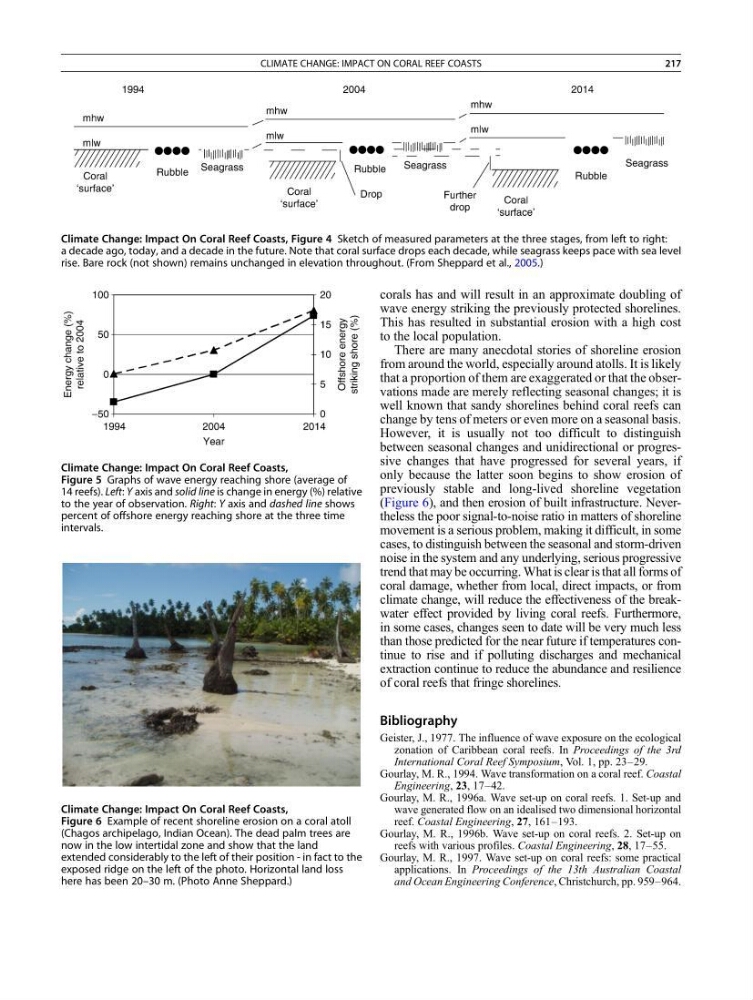
Climate Change: Impact On Coral Reef Coasts, Figure 4 Sketch of measured parameters at the three stages, from left to right:
a decade ago, today, and a decade in the future. Note that coral surface drops each decade, while seagrass keeps pace with sea level
rise. Bare rock (not shown) remains unchanged in elevation throughout. (From Sheppard et al., 2005.)
Climate Change: Impact On Coral Reef Coasts,
Figure 5 Graphs of wave energy reaching shore (average of
14 reefs). Left: Y axis and solid line is change in energy (%) relative
to the year of observation. Right: Y axis and dashed line shows
percent of offshore energy reaching shore at the three time
intervals.
Climate Change: Impact On Coral Reef Coasts,
Figure 6 Example of recent shoreline erosion on a coral atoll
(Chagos archipelago, Indian Ocean). The dead palm trees are
now in the low intertidal zone and show that the land
extended considerably to the left of their position - in fact to the
exposed ridge on the left of the photo. Horizontal land loss
here has been 20–30 m. (Photo Anne Sheppard.)
CLIMATE CHANGE: IMPACT ON CORAL REEF COASTS
217
wave energy striking the previously protected shorelines.
This has resulted in substantial erosion with a high cost
to the local population.
There are many anecdotal stories of shoreline erosion
from around the world, especially around atolls. It is likely
that a proportion of them are exaggerated or that the observations made are merely reflecting seasonal changes; it is
well known that sandy shorelines behind coral reefs can
change by tens of meters or even more on a seasonal basis.
However, it is usually not too difficult to distinguish
between seasonal changes and unidirectional or progressive changes that have progressed for several years, if
only because the latter soon begins to show erosion of
previously stable and long-lived shoreline vegetation
(Figure 6), and then erosion of built infrastructure. Nevertheless the poor signal-to-noise ratio in matters of shoreline
movement is a serious problem, making it difficult, in some
cases, to distinguish between the seasonal and storm-driven
noise in the system and any underlying, serious progressive
trend that may be occurring. What is clear is that all forms of
coral damage, whether from local, direct impacts, or from
climate change, will reduce the effectiveness of the breakwater effect provided by living coral reefs. Furthermore,
in some cases, changes seen to date will be very much less
than those predicted for the near future if temperatures continue to rise and if polluting discharges and mechanical
extraction continue to reduce the abundance and resilience
of coral reefs that fringe shorelines.
Bibliography
Geister, J., 1977. The influence of wave exposure on the ecological
zonation of Caribbean coral reefs. In Proceedings of the 3rd
International Coral Reef Symposium, Vol. 1, pp. 23–29.
Gourlay, M. R., 1994. Wave transformation on a coral reef. Coastal
Engineering, 23, 17–42.
Gourlay, M. R., 1996a. Wave set-up on coral reefs. 1. Set-up and
wave generated flow on an idealised two dimensional horizontal
reef. Coastal Engineering, 27, 161–193.
Gourlay, M. R., 1996b. Wave set-up on coral reefs. 2. Set-up on
reefs with various profiles. Coastal Engineering, 28, 17–55.
Gourlay, M. R., 1997. Wave set-up on coral reefs: some practical
applications. In Proceedings of the 13th Australian Coastal
and Ocean Engineering Conference, Christchurch, pp. 959–964.
Climate Change: Impact On Coral Reef Coasts, Figure 4 Sketch of measured parameters at the three stages, from left to right:
a decade ago, today, and a decade in the future. Note that coral surface drops each decade, while seagrass keeps pace with sea level
rise. Bare rock (not shown) remains unchanged in elevation throughout. (From Sheppard et al., 2005.)
Climate Change: Impact On Coral Reef Coasts,
Figure 5 Graphs of wave energy reaching shore (average of
14 reefs). Left: Y axis and solid line is change in energy (%) relative
to the year of observation. Right: Y axis and dashed line shows
percent of offshore energy reaching shore at the three time
intervals.
Climate Change: Impact On Coral Reef Coasts,
Figure 6 Example of recent shoreline erosion on a coral atoll
(Chagos archipelago, Indian Ocean). The dead palm trees are
now in the low intertidal zone and show that the land
extended considerably to the left of their position - in fact to the
exposed ridge on the left of the photo. Horizontal land loss
here has been 20–30 m. (Photo Anne Sheppard.)
CLIMATE CHANGE: IMPACT ON CORAL REEF COASTS
217