

Enormous stands of very solid limestone colonies that
packed the zone from the surface to about 4 m depth have
been almost totally eliminated by disease (Rosenberg and
Loya, 2004). As a result, affected reefs no longer contain
a wave break reaching the low water level. Instead, this
zone now consists of disintegrating rubble, remnants of
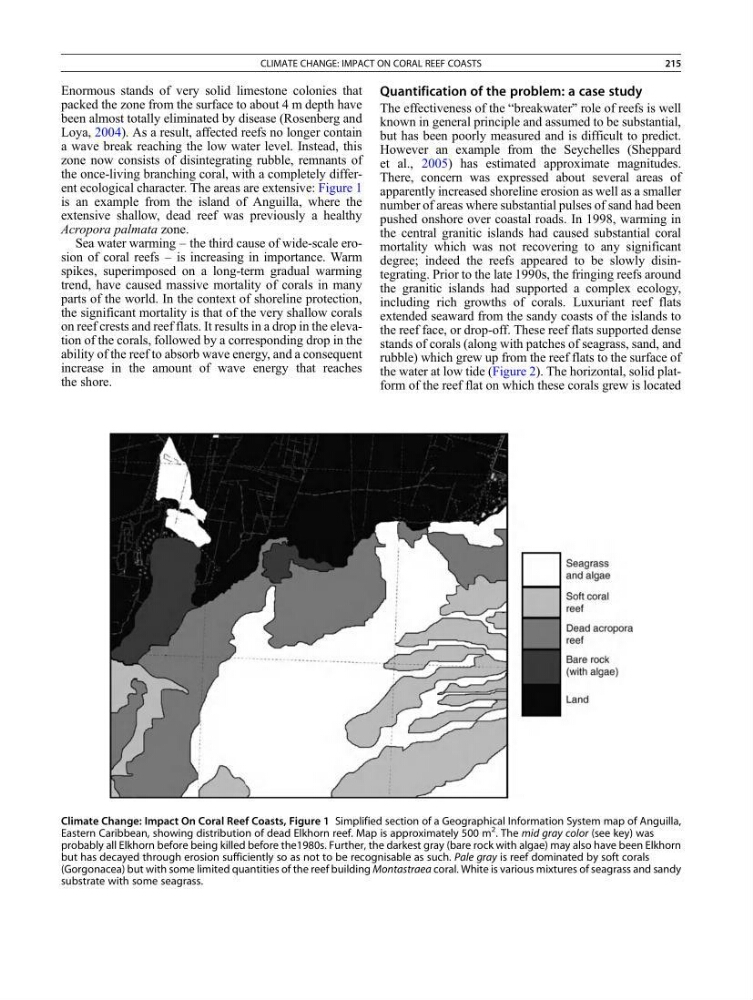
the once-living branching coral, with a completely different ecological character. The areas are extensive: Figure 1
is an example from the island of Anguilla, where the
extensive shallow, dead reef was previously a healthy
Acropora palmata zone.
Sea water warming – the third cause of wide-scale erosion of coral reefs – is increasing in importance. Warm
spikes, superimposed on a long-term gradual warming
trend, have caused massive mortality of corals in many
parts of the world. In the context of shoreline protection,
the significant mortality is that of the very shallow corals
on reef crests and reef flats. It results in a drop in the elevation of the corals, followed by a corresponding drop in the
ability of the reef to absorb wave energy, and a consequent
increase in the amount of wave energy that reaches
the shore.
Quantification of the problem: a case study
The effectiveness of the “breakwater” role of reefs is well
known in general principle and assumed to be substantial,
but has been poorly measured and is difficult to predict.
However an example from the Seychelles (Sheppard
et al., 2005) has estimated approximate magnitudes.
There, concern was expressed about several areas of
apparently increased shoreline erosion as well as a smaller
number of areas where substantial pulses of sand had been
pushed onshore over coastal roads. In 1998, warming in
the central granitic islands had caused substantial coral
mortality which was not recovering to any significant
degree; indeed the reefs appeared to be slowly disintegrating. Prior to the late 1990s, the fringing reefs around
the granitic islands had supported a complex ecology,
including rich growths of corals. Luxuriant reef flats
extended seaward from the sandy coasts of the islands to
the reef face, or drop-off. These reef flats supported dense
stands of corals (along with patches of seagrass, sand, and
rubble) which grew up from the reef flats to the surface of
the water at low tide (Figure 2). The horizontal, solid platform of the reef flat on which these corals grew is located
Climate Change: Impact On Coral Reef Coasts, Figure 1 Simplified section of a Geographical Information System map of Anguilla,
Eastern Caribbean, showing distribution of dead Elkhorn reef. Map is approximately 500 m
2 . The mid gray color (see key) was
probably all Elkhorn before being killed before the1980s. Further, the darkest gray (bare rock with algae) may also have been Elkhorn
but has decayed through erosion sufficiently so as not to be recognisable as such. Pale gray is reef dominated by soft corals
(Gorgonacea) but with some limited quantities of the reef building Montastraea coral. White is various mixtures of seagrass and sandy
substrate with some seagrass.
CLIMATE CHANGE: IMPACT ON CORAL REEF COASTS
215
packed the zone from the surface to about 4 m depth have
been almost totally eliminated by disease (Rosenberg and
Loya, 2004). As a result, affected reefs no longer contain
a wave break reaching the low water level. Instead, this
zone now consists of disintegrating rubble, remnants of
the once-living branching coral, with a completely different ecological character. The areas are extensive: Figure 1
is an example from the island of Anguilla, where the
extensive shallow, dead reef was previously a healthy
Acropora palmata zone.
Sea water warming – the third cause of wide-scale erosion of coral reefs – is increasing in importance. Warm
spikes, superimposed on a long-term gradual warming
trend, have caused massive mortality of corals in many
parts of the world. In the context of shoreline protection,
the significant mortality is that of the very shallow corals
on reef crests and reef flats. It results in a drop in the elevation of the corals, followed by a corresponding drop in the
ability of the reef to absorb wave energy, and a consequent
increase in the amount of wave energy that reaches
the shore.
Quantification of the problem: a case study
The effectiveness of the “breakwater” role of reefs is well
known in general principle and assumed to be substantial,
but has been poorly measured and is difficult to predict.
However an example from the Seychelles (Sheppard
et al., 2005) has estimated approximate magnitudes.
There, concern was expressed about several areas of
apparently increased shoreline erosion as well as a smaller
number of areas where substantial pulses of sand had been
pushed onshore over coastal roads. In 1998, warming in
the central granitic islands had caused substantial coral
mortality which was not recovering to any significant
degree; indeed the reefs appeared to be slowly disintegrating. Prior to the late 1990s, the fringing reefs around
the granitic islands had supported a complex ecology,
including rich growths of corals. Luxuriant reef flats
extended seaward from the sandy coasts of the islands to
the reef face, or drop-off. These reef flats supported dense
stands of corals (along with patches of seagrass, sand, and
rubble) which grew up from the reef flats to the surface of
the water at low tide (Figure 2). The horizontal, solid platform of the reef flat on which these corals grew is located
Climate Change: Impact On Coral Reef Coasts, Figure 1 Simplified section of a Geographical Information System map of Anguilla,
Eastern Caribbean, showing distribution of dead Elkhorn reef. Map is approximately 500 m
2 . The mid gray color (see key) was
probably all Elkhorn before being killed before the1980s. Further, the darkest gray (bare rock with algae) may also have been Elkhorn
but has decayed through erosion sufficiently so as not to be recognisable as such. Pale gray is reef dominated by soft corals
(Gorgonacea) but with some limited quantities of the reef building Montastraea coral. White is various mixtures of seagrass and sandy
substrate with some seagrass.
CLIMATE CHANGE: IMPACT ON CORAL REEF COASTS
215