

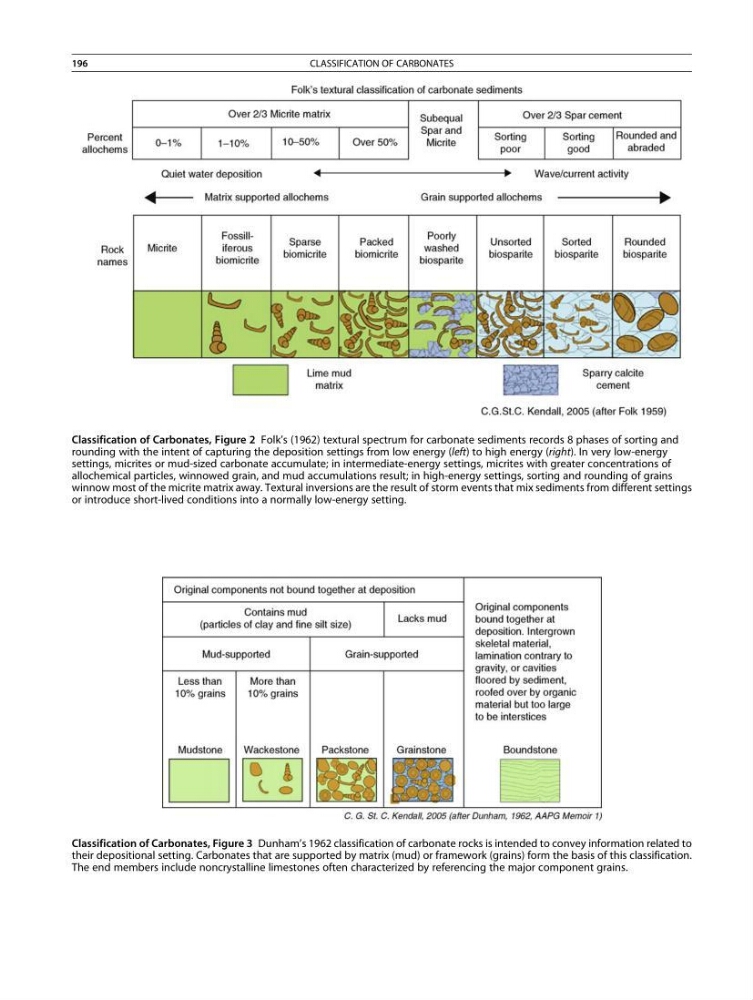
Classification of Carbonates, Figure 2 Folk’s (1962) textural spectrum for carbonate sediments records 8 phases of sorting and
rounding with the intent of capturing the deposition settings from low energy (left) to high energy (right). In very low-energy
settings, micrites or mud-sized carbonate accumulate; in intermediate-energy settings, micrites with greater concentrations of
allochemical particles, winnowed grain, and mud accumulations result; in high-energy settings, sorting and rounding of grains
winnow most of the micrite matrix away. Textural inversions are the result of storm events that mix sediments from different settings
or introduce short-lived conditions into a normally low-energy setting.
Classification of Carbonates, Figure 3 Dunham’s 1962 classification of carbonate rocks is intended to convey information related to
their depositional setting. Carbonates that are supported by matrix (mud) or framework (grains) form the basis of this classification.
The end members include noncrystalline limestones often characterized by referencing the major component grains.
196
CLASSIFICATION OF CARBONATES
rounding with the intent of capturing the deposition settings from low energy (left) to high energy (right). In very low-energy
settings, micrites or mud-sized carbonate accumulate; in intermediate-energy settings, micrites with greater concentrations of
allochemical particles, winnowed grain, and mud accumulations result; in high-energy settings, sorting and rounding of grains
winnow most of the micrite matrix away. Textural inversions are the result of storm events that mix sediments from different settings
or introduce short-lived conditions into a normally low-energy setting.
Classification of Carbonates, Figure 3 Dunham’s 1962 classification of carbonate rocks is intended to convey information related to
their depositional setting. Carbonates that are supported by matrix (mud) or framework (grains) form the basis of this classification.
The end members include noncrystalline limestones often characterized by referencing the major component grains.
196
CLASSIFICATION OF CARBONATES