

The Allochthonous grains are usually sourced intraformational or certainly intrabasinal.
The early researchers appreciated the complicated
nature of carbonate rocks. They classified them both on
the basis of origin of the components and depositional textures. Carozzi (1960) also offered a classification scheme
which recognized several subtypes of Autochthonous
and Allochthonous varieties of carbonates.
It was Folk (1959) who first successfully presented
a comprehensive carbonate classification. He divided
limestones into autochthonous, the so-called biolithites,
and allochemical, those composed of various types of
grains and matrix or cement. One or more grains can be
associated with lime mud (= micrite) or lack micrite and
instead are cemented by sparry calcite (= sparite). This
classification has genetic implications and hence the conditions of the depositional setting and the formation of the
grains are inferred. Interpretations about the depositional
setting are of fundamental significance to oil/gas exploration and hence this classification scheme has gained wide
acceptance.
Durham (1962) proposed another classification scheme
that is used as much as Folk (1959, 1962) by the oil/gas
industry. Both classifications distinguish allochems,
matrix or micrite, and sparry calcite cement and both
schemes emphasize texture (depositional texture and
hence depositional setting). Both are widely used today
with some modifications (Embry and Klovan, 1971;
James, 1984) to the virtual exclusion of all other limestone
classification schemes. Many geologists use the two
schemes interchangeably. Concurrently, micrite is recognized both as a sedimentary matrix, internal cavity sedimentary fill, and as a diagenetic product and cement,
while some carbonate grains are the products of later diagenetic modifications (Reid et al., 1990; Wright,1992).
Application of the recommended carbonate
classification schemes
Irrespective of the classification scheme used (Folk or
Dunham), the first question one should ask when classifying limestone is “can the deposition texture still be
recognized?”
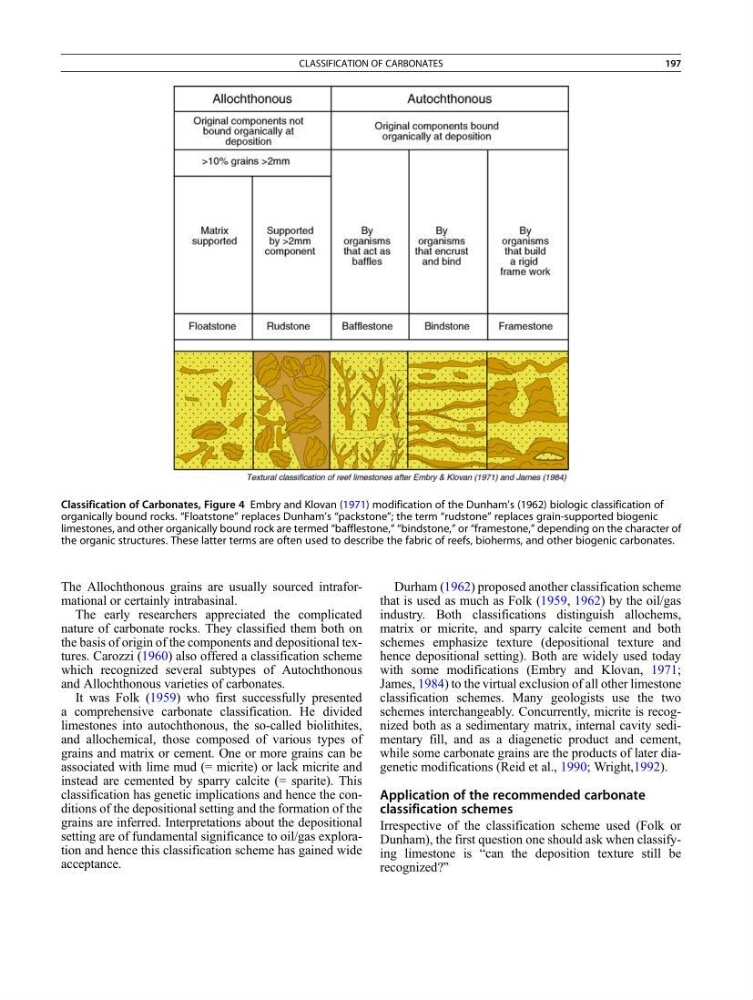
Classification of Carbonates, Figure 4 Embry and Klovan (1971) modification of the Dunham’s (1962) biologic classification of
organically bound rocks. “Floatstone” replaces Dunham’s “packstone”; the term “rudstone” replaces grain-supported biogenic
limestones, and other organically bound rock are termed “bafflestone,” “bindstone,” or “framestone,” depending on the character of
the organic structures. These latter terms are often used to describe the fabric of reefs, bioherms, and other biogenic carbonates.
CLASSIFICATION OF CARBONATES
197
The early researchers appreciated the complicated
nature of carbonate rocks. They classified them both on
the basis of origin of the components and depositional textures. Carozzi (1960) also offered a classification scheme
which recognized several subtypes of Autochthonous
and Allochthonous varieties of carbonates.
It was Folk (1959) who first successfully presented
a comprehensive carbonate classification. He divided
limestones into autochthonous, the so-called biolithites,
and allochemical, those composed of various types of
grains and matrix or cement. One or more grains can be
associated with lime mud (= micrite) or lack micrite and
instead are cemented by sparry calcite (= sparite). This
classification has genetic implications and hence the conditions of the depositional setting and the formation of the
grains are inferred. Interpretations about the depositional
setting are of fundamental significance to oil/gas exploration and hence this classification scheme has gained wide
acceptance.
Durham (1962) proposed another classification scheme
that is used as much as Folk (1959, 1962) by the oil/gas
industry. Both classifications distinguish allochems,
matrix or micrite, and sparry calcite cement and both
schemes emphasize texture (depositional texture and
hence depositional setting). Both are widely used today
with some modifications (Embry and Klovan, 1971;
James, 1984) to the virtual exclusion of all other limestone
classification schemes. Many geologists use the two
schemes interchangeably. Concurrently, micrite is recognized both as a sedimentary matrix, internal cavity sedimentary fill, and as a diagenetic product and cement,
while some carbonate grains are the products of later diagenetic modifications (Reid et al., 1990; Wright,1992).
Application of the recommended carbonate
classification schemes
Irrespective of the classification scheme used (Folk or
Dunham), the first question one should ask when classifying limestone is “can the deposition texture still be
recognized?”
Classification of Carbonates, Figure 4 Embry and Klovan (1971) modification of the Dunham’s (1962) biologic classification of
organically bound rocks. “Floatstone” replaces Dunham’s “packstone”; the term “rudstone” replaces grain-supported biogenic
limestones, and other organically bound rock are termed “bafflestone,” “bindstone,” or “framestone,” depending on the character of
the organic structures. These latter terms are often used to describe the fabric of reefs, bioherms, and other biogenic carbonates.
CLASSIFICATION OF CARBONATES
197