

In the late 1950s and early 1960s descriptions were based
on size nomenclature, namely, calcilutile, calcarenite, and
calcirudite. Others used calculite and calcisiltite for
mud and silt sized, respectively. The work of Illing
(1954), Folk (1959), Carozzi (1960), Dunham (1962),
Embry and Klovan (1972), and James (1984) addressed
these shortcomings and the two commonly accepted
schemes that evolved from these are used today in industry
and academia. As explained above, these are based on the
classification schemes of Folk (1962) and Dunham (1962).
Pettijohn (1952) divided limestones into two groups:
1. Autochthonous – formed in situ by biochemical
processes
2. Allochthonous – consisting of transported and
redeposited material.
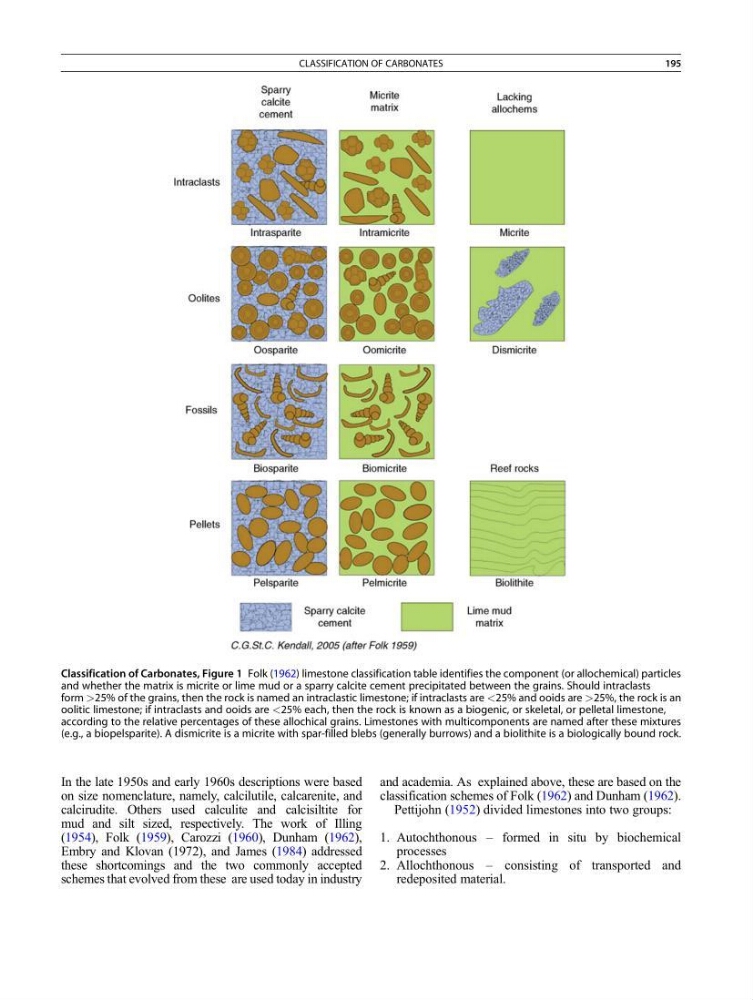
Classification of Carbonates, Figure 1 Folk (1962) limestone classification table identifies the component (or allochemical) particles
and whether the matrix is micrite or lime mud or a sparry calcite cement precipitated between the grains. Should intraclasts
form >25% of the grains, then the rock is named an intraclastic limestone; if intraclasts are <25% and ooids are >25%, the rock is an
oolitic limestone; if intraclasts and ooids are <25% each, then the rock is known as a biogenic, or skeletal, or pelletal limestone,
according to the relative percentages of these allochical grains. Limestones with multicomponents are named after these mixtures
(e.g., a biopelsparite). A dismicrite is a micrite with spar-filled blebs (generally burrows) and a biolithite is a biologically bound rock.
CLASSIFICATION OF CARBONATES
195
on size nomenclature, namely, calcilutile, calcarenite, and
calcirudite. Others used calculite and calcisiltite for
mud and silt sized, respectively. The work of Illing
(1954), Folk (1959), Carozzi (1960), Dunham (1962),
Embry and Klovan (1972), and James (1984) addressed
these shortcomings and the two commonly accepted
schemes that evolved from these are used today in industry
and academia. As explained above, these are based on the
classification schemes of Folk (1962) and Dunham (1962).
Pettijohn (1952) divided limestones into two groups:
1. Autochthonous – formed in situ by biochemical
processes
2. Allochthonous – consisting of transported and
redeposited material.
Classification of Carbonates, Figure 1 Folk (1962) limestone classification table identifies the component (or allochemical) particles
and whether the matrix is micrite or lime mud or a sparry calcite cement precipitated between the grains. Should intraclasts
form >25% of the grains, then the rock is named an intraclastic limestone; if intraclasts are <25% and ooids are >25%, the rock is an
oolitic limestone; if intraclasts and ooids are <25% each, then the rock is known as a biogenic, or skeletal, or pelletal limestone,
according to the relative percentages of these allochical grains. Limestones with multicomponents are named after these mixtures
(e.g., a biopelsparite). A dismicrite is a micrite with spar-filled blebs (generally burrows) and a biolithite is a biologically bound rock.
CLASSIFICATION OF CARBONATES
195