

Sargassum brown algae drifting through surface waters
around the reefs and so is often found washed up on
nearby beaches. In older fossil reefs, branching and lattice
bryozoans inhibited movement of loose sediments around
reefs, functioning as sediment baffles, trappers, binders,
or stabilizers. In other reef structures, dead coral
bioherms’ surfaces were covered by a solid veneer of
encrusting bryozoans. In still others, originally more
extensive bryozoan crusts appear so corroded and partially
dissolved that they obviously served as a source of dissolvable carbonate during diagenesis.
Continuing investigations
After elucidation of the reefal bryozoans’ roles, investigations of these animals have continued, diversifying into
several different types of studies.
Most immediate have been documenting species
identities and distributions within various living reefs
like Bermuda (Cuffey and Fonda, 1986), Enewetak Atoll,
Marshall Islands (Cuffey and Cox, 1987), Belize
(Winston, 1984), Bali and other Indonesian Reefs
(Winston and Heimberg, 1986), the Solomons (Tilbrook,
2006), and others.
In addition to these faunal studies, others have focused
on particular reefal-bryozoan species’ ecology (Cuffey
and Foerster, 1975; Cuffey and McKinney, 1982) and
interactions like competitive overgrowths (Jackson,
1979). A few new species have been reported from certain
remote reefs like Enewetak Atoll, Marshall Islands
(Cuffey and Cox, 1987); otherwise, known reefal species
do not appear to be restricted exclusively to reef habitats.
Within-species variability, particularly in colony form,
can in certain species be related to wave energy;
Schizoporella errata in Bermuda grows into compact nodular masses under turbulent conditions, but erect open
branches in quiet situations (Cuffey and Fonda, 1976).
Modern coral reefs exhibit Geomorphic Zonation, the
best example of which is the Atlantic/Caribbean
Forereef/Reef Front corals (shallow Acropora palmata,
middle Acropora cervicornis, and deep Montastrea
annularis). Reefal bryozoans however, do not show such
depth-related species assemblages; instead, the various species’ depth ranges overlap progressively and gradually,
going down the reef front (Forereef/Reef Front), as
documented on Bonaire’s reef-slope (Kobluk et al., 1988).
The particular individual species’ depth ranges may prove
useful in paleoecologic interpretations, however, even if
multispecies assemblages can not be recognized. Moreover,
depending on the number and abundances of the shallowest
species, a diver in the field may observe that some reefs
have abundant bryozoans from the sea-surface on down,
whereas others show common colonies only below 10 m
or 30 ft (like Bermuda and Enewetak Atoll, Marshall
Islands respectively; Cuffey, 1973).
In contrast to vertical or depth Geomorphic Zonation,
reefal bryozoans in some cases show horizontal Geomorphic Zonation, related to distance from shore or open
ocean. Reefal (i.e., off-shore) versus in-shore species
suites can be recognized in Bermuda (Fonda and Cuffey,
1976), as can diversified outer-reef versus restricted
lagoonal-reef assemblages in the Bahamas (Cuffey and
Fonda, 1977).
Traditionally, reefal bryozoan species have been identified by examining their colonies’ horizontal upper surfaces. However, those surfaces are often covered, not
visible, when reef masses are cut into by quarrying,
road-cuts, or ship groundings, and hence their bryozoans’
appearance in vertical cross-sections must be used instead
for identifications to determine the particular species
involved in those reefs. Taxonomists have not usually
published such views, and thus work has begun on coordinating surface with cross-section appearances (Kosich and
Cuffey, 1978). Preliminary results have been used successfully on modern bryozoan reef rock at Joulters Cays
(Cuffey et al., 1977).
A great many other aspects of bryozoan involvement in
modern and geologically recent fossil reefs could be analyzed – physiologic, biogeographic, pharmaceutical, geochemical, etc. However, not enough time nor workers
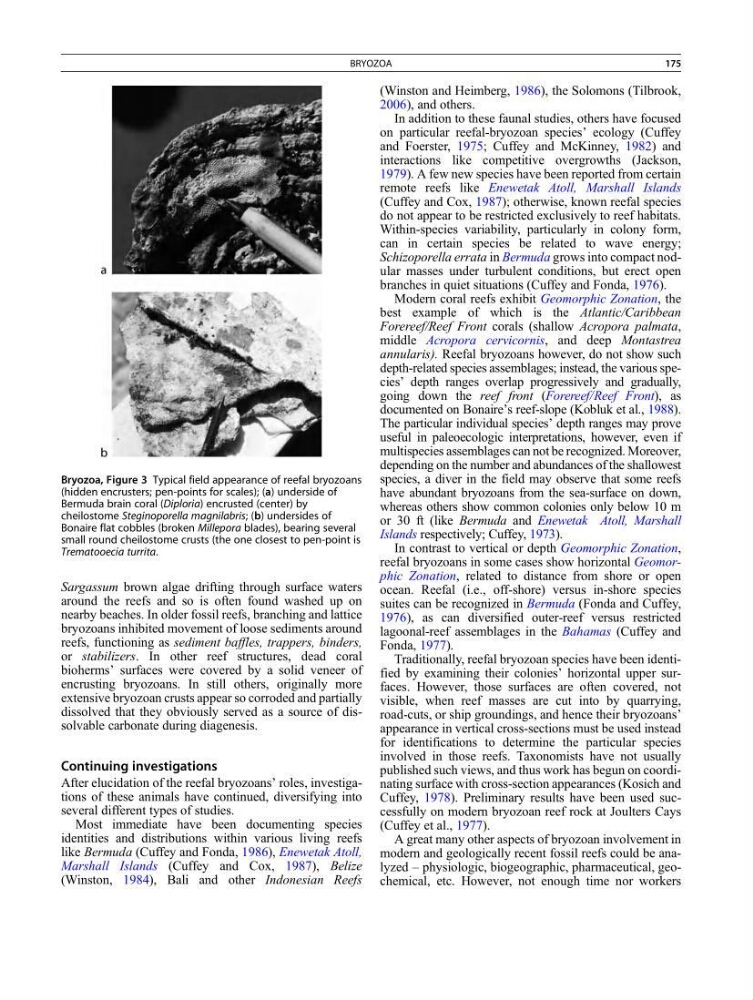
Bryozoa, Figure 3 Typical field appearance of reefal bryozoans
(hidden encrusters; pen-points for scales); (a) underside of
Bermuda brain coral (Diploria) encrusted (center) by
cheilostome Steginoporella magnilabris; (b) undersides of
Bonaire flat cobbles (broken Millepora blades), bearing several
small round cheilostome crusts (the one closest to pen-point is
Trematooecia turrita.
BRYOZOA
175
around the reefs and so is often found washed up on
nearby beaches. In older fossil reefs, branching and lattice
bryozoans inhibited movement of loose sediments around
reefs, functioning as sediment baffles, trappers, binders,
or stabilizers. In other reef structures, dead coral
bioherms’ surfaces were covered by a solid veneer of
encrusting bryozoans. In still others, originally more
extensive bryozoan crusts appear so corroded and partially
dissolved that they obviously served as a source of dissolvable carbonate during diagenesis.
Continuing investigations
After elucidation of the reefal bryozoans’ roles, investigations of these animals have continued, diversifying into
several different types of studies.
Most immediate have been documenting species
identities and distributions within various living reefs
like Bermuda (Cuffey and Fonda, 1986), Enewetak Atoll,
Marshall Islands (Cuffey and Cox, 1987), Belize
(Winston, 1984), Bali and other Indonesian Reefs
(Winston and Heimberg, 1986), the Solomons (Tilbrook,
2006), and others.
In addition to these faunal studies, others have focused
on particular reefal-bryozoan species’ ecology (Cuffey
and Foerster, 1975; Cuffey and McKinney, 1982) and
interactions like competitive overgrowths (Jackson,
1979). A few new species have been reported from certain
remote reefs like Enewetak Atoll, Marshall Islands
(Cuffey and Cox, 1987); otherwise, known reefal species
do not appear to be restricted exclusively to reef habitats.
Within-species variability, particularly in colony form,
can in certain species be related to wave energy;
Schizoporella errata in Bermuda grows into compact nodular masses under turbulent conditions, but erect open
branches in quiet situations (Cuffey and Fonda, 1976).
Modern coral reefs exhibit Geomorphic Zonation, the
best example of which is the Atlantic/Caribbean
Forereef/Reef Front corals (shallow Acropora palmata,
middle Acropora cervicornis, and deep Montastrea
annularis). Reefal bryozoans however, do not show such
depth-related species assemblages; instead, the various species’ depth ranges overlap progressively and gradually,
going down the reef front (Forereef/Reef Front), as
documented on Bonaire’s reef-slope (Kobluk et al., 1988).
The particular individual species’ depth ranges may prove
useful in paleoecologic interpretations, however, even if
multispecies assemblages can not be recognized. Moreover,
depending on the number and abundances of the shallowest
species, a diver in the field may observe that some reefs
have abundant bryozoans from the sea-surface on down,
whereas others show common colonies only below 10 m
or 30 ft (like Bermuda and Enewetak Atoll, Marshall
Islands respectively; Cuffey, 1973).
In contrast to vertical or depth Geomorphic Zonation,
reefal bryozoans in some cases show horizontal Geomorphic Zonation, related to distance from shore or open
ocean. Reefal (i.e., off-shore) versus in-shore species
suites can be recognized in Bermuda (Fonda and Cuffey,
1976), as can diversified outer-reef versus restricted
lagoonal-reef assemblages in the Bahamas (Cuffey and
Fonda, 1977).
Traditionally, reefal bryozoan species have been identified by examining their colonies’ horizontal upper surfaces. However, those surfaces are often covered, not
visible, when reef masses are cut into by quarrying,
road-cuts, or ship groundings, and hence their bryozoans’
appearance in vertical cross-sections must be used instead
for identifications to determine the particular species
involved in those reefs. Taxonomists have not usually
published such views, and thus work has begun on coordinating surface with cross-section appearances (Kosich and
Cuffey, 1978). Preliminary results have been used successfully on modern bryozoan reef rock at Joulters Cays
(Cuffey et al., 1977).
A great many other aspects of bryozoan involvement in
modern and geologically recent fossil reefs could be analyzed – physiologic, biogeographic, pharmaceutical, geochemical, etc. However, not enough time nor workers
Bryozoa, Figure 3 Typical field appearance of reefal bryozoans
(hidden encrusters; pen-points for scales); (a) underside of
Bermuda brain coral (Diploria) encrusted (center) by
cheilostome Steginoporella magnilabris; (b) undersides of
Bonaire flat cobbles (broken Millepora blades), bearing several
small round cheilostome crusts (the one closest to pen-point is
Trematooecia turrita.
BRYOZOA
175